
More aggressive approach
Yale and partners such as Briggs Equipment to work closer together in ‘more aggressive’ bid for major accounts across Europe.
Yale has put a team together at its Europe, Middle East and Africa HQ in Frimley to help its distributors and dealers better target major corporate accounts.
The team has been set up to identify large corporate account that are nearing end of contract, as well as developing joint solutions with business partners, such as Briggs Equipment in the UK, to attempt to win new business.
Harry Sands became Senior Vice President, Managing Director, Europe, Middle East and Africa for the Group in June 2015. He explains: "Our share is not what it should be in EMEA, and we need to grow it together with our business partners. We see this as a new kind of partnership, not A dealer to supplier relationship.
"Our dealers today are more business partners. all we have been trying to do is getting the companies to work together as business partners.
"We've set up a team in Frimley that is identifying accounts we don't participate in today and understanding when they will turn over their fleets so we can go in to these clients with a value proposition, and fight our corner, shoulder-to-shoulder with Briggs."
Harry believes the Yale product is better than the competition, with a stand-out total cost of ownership argument. He also believes that choosing Yale would be a boost for UK manufacturing and will help keep manufacturing keeping jobs in the UK.
"We've put this in place in the last few years and it has been a big investment. This approach is more aggressive than it has been in the past," explains Harry.
Manufacturing strength
Highlighting this UK manufacturing strength, the manufacturer celebrated the production of the 400,000th truck built at its plant in Craigavon, Northern Ireland, by donating the forklift to Oxfam, for use at its distribution centre in Bicester.
The ceremonial presentation of the Yale Veracitor VX, which has been signed by all of the staff at the Craigavon factory, was made to Oxfam GB’s Finance Director Alison Hopkinson by Craigavon Plant Manager Jim Downey during an exclusive event on January 19th before a specially invited audience of employees, suppliers, and dignitaries, including the Minister of the Department of Enterprise, Trade and Investment, Jonathan Bell MLA and the Lord Mayor of Armagh City, Banbridge, and Craigavon, Darryn Causby.
Prior to the grand reveal, guests enjoyed factory tours of the plant, a series of presentations from senior members of the Yale team and a video showcasing the journey of the charity truck as it progressed along the production line.
Iain Friar, Yale brand manager, said: “We are all incredibly proud that the 400,000th truck has been produced here in Craigavon, and we wanted to celebrate the contribution made by so many people in achieving that milestone.
“Yale is committed to ‘people, products and productivity’ and we firmly believe that it is our people who have put us where we are today. The 400,000th truck is the embodiment of the innovative approach and loyalty we receive from our Yale people.
“We wanted to choose a charity with the same ethos as Yale, an organisation like ourselves that has people at its core. Not only is Oxfam internationally recognised for helping people in need, we felt that one of our forklift trucks would actually be of real benefit to its operation.”
Alison Hopkinson, of Oxfam GB, said: “Not only does this truck represent a real cost saving to Oxfam, it will help us come to the aid of people in desperate need more efficiently. Oxfam relies on the generosity of its supporters and we are so grateful and touched by the Yale team’s kind and thoughtful gift.”
Oxfam warehouse
Behind the scenes planning for the charitable donation began many months ago, with the technical team from Yale asking Oxfam exactly what sort of truck would suit its needs in terms of capacity, capability and fuel type. By liaising with the logistics manager from Oxfam, UK territory manager for Yale, Andrew Hine, specified that the 400,000th truck should be a GDP/GLP20-30VX model, selected for its manoeuvrability, reach and ease of use.
Oxfam’s Bicester warehouse handles a variety of load sizes and weights, which have been manually weighed on scales prior to dispatch via air freight around the world. Yale’s partners, RAVAS have generously donated i-Forks for the 400,000th truck to save Oxfam time by automatically weighing the load when it is lifted.
As Oxfam’s truck needs to be always ready to respond to emergencies, Yale’s UK dealer, Briggs Equipment, has offered to maintain and service the truck. This is another example of Yale working with its partners to tailor the solution to the client.
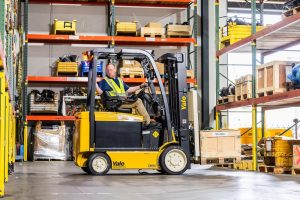
The Veracitor VX offers innovative technology to reduce brake and tyre wear, longer service intervals, and outstanding engineering quality. Fuel efficiency is built in; the Yanmar 2.6L diesel engine consumes as little as 3.0 litres hour while the LPG engine range delivers new levels of performance.
Oxfam responds to emergencies around the world, for example saving lives by delivering the ability to source and store clean water for drinking and sanitation. Its Bicester depot currently operates with a 20-year-old counterbalance 2.5 ton, LPG, 4-wheel truck which is in desperate need of replacing.
The Veracitor VX was selected as the truck of choice because it offers the highest levels of productivity, ergonomics and dependability.
Rod Hogg, logistics manager at Oxfam GB adds: "Warehousing and logistics are extremely important to us. When we need to get aid out in an emergency we have to have a supply chain which is effective. Our warehouse in Bicester is unique in UK in that it is dedicated to storing humanitarian goods."
The 2,000 sq m warehouse also deploys a JCB teletruk, which was donated during the tsunami crisis. This allows Oxfam to load two adjacent lorries from one side in its small loading yard.
The majority of items are crated and block stacked, with some shelving for small picks.
Rod adds: "We have to package all our goods robustly because as you go further down the supply chain, roads get worse. At the destination there won't be a forklift to get the load off the lorry, so it tends to be dropped on to rubber tyres. The load has to be able to withstand the impact with robust packaging with very little airspace."