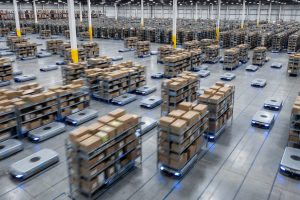


Powerful intralogistics in a compact footprint
Consolidating dry-food goods from several warehouses into a non-food distribution centre, Coop Denmark turned to Dematic for high performance and flexibility in a compact footprint.
When the chill winds of the global recession blew, Coop Denmark looked hard at its network of distribution centres and made the decision to consolidate slow-moving dry-food goods from a number of warehouses into a recently constructed 45,000 sq m facility in Odense.
Built as a non-food centre the Odense DC had an existing automated 32,000 pallet high bay store, but a solution was required to considerably upscale the operation, expand the space by 10,000 square metres and radically adapt its function to manage the break-bulk distribution of both non-food and dry-food goods for the Coop’s 1200 national retail outlets.
A key element to this transformation was in creating a goods-to-man automated picking system capable of breaking-bulk for slow-moving products and then assembling store orders in totes for despatch.
Christian Flindt, Coop Denmark’s technical manager at the Odense DC explains: “The four local warehouses were 100,000 square metres in total so we had to find a way to ‘squeeze’ it all in to one facility. The Dematic system only occupies 6500 sq m of the warehouse, but it takes 70% of the volume of the goods. So we didn’t need a lot of forklift trucks!”
Flindt demanded the solution be “fast, reliable and scaleable”, and the goods-to-man picking technology deployed increased productivity from 140 to 450 items picked per hour.
Another crucial design parameter was that the solution should “deliver value for the end-customer”. This it did by improving on-shelf availability in the retail stores by preparing ‘store ready’ orders in totes, per category and packed in sequence, for faster shelf replenishment at the retail outlet – saving shop staff half an hour per pallet of totes.
RapidPick
The elegance of the solution lay in the simplicity of the concept and the sophistication of the technology applied. Dematic’s MultiShuttle technology linked to RapidPick intelligence offered the solution.
The system was designed for small-sized slow/medium movers that were inefficient to pick in a conventional way but that fit easily into a tote. In total there are some 45,000 storage locations in the MultiShuttle, offering the capability to hold around 9,000 SKUs, presenting Coop Denmark with a design capacity to fulfil 62,000 order lines per day for between 300-400 shops.
How it works
Pallets are requested from the pre-existing high-bay and transported to one of eight decant stations – each of the stations has two pallet positions to pick from – and here someone picks the required number of cartons or items, as instructed on-screen, and places them into ‘internal’ totes.”
These totes are then directed by the warehouse control system to the 45,000 location MultiShuttle Buffer store – a dynamic, dense cube of double-deep tote storage space served by 96 Generation 2 Dematic Shuttles. It has a capacity of 4,300 double cycles per hour.
Coop picks from pallets into totes and stores the number of SKUs needed for up to a week in the Multishuttle Buffer, and from here they are called off and sent to one of nine RapidPick stations [type A6]. The internal tote arrives in a central position at the RapidPick station and items are picked and placed into customer orders. Each station has six order tote positions to pick into, but normally there are only up to five orders open at the same time.
The operative at the RapidPick station receives picking instructions on-screen and is clearly directed by the system as to the number of items to pick and into which tote to place the items – followed by a simple confirmation. Completed totes are given a label with shop number and name, along with a bar code. The capacity here is 400 order lines per hour, per station.

Store order totes [external totes] are taken from the RapidPick stations to a MultiShuttle Commissioning Buffer, where 24 Generation 2 shuttles carry totes to the 4000 tote locations in the system – and this has a capacity of 1000 double cycles per hour.
Finally, store orders are called off from the Commissioning Buffer for palletising. Two stations with articulated robots handles the store totes in pairs and places them on either ½ or 1/1 EUR pallets and they even insert a pallet mid in stack allowing “high” pallets for transport and delivering “low” pallets to the stores. The pallet is transported via wrapping and label application and sent off to one off three despatch lanes for truck handling.
Flindt is pleased with the performance of the system and was impressed by Dematic’s response to fixing any errors. In particular, he praises the 16 Dematic service engineers working on site as part of the full maintenance contract.