

Swarm intelligence
In an age where production is growing and ever smaller batches are transported, the production and distribution sides are virtually dependent on the efficiency and flexibility of the transport logistics, says Kardex Remstar.
The vision of a fourth industrial revolution in general and the concept of the Smart Factory in particular can only become reality in the first place if the logistics can guarantee that raw materials, primary products, and articles ready for shipping are in the right place at the right time.
One big trend in intralogistics operations of the future is the introduction of “cellular transport systems” in the warehouse. This involves swarms of autonomous vehicles which can sense their surroundings independently using laser scanners, infrared sensors, and RFID chips, and navigate to their respective destinations autonomously.

With no central control system these devices deal with incoming transport orders among themselves, set rules governing the right of way, and share data on the position of each vehicle in the warehouse. Since each shuttle processes information on a decentralised basis, the entire control system is spread across a number of virtual shoulders. If disruptions occur, the vehicle swarm reacts on its own and rectifies the problem.
Autonomous transport robots
This is where companies such as Kardex Remstar and Servus Intralogistics come into play. In keeping with the keyword “Smart Factory” the two companies have developed a new solution for optimising their customers’ internal production logistics.
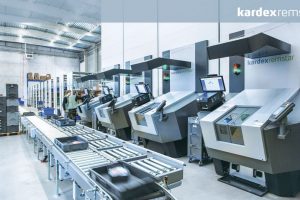
Dynamic retrieval solutions from Kardex and a special transport system from Servus Intralogistics, which consists of autonomous transport robots traveling on a track, form the basic elements of the solution. The products of both companies have been available separately for a long time. What is new is the fact that the components have been packaged together with the help of newly developed software to produce one complete and efficient solution. Parts required in the assembly area are stored in the space-saving vertical storage lifts, vertical carousels, or box storage systems from Kardex. At the time of retrieval the Servus transport system automatically picks up the parts from the warehouse and transports them to the assembly area with the help of autonomous transport robots. At the same time, the devices automatically receive information about the necessary work steps and take care of all further steps independently.
Accordingly, the Servus system requires no central control system, because the transport robots communicate directly with other transport robots and workstations via infrared and thus react to their immediate environment. The transport system has proven to be particularly flexible, because the track route can be freely configured in the production hall and optimally adapted to existing building structures. As such, the track can be installed anywhere – from the floor to the ceiling – in the warehouse and production halls.
{EMBED(923369)}
With the novel system the intelligent and interlinked vehicles perform all transport tasks, for instance from a high-bay storage system to the workstations where the goods are processed or picked. Yet the agile helpers are not guided on their journeys by warehouse management software, but instead manage their coordination independently among themselves without any kind of central control system.
The vehicles communicate with one another and control themselves using the principle of swarm intelligence. This is made possible by the use of newly developed sensor technology equipped with functions such as radio location, and distance and navigation instrumentation. Such technology helps the individual shuttles to select the shortest and most direct route to their destination at all times and determine among themselves which shuttles will handle particular orders and the best route to take, thereby guaranteeing maximum throughput and thus efficiency in the warehouse.
Collisions are also prevented by the integrated sensor concept, which automatically stops the vehicles if there is an imminent threat of a collision with another device or a person.

Related posts