

Siemens builds future proof warehouse
Siemens Industrial Turbomachinery invested £48 million to consolidate its service and storage operations into a new Global Service Operation Centre.
Key objectives for the new joint warehousing, engine management, tooling and spare parts facility at Teal Park site were to: promote health and safety, facilitate growth, increase cycle speed, expand capabilities and reduce costs within a future-proof operation.
Siemens met this challenge through closely collaborating with MHE suppliers to help store and pick the company’s 15,000 SKUs – anything from nuts & bolts up to 6-tonne engines.
The previous facility stored these heavy engines on the warehouse floor, occupying a large footprint with a considerable amount of wasted space above.

The answer was a three-level high engine rack providing 72 locations, served by a wire-guided sideloader. The bespoke design, by BITO Storage Systems using standard beams and uprights, enables engines weighing up to 6-tonnes, and stored on 1-tonne pallets (specially designed by local fabricator Rilmac), to be located on the first beam level as well as ground level. The top-level locations can hold up to 4-tonnes.
Siemens has never racked engines before and this was also the heaviest pallet that BITO has ever stored.
The facility also includes 700 locations of standard pallet racking for the bulk store and 3650 locations of high-rise VNA racking.
Ten 11 metre high Kardex Remstar XP500 shuttles provide space efficient small parts storage and retrieval.
Automated transport
Six BITO LEO Locative AGVs continuously circulate, following tape laid on the floor. Floor mounted barcodes give each LEO instructions and guide it reliably to a hand-over station where it deposits its tote and collects any awaiting pick-up.
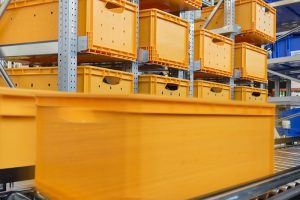
Foldable containers are used for the Internal transport totes. The scheme incorporates empty tote storage above the LEO stations using Carton Live Storage (CLS) as a buffer. When an item is sent across from Goods In for putaway, the component is removed from the tote and put in the appropriate bin of a Kardex unit. The empty collapsible totes are then folded down and fed into the back of a CLS lane to flow to the front, ensuring a tote is available when components are required for the outbound pick up by a LEO.
Small parts picking
The ten Kardex Shuttles offer a total of up to 76,800 locations and optimal small part location flexibility. Each shelf holds ten 600 x 400 mm containers, which can each be segregated into required number and size of bin locations using plastic dividers. This can create a maximum of 80 bin locations per shelf and Siemens has the flexibility to create different sized locations.
Orders picked into a totes are placed on a station to await collection by a LEO to take them to the packaging station, allowing the operatives to get on with their next task. This ‘buffer’ also gives Siemens clear visibility of work-in-progress in each of the areas.
On time and on budget
Construction of the GSOC commenced in May 2017, with first fix taking place in October 2017 and the warehouse fit-out from end of November. Before Christmas, all of BITO’s racking and the Kardex Shuttles were installed. Hand over of new facility was 21 March, and it went live on 2 April.
Key results
- The GSOC separates human and busy forklift truck areas by using LEOs to transport goods. Stopping devices on forklifts and LEOs prevent collisions. LEOs also minimise manual handling.
- In terms of financial benefits, the £400,000 racking investment represents a huge saving on the additional £3 million required for the original plan to build a 10,000 square metre facility on the constrained site. The racking saves 1500 square metres of footprint, while the Kardex Shuttles save a total of 1200 square metres. The engine rack itself has resulted in a two-thirds reduction of floor space occupied by the engines compared to the previous facility.
- The low-cost LEO system gives Return on Investment (ROI) within a year, compared to the typical 5-year period for conventional AGVs. Unlike other AGVs, LEO installation is simple and quick with the units following tape laid on the floor, giving complete flexibility to reconfigure and maximise efficiency by simply pulling up the tape and relaying new routes. Siemens can scale up if required by buying or hiring extra LEOs straight off the shelf.

Ultimately the new GSOC facilitates growth without needing to increase headcount. It ensures stock availability and the same- or next day response to help customers minimise downtime, which for a turbine can cost in excess of £100,000 per hour. Normal service hours of 07.30 to 16.00 are extended to cover peak times. Any demands on the warehouse will be picked and packed the same day. If completed by 16.00, they will be shipped that day.
Clive Cox, project manager for Siemens Industrial Turbomachinery, says: “When it came to installation BITO’s on-site team were very efficient and complimented by the main construction group on their work ethic and housekeeping so from our point of view, it all worked very well. We are extremely happy with the quality of BITO products. The company is supportive, very responsive and worked closely with us to give the service we needed throughout the complex project.”
{EMBED(1047701)}