

Quest for precision on ESG
Innovative robotic systems provider Exotec is increasing emphasis on sustainability, with detailed ESG analysis of its systems helping customers fully assess the performance of their warehouses.

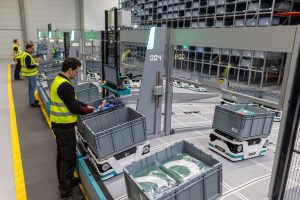
EXOTEC HAS worked out the carbon footprint of its system down to the robot, rack and bin. For example, the carbon footprint of one robot is 760kg of Co2.
Exotec head of ESG Nicolas Hunsinger, said: “This approach allows us to educate customers, so they are aware of what they are buying and using in their warehouses.
“Exotec is proactive about carbon footprint in its market. We are the first in our industry to share the carbon footprint of our robots, so our customers are aware and make educated purchases.
“We have the same approach with our own suppliers; we ask them to be responsible and are asking them the carbon footprint of what we purchase.”
The insight came as part of a recent masterclass Nicolas carried out with Abbie Morris, CEO of Compare Ethics, an organisation that uses AI to help retailers adhere to sustainability regulations.
Abbie told listeners about the business challenge and the opportunity of ESG.
“Though 15% of businesses are struggling, 88% of CEOs said they are committed to sustainability and investing more than ever before, with clear drivers around operations and efficiency,” she explained.

Tackling the idea that warehouse automation, in itself, always increases carbon footprint, Nicolas insists the picture is more complex.
“Exotec’s Skypod system will produce a threefold increase in throughput. One worker can do the job of three workers with Skypod, and you can do that on third of the surface that you would need for manual handling.”
When it comes to environmental sustainability, Exotec’s focus is carbon footprint and energy consumption as a whole.
“We don’t see an increase of carbon footprint at the moment. In certain circumstances, with different energy sources etc, SkyPod decreases carbon footprint by 20%, particularly if you take into account fewer workers, and therefore fewer commuters, and less heating. We are 100% sure that we don’t increase the carbon footprint for equivalent performance,” said Nicolas.
The company has worked hard to assess the Skypod system and reduce its carbon footprint. This includes a switch to recycled plastic, which reduced the bin’s footprint by 40%, and a 30% reduction of the rackweight, which translated to a reduction in carbon footprint of 20%.
A question of culture
It’s about more than the technical aspects of the products and solutions, the culture of a company has to be right to truly embrace sustainability.
Nicolas explains: “First, we raise awareness, and translate macro topics into tangible bites. We have a baseline and targets which we tackle. We report, set targets, and start again.
“Exotec holds each team accountable for carbon footprint, not just the ESG team – tech, transportation etc are all held accountable.
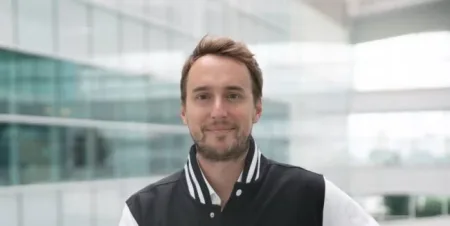
“We work on ESG in the ‘Exotec way’ – we measure, assess, commit and deploy – it is an analytical approach to ESG .”
Finally, Exotec is also facilitating the second hand use of its systems. Nicolas concludes: “Five of our systems are being used by customers as second hand, some are sold from one customer to another customer.
“Most of the system can be reused, and it’s a good value for the new customer because it’s still high tech for a much lower price.”