
Clark crossover forklift undergoes endurance testing at Duisburg Zoo
Clark industrial trucks have been an integral part of logistics operations at Duisburg Zoo for several years now – from transporting feed and various materials to performing unusual tasks.
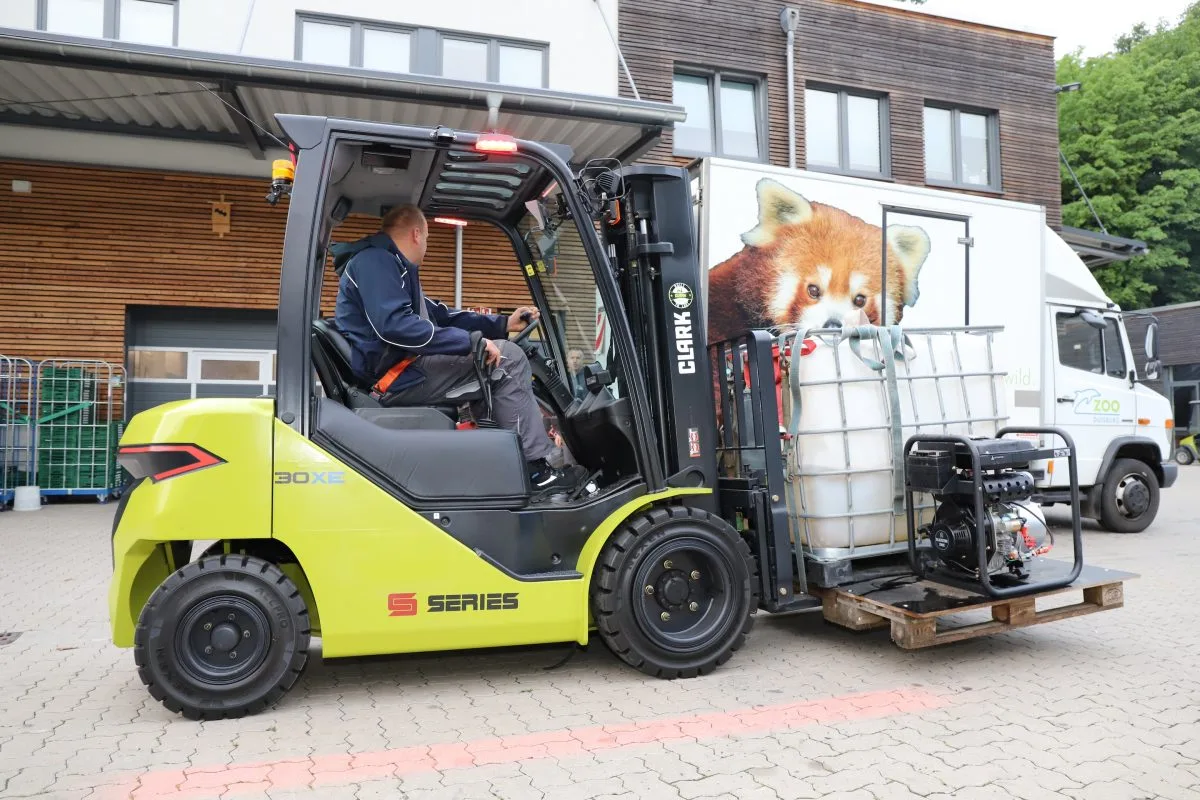
CLARK FORKLIFTS have also proven their worth when it comes to sensitive live cargo: Clark electric forklifts helped to safely transfer three manatees, also known as sea cows, to their new home in the Rio Negro tropical hall. Now Duisburg Zoo has put a Clark electric forklift truck from the Crossover series through its paces. The Renegade S30XE demonstrated its capabilities not only in the farmyard, but also when transporting feed to the animals’ enclosures.
The diverse range of applications at the zoo, with very different logistical requirements, provided the perfect testing ground for the flexibility, robustness, and versatility of the Clark Crossover series: indoor and outdoor use, different floor surfaces, long transport distances, different load carriers and transport goods, as well as use in wet and dirty conditions. Since the Clark S30XE electric forklift was designed precisely for these challenges, the result was hardly surprising: the Renegade passed the test at Duisburg Zoo with flying colors and proved that the Crossover forklifts can compete with combustion engines in every respect. This is also confirmed by Christopher Grefer, an employee in the technical department at Duisburg Zoo: “In addition to the high performance and robust construction, I was particularly impressed by the very small turning radius of the electric forklift and the many sophisticated safety features, which not only make it easier to work with the forklift, but also reduce the risk of accidents at our zoo.” Another plus point was the automatic fork adjustment. “This allows us to conveniently adjust the forks to the often very different load carriers here at the zoo at the touch of a button,” says Grefer. Duisburg Zoo was also impressed by the 360° camera with AI-based pedestrian detection. The rear-view camera transmits the route and the surroundings behind the forklift directly to the color display in real time. This means that the driver always has an overview of what is behind the forklift, even when reversing. This increases safety during operations. But first things first…
The Clark Crossover series is intended to replace combustion engine forklifts
The crossover electric forklifts have been on the market since early 2025. They include the L25-35XE and S25-35XE series with load capacities ranging from 2.5 to 3.5 tons, which have been launched under the names Raider and Renegade. The crossover series are designed to take over the areas of application of combustion engines. To this end, Clark has mounted the electric forklifts on the proven chassis of combustion engine forklifts. The crossover forklifts thus not only have the high ground clearance of combustion engine forklifts, but also the correspondingly larger tires and high level of comfort. This means that nothing stands in the way of more demanding outdoor applications – especially on uneven zoo grounds or on bumpy terrain. The crossover forklifts also have comparable values to combustion engines in terms of driving speed, working width, turning radius, and climbing ability.
Thanks to water-protected components, such as IP54 protection (dust and splash-proof) for the drive and hydraulic motor, they can be used in damp working environments or outdoors in bad weather without any problems. The test vehicle used at the zoo – the Renegade S30XE – had a load capacity of three tons with a load centre distance of 500 mm. The vehicle was equipped with an 80-volt (18.7 kW) lithium-ion battery, 4800 mm triplex mast, four hydraulic functions, super-elastic tires, front and rear work lights, strobe warning light, reverse alarm, warning zone light, Clark Smart Display, and a Grammer seat with seat belt monitoring. The forklift was also equipped with a partial cab, i.e., with a steel roof, front and rear windows. Depending on requirements, different cabs are available for the Renegade, such as rain protection (steel roof), weather protection (steel roof and front window), partial (steel roof, front and rear windows) and full cab with air conditioning or heating. Like the Clark S-Series Electric, the Renegade has numerous safety features and customisable options for maximum operating comfort and safety.
The farmyard is the heart of the zoo’s operations
The trial use of the Clark Renegade began at the new replacement building for the Duisburg Zoo’s farmyard, which was completed in 2022. This is the control centre for supplying the animals. The two buildings not only house storage areas for animal feed, but also the workshops of the zoo’s own gardeners and craftsmen (carpentry, metalworking, electrical workshop), a hay barn, and changing rooms and showers for the staff. The nine cold rooms in the feed store are used to store pallets and sacks of fresh vegetables such as lettuce, tomatoes, and carrots, as well as crates of fruit, at temperatures of 2-6 °C. Frozen fish for dolphins, African penguins, sea lions, pelicans, and other animals is stored in a freezer room at minus 18-20 °C.
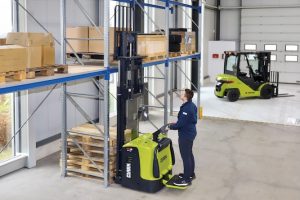
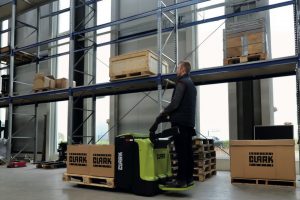
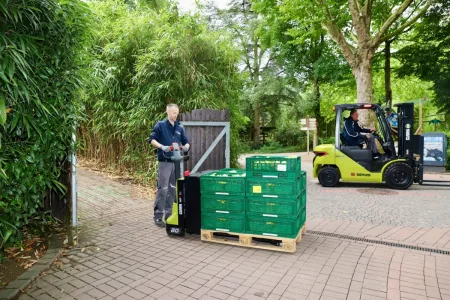
The farmyard also has a high-bay warehouse for pellets, grain feed, and other dry feed to supply the more than 4,700 animals. A Clark HPT hand pallet truck and a Clark WSX16 high-lift pallet truck ensure the flow of delivered feed into the warehouse. The meat for the predators is transported directly from the refrigerated truck into the building via a sophisticated system of overhead pipes. Switches determine the route: portioning room, cold storage room, or freezer. It’s like a wholesale market, except that most of the customers have four legs. Work in the feed area begins at six in the morning. Prepared crates of fruit and vegetables, sacks of pellets, and special feed are then transported to the animal care work areas – the territories. When the animal keepers start their shift, the food ordered the day before from the central warehouse is already ready so that breakfast for the animals can be prepared immediately. Four employees ensure that the zoo’s food stores are always full. They order fine moss for the reindeer, fresh fish for the sea lions, and grow corn, grass, and alfalfa themselves on leased fields.
Renegade puts itself to the test
During the test, the Renegade worked hand in hand with the Clark HPT hand pallet truck and the WSX16 high-lift pallet truck. Its tasks in the test included unloading animal feed from trucks in the feed warehouse, transporting various materials between the zoo’s workshops, and transporting feed or hay to the enclosures. In accomplishing its assigned tasks, the Renegade impressed with its excellent all-round visibility and sensitive load handling. From vegetables, fruit, and pellet bags to mesh boxes with irrigation tanks or roots for landscaping the animal enclosures, the S30XE crossover electric forklift transported each of these loads safely and reliably to their destination. The Renegade proved its worth in particular on longer distances, for example when transporting feed to the manatees in the Rio Negro tropical hall, thanks to its vibration- and shock-free driving style, even on rough terrain. The fully suspended, comfortable seat and the forklift’s high ground clearance contribute to this. Material handling is simplified by the ergonomic arrangement of the controls. This reduces physical strain on the driver and enables easy operation without unnecessary arm and shoulder movements. Sometimes it’s the little things that make the operator’s job easier. “When reversing, for example, the grab handle on the rear bar is very practical,” explains Christopher Grefer. “The integrated directional control switch on the hydraulic lever is also very helpful, as it allows you to control the forklift intuitively and effortlessly.” On inclines or ramps, a standard roll-back protection features increases safety, as the automatic parking brake prevents the truck from rolling back unintentionally.
Straw on the forks and not in the forklift brain
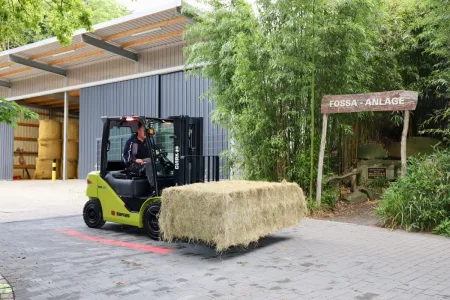
The Clark Renegade had to take on additional tasks in the hay barn, which was completed in 2024 – the central large-scale storage facility for hay and straw. With a floor space of 270 m², the lightweight hall offers enough space to store the zoo’s half-yearly requirements. Behind four large sliding doors in the hay barn are hundreds of bales of hay and straw, stacked tightly together in eight rows. Up to six of the large bales, weighing around 350 kg and measuring 2.5 meters in length, can be stacked on top of each other. In total, the barn has a storage capacity of up to 400 XXL bales. “We currently feed our animals three to four different types of hay. They all differ in their composition, harvest time, and the types of grass used,” explains Richard Luhmer, animal keeper at Duisburg Zoo. In addition to mountains of fresh hay, the zoo also needs an average of four large bales of straw per week, which is mainly used as bedding in the stables and is also stored in the barn. The Renegade not only had to load and unload the straw for the animal enclosures and the hay for feeding the ungulates in the hay barn but also transport it.
After completing all tests, the zoo staff agree: the crossover electric forklift is in no way inferior to combustion engine vehicles in terms of performance and comfort. “In all areas of application where we tested the vehicle, it proved itself with high flexibility, robustness, and performance,” emphasise the zoo employees. This means that the crossover series could become a real game changer in the forklift world.