

In Depth Focus Aesthetics: I feel pretty…
Recent headlines have called warehouses ‘monstrous’, ‘blights on the landscape’, bringing neighbours to tears and destroying lives and, whether logistics companies actually have a hand in their design and development or not, the bad publicity taints. So, should warehouses be prettier? Liza Helps explores.
By Liza Helps, Property Editor, Logistics Matters
ACCORDING TO the British Property Federation the logistics sector contributes around £232 billion GVA a year to the UK economy and supports 2.7 million high quality jobs.
However, recent headlines have called warehouses ‘monstrous’, ‘blights on the landscape’, ‘unnecessary’, bringing neighbours to tears and destroying lives and whether logistics companies actually have a hand in their design and development or not, the bad publicity taints.
For in the same breath that the ‘look’ of a warehouse is commented upon so too is its end use with the perception of jobs in the logistics industry traduced, belittled and bad mouthed as being poorly paid, dead-end, unhealthy both physically and mentally, open to abuse and to top it off don’t provide nearly as many jobs or indeed ‘good quality’ jobs (whatever they are) per ft2 as manufacturing, advanced manufacturing and data warehousing – all of which are more acceptable not just at a local level but also governmentally.
A quick internet search specifically asking for warehouse job perceptions saw the following synopsis: “Perceptions of warehouse jobs are often negative, characterised as physically demanding, repetitive, and lacking prestige – especially among younger demographics.”
There is a an almost insurmountable disconnect between perception and reality to the extent that despite facts, figures and other data to the contrary, that this public perception of the logistics sector, is stubbornly adhered to. And it is only further ingrained through controversial planning applications whereby some councillors and local MPs, mindful of public opinion spout spurious opinion – even in the Houses of Parliament – which is dutifully reported as fact, further compounding the issue.
Recently, there has been a spate of industrial and logistics schemes under construction, or just completed, which have hit the headlines for overshadowing homes, blocking views, and in general destroying neighbourhoods, drawing even further approbation. Unsurprisingly, local politicians and councillors are out in full support of residents and promising to ‘look into’ the issues and find who is responsible for this ‘breach’ despite these schemes going through due process and legitimately securing planning approval.
Architect Corstorphine & Wright head of industrial and logistics Mike Teague, says: “Logistics has always been a commercially driven sector, but in a world of increasing land values and soaring construction costs, it has become vital to a development’s viability that the appraisal stacks – particularly speculative developments.

“In my view, the recipe for that is quite simple, deliver as much development density as possible, at a size-point that responds to market demand, in the most cost-effective way possible. While this recipe may drive economic growth, it is fair to say it has created at times, some rather unsightly developments that have not helped our sector’s perceptions outwardly.”
Developer investor GLP agrees, adding: “As in any industry, real estate is not all the same. There are undoubtably valid concerns about certain developments that have made recent headlines for the wrong reasons, stemming from homeowners where a warehouse has been developed too close to residential development, without appropriate consultation. This tarnishes a sector that creates great value for the UK providing critical infrastructure.”
“Logistics gets a tough press,” says investor developer Prologis UK vice president Robin Woodbridge, “and a politician’s job [locally and nationally] is to represent what society is thinking: we owe it to the [logistics] sector to demonstrate that it is a sector of value.
“Every representation [to the public] is a demonstration of the importance of the sector.”
Industrial and logistics developers are particularly attuned to the problem – a delayed application costs tens, if not hundreds of thousands of pounds directly, and can cost the local and national economy much more.
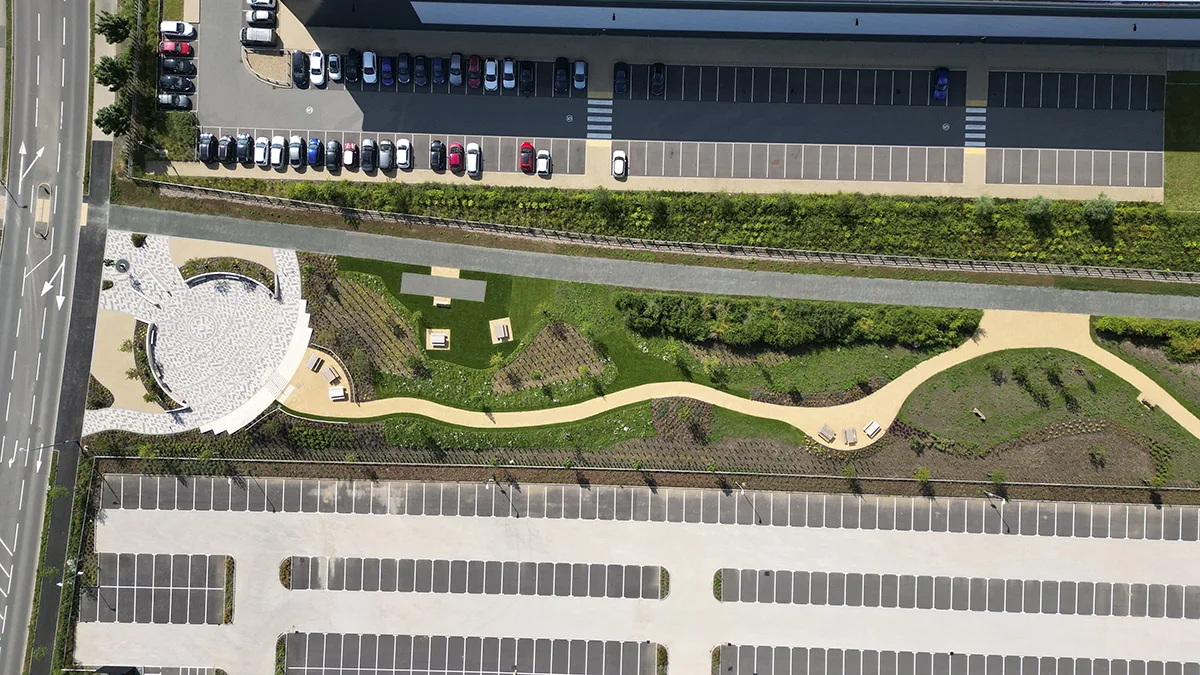
It is no coincidence that applications for industrial and logistics development especially the larger more strategic schemes, now come with ever increasing and more detailed information on landscaping, community amenity space, public access, and in depth explanations regarding building design and how that underscores wellness not just for the office elements but also the warehouse elements of the development.
One recent planning document went so far as to promote the idea that the scheme has been designed not just to minimise [its environmental] impact—’but to actively improve the health and wellbeing of the local community. From new walking routes and green spaces to job creation and thoughtful design’, adding that the development ‘offers long-term benefits that would grow over time’.
Woodbridge adds: “If it wasn’t for the weather and the fact that people steal stuff sometimes, warehouses would not be needed – as it is, they are a necessity.”
And likely to become even more so, says GLP, ‘with the government’s stated aim to deliver 1.5 million new homes [by 2029], this means we can expect further demand for logistics warehousing across the country from increasing consumer demand’. Indeed, a DTRE research report noted that there would need to be 103 million ft2 of new warehousing space over the same time period to support the residential boom based on the fact that average ratio of warehouse floorspace to homes in the UK, is approximately 69 ft2 per home.
Teague notes: “Because many of the best, most straightforward industrial sites have already been developed, the next wave of growth will inevitably take place in more sensitive locations such as adjacent to homes, town centres and public routes. This makes placemaking and legacy essential rather than optional. The logistics sector must demonstrate that these large-scale facilities can be well-considered contributors to the built environment, not ‘monstrosities’ imposed upon it.”
He adds: “The reality is the recipe for successful developments has not changed and nor have the commercial parameters, but good design doesn’t have to cost more.
“Through intelligent master planning, we can design building forms and operational spaces that meet required densities and functional needs while creating greater efficiency. This approach frees up more land for green spaces, which in turn enhance biodiversity, support placemaking and help the development integrate more sensitively within its surroundings.
“What is encouraging, is that more developers and investors recognise the value of design, not only in meeting ESG and sustainability benchmarks but also in attracting occupiers and giving an edge on competition. Given the competitive nature of this sector, as each development with better design comes forward, it drives the whole sectors quality standards forwards – which will help shift perceptions and create a stronger, more resilient reputation for logistics as a good neighbour.”
Many of the big investor developers take the legacy/wellness/sustainability piece extremely seriously. Woodbridge says: “We genuinely want our [logistics] parks to be great places to work. Helping customers attract and retain talent is a big commercial reason for this, but its also just the right thing to do. We are not just building sheds – we are building places.”
SEGRO’s head of national markets Dan Holford adds: “We are not just thinking how we can get the biggest amount of space on the smallest amount of land, we are long term investors to 60 years and beyond – we are an integral part of a community and the design and approach to development we take has to be sympathetic at all levels to the surroundings.”
The time, effort and money going into an application and its subsequent construction is as phenomenally complicated as the issues arising that make it so, but one area where simplification could make a huge difference is planning.
“Right now,” says UK Warehousing Association CEO Clare Bottle, “the planning system does not work for anyone, does not fulfil the needs of business. Simplifying it does not mean that communities will be ignored or ridden over rough shod. For example, the statutory lists of consultees is out of hand with up to 100 per planning application producing bullshit reports and all of these are given equal importance. More money needs to go into public community consultation not extraneous consultee nonsense.”
Architect Chetwoods executive director, Philip Stanway is acting as planning advisor on the 8 million ft2 plus West Midlands Interchange, a strategic rail freight exchange in Staffordshire. He says: “A good planning consultation engaging local communities enabling them to voice concerns so we can mitigate them before submitting a planning application is essential.
“It also allows us to illustrate and explain what we are trying to do, showing how the scheme looks, how it sits in the landscape. We can explain face to face how the scheme fits in the supply chain and how important it is to the economy and people’s lives. We can explain why [the warehouses] are needed and the type and variety of jobs on offer; 30% of the jobs are degree level. Most people think they are all minimum wage and low skilled.”

“Once engaged the public is usually very receptive; the issue,” he says, “is that public consultations are poorly attended. People just don’t pick up on public consultations perhaps it’s the way they are publicised through mail drop and newspaper adverts – perhaps in this day an age of social media there needs to be a rethink on how that is done.”
While sorting planning issues will help, the real crux of the matter is the wider education piece, says Holford: “We need to educate as many people as we can. We are not in the post industrial era any longer, the perception people have of industrial buildings being tired, dirty and polluting is factually incorrect.”
The education piece needs to be done at every level from the general public to the policy makers adds GLP: “Awareness of logistics economic and social value is improving but some local authorities still underestimate its role, making the planning process more complex than it needs to be.”
Stanway agrees: “They have a perception in mind that is not correct, but if they went and actually looked at a logistics buildings it would change.”
“Seeing is definitely believing,” says Woodbridge, “We know logistics buildings are big, but we don’t want people to drive past and think ‘ugh, what’s that?’ I asked our architects on a recent multi-level project: ‘Make it a wow, not an ugh.’ That’s the brief. We’ve had councillors visit recently and say, ‘Wow, this is not what I was expecting.’ That’s what we’re aiming for – buildings and places that surprise people, in a good way.”
The UKWA and the British Property Federation’s industrial committee are certainly taking that education piece to those in power and developers continue to seek to engage the public through planning as well as through myriad training programmes and continued community relations ranging from construction and even operating training centres and public amenities long after a development is fully occupied.
Stanway says: “Perhaps the logistics sector just does its job too well, quietly getting on with it without being noticed on a day-to-day basis. Perhaps the sector should be doing more to promote the positives.”
And there are a lot of those, Bottle says: “There can be friction between communities and warehouses if those communities do not see any benefits – they need to be reassured that warehouse will generate economic prosperity.”
Business rates generated keeps local taxes down, warehousing provides a huge variety of jobs and career progression as well much need entry level jobs, roof top solar generation from warehouses could mean cheaper electricity for all in the future via community energy companies for instance.
As for prettier warehouses per se Teague says: “Ultimately, “prettier” isn’t the point. It’s about being better designed and about creating environments that are efficient, sustainable and contextually aware. If we get that balance right, we not only support our clients’ commercial goals but also help the industry move beyond unhelpful labels or blanket perceptions and towards genuine public acceptance.”