

Review of the year: Keep calm and carry on
The property market has witnessed important trends in 3PL take-up, eCommerce and defence, and much else besides, explains Liza Helps.
‘RESILIENCE’ HAS to be word of the year for logistics occupiers during 2025 notwithstanding continued geopolitical shocks such as President Trump’s Liberation Day tariffs and domestic economic hammer blows ranging from national insurance hikes to increases in business rates liabilities, increased energy prices and economic uncertainty.
“This last trend,” notes property law firm Forster’s commercial real estate partner Anthony Goodmaker: “was particularly compounded by the longer than usual run up to the Autumn budget, which stalled returning momentum in Q2 and Q3 as occupiers and landlords placed decisions on hold while awaiting its publication.”
That long run up and the ‘will-they-won’t-they’ leaks regarding exactly what was in the Budget has been cited as one of the main causes of the unexpected contraction in the UK economy by 0.1% in October 2025 in the lead up to the November budget.
Yet despite this, 2025 has seen the highest amount of industrial and logistics space transact since the pandemic, hinting at a ‘Keep-Calm-and-Carry-On’ attitude among the UK business/supply chain community.
“There’s always a reason – a very good reason – not to do something,” says Knight Frank logistics partner Charles Binks, “and then you get to a point where businesses can’t keep putting things off. They’ve got to do something, and cope with whatever’s being thrown at them. A point where they say: ‘Now’s the moment to move. We can’t put it off any longer’.”
GLP Europe (now Marq Logistics) UK managing director, Brice Topley agrees: “For many occupiers, decisions around operational requirements can only be delayed for so long, and we are now seeing more active requirements coming back into the market.”
Indeed, the consensus is that there has been a marked uplift in transactional activity especially the last six weeks of the year following the Autumn Budget.
Developer SEGRO’s head of national markets Dan Holford, says: “We have seen an uptick in enquiries across our portfolio towards the end of 2025 and we expect this trend to continue into 2026. Occupiers have been cautious over the past 18 months, but we’re seeing the appetite for expansion start to return.”
Indeed, DTRE Industrial & Logistics Leasing partner, Tom Fairlie notes: “We’ve seen a flurry of activity, in terms of viewings, heads of terms in circulation, requests for proposals from the 3PL market mainly, but there have also been a lot of end users and eCommerce occupiers in the last six weeks, since in the lead up to, and then post the budget.”
According to Newmark UK’s head of national industrial and logistics agency Charles Spicer: “The last quarter has seen the business move up a gear with properties going under offer and let.”
Property consultancy Box 4 founding partner James Goode noted: “[Transactional] activity was noticeably back-loaded, with momentum strengthening into the second half of the year with activity in the fourth quarter accounting for around 1.74 million ft2 – 37% of annual take-up in the Northwest.”
While there has been a lot of activity in the fourth quarter, figures from the Savills Requirements Index have been increasing steadily throughout the year recovering from a sharp decline in the aftermath of the Liberation Day tariffs in April 2025, to recording a 16% increase quarter-on-quarter and a 12.3% increase year-on-year. “However,” says Savills logistics research associate Lewis Rapley, “Even as requirements have improved in Q3 2025, they still remain well below healthy levels. That aside, the increase should translate into continued momentum in the market in 2026, with requirements typically taking between nine and twelve months to materialise in take-up.”
For Colliers head of industrial and logistics Len Rosso all in all it has been an ‘incredible’ year in terms of take up considering the backdrop from the UK and global perspective. “Decisions have been taking a long time and a lot [of occupiers] had kicked that can down the road for too long but that changed, circa.30 million ft2 [transacted] is a terrific amount of space and it just shows the resilience of the logistics industry.”
Provisional take-up figures from Savills latest Big Shed Briefing show take-up of industrial and logistics space in units of 100,000 ft2+ in the UK stands at 33.05 million ft2 in 2025, ahead of both 2023 and 2024 volumes by 16% and 13% respectively, year-on-year. The firm also notes that this figure is 27% ahead of the long-term, pre-Covid average (2007-2019), signifying a turning point following a post-pandemic market correction.
Adding in smaller midbox units from 50,000 ft2 pushes take up to some 40 million ft2 says Knight Frank’s Head of UK & European Industrial Research Claire Williams: “That is a lot healthier than last year – roughly up 9%.”
If that were not enough there is a further 6.2 million ft2 in units over 100,00 ft2 under offer according to Savills which is set to complete in Q1 2026.
One of the key findings from all the research was an increase in the size of units being taken up and the increase in the number of those larger properties being transacted. Savills’ Rapley notes: “While there have not been as many individual deals [of all sizes] in total in 2025 as in 2024, what we did see was a bigger commitment to larger boxes.”
To clarify, although deal numbers transacted are lower, the amount of space taken up is in fact higher.
Looking at this larger box segment of the market, Colliers head of industrial and logistics research Andrea Ferranti adds: “On provisional analysis there have been 13 deals transacted over the 400,000 ft2 mark. The 10-year average sits at 11 deals a year. In 2024 there were only eight deals over 400,000 ft2 recorded – so this year has seen a 62.5% increase.”
Colleague Rosso reckons there are possibly two further 400,000 ft2 plus units under offer at the end of the year putting the total figure at 15 – practically doubling the number of very big box deals transacted in 2025 compared to 2024.
“Big shed demand is back,” says Cushman & Wakefield’s Head of UK Logistics and Industrial & Retail Research Edward Bavister: “Not quite seeing a million ft2 plus campuses but we are seeing confidence from the occupier market that those units are starting to transact again.”
DTRE’s Fairlie notes: “The bigger boxes do seem to be flavour of the month.”
These bigger transactions have tended to be build-to-suit ones with Knight Frank’s Williams noting: “In the first three quarters of the year build-to-suits accounted for 25% of take-up which is greater than the percentages for certainly the last couple of years in terms of square footage.”
Developer HBD director David Nutall says: “We have noted an increase in occupiers looking for more specific requirements, which is likely driven by a combination of factors including greater weighting of manufacturing and processing enquiries and a drive toward automation.”
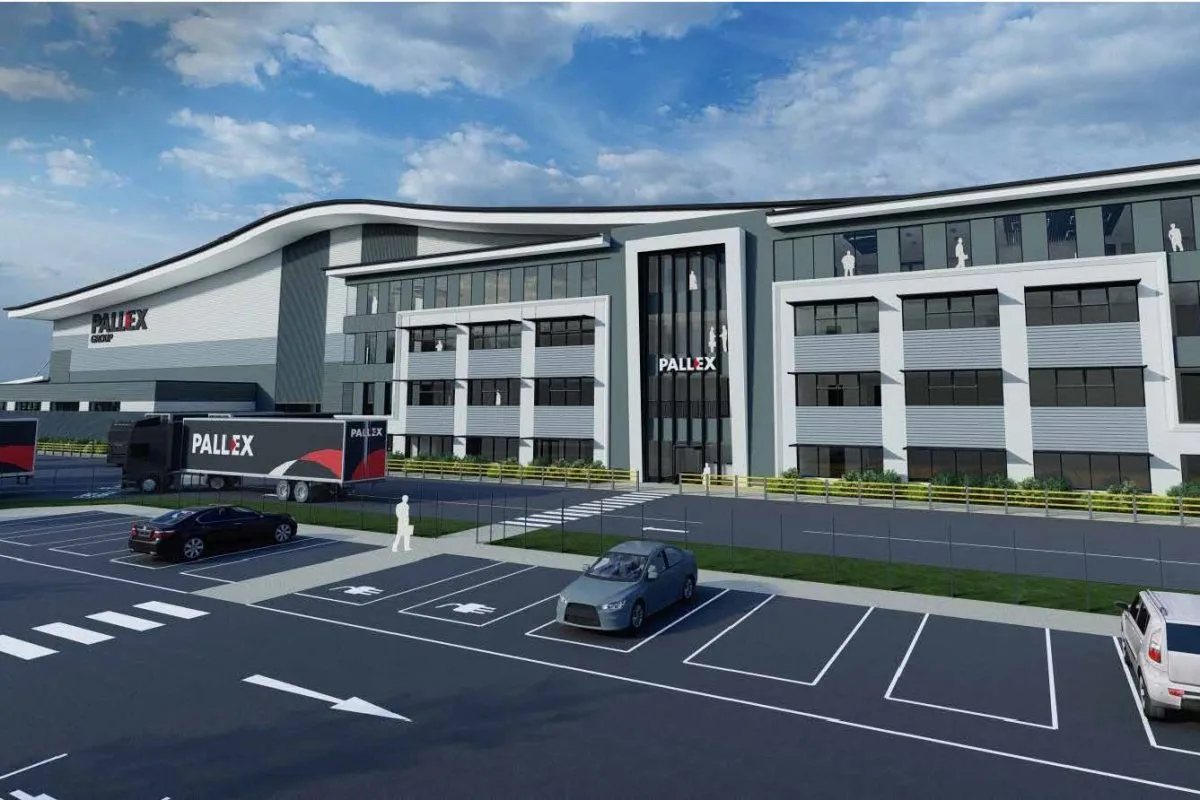
Build-to-suit deals include Marks & Spencer securing a 1.29 million ft2 facility at Prologis’ RFI DIRFT III scheme in the East Midlands, Tesco taking an 850,000ft2 facility at DP World’s London Gateway, DSV committing to a 600,000 ft2 pre-let at IM Properties’ 5 million ft2 + Mercia Park scheme in Leicestershire, Palletways securing a build-to-suit with Prologis for a 640,000 ft2 warehouse in Fradley Park, as well as Pall-Ex teaming up with developer Barberry for a 408,000 ft2 bespoke unit in Hinckley, Leicestershire.
There are two further build-to-suits that are subject to planning also on the cards these include a 400,000 ft2 facility for a Chinese ecommerce company at Clowes Development’s Dove Valley Park near Derby plus a massive 2.399 million ft2 capacity multi-level state-of-the-art bespoke warehouse for Amazon at Caddick Developments’ 4.5 million ft2 EM.EX Worksop scheme in the East Midlands.
There have also been a number of deals seeing speculative and second hand large warehouses being taken including GXO securing Panattoni’s 884,219 ft2 unit at Panattoni’s 1.3 million ft2 Panattoni Park Avonmouth, ID Logistics taking Logicor’s 556,000 ft2 Sherburn 550 unit in Yorkshire in May and then Panattoni’s 440,167 ft2 S440 facility in Sittingbourne as well as Tesco taking a 491,926 ft2 warehouse at Mountpark’s Mountpark Hinckley scheme in Leicestershire. 3PL Bleckmann snapped up the 403,990 ft2 former Boohoo warehouse at Prologis RFI DIRFT III and Regent Glass took Indurent’s Omega 420 building in the Northwest.
Rapley notes: “In terms of square footage taken up in units over 400,000 ft2, we calculated 8.95 million ft2 with some 3.83 million ft2 the East Midlands, which is the top region for number of 400,000 ft2 plus deals as well as surprisingly 3.4 million ft2 in the Southwest [this includes Jaguar Land Rover’s 2.6 million ft2 battery gigafactory].”
At first glance 3PLs accounted for well over a third of take-up, followed by manufacturers at 18%, online retailers at around 8-10% and the remainder spread out across a range of sectors including wholesale, high street retail and food production.
However, while 3PLs appear to be taking a lot of space, this is predominantly on behalf of online retailers like Amazon, and 3PLs such as Super Smart who continue to support the growth of Chinese e-commerce in the UK. Online retailers are, therefore, more active than the figures suggest.
It is thought Amazon has taken up somewhere in the region of 3 million ft2 plus warehouse space through 3PL ‘3+1+1’ contracts in 2025 with ID Logistics in Yorkshire and Kent and GXO in Avonmouth to name just three deals.
JD Logistics the logistics arm of Chinese ecommerce conglomerate has taken two units totalling 5531,519 ft2 at PLP’s 1.06 million ft2 PLP MK scheme in Milton Keynes while Chinese 3PL Super Smart Services took Panattoni’s 345,284 ft2 unit at Panattoni Park J28 Central M1 to serve ecommerce contracts with the likes of TEMU and SHEIN. New Chinese 3PL entrant Top Cloud Logistics took DC6 a 164,103 ft2 newly built facility at Prologis’ 65-acre Prologis Park Midpoint in Birmingham, West Midlands.
The elevated levels of take up has meant that net absorption of space [the amount of space taken up versus the amount of space brought back to the market] turned positive in Q3 2025 for the first time in since Q4 2022 and this continued into Q4 increasing from 2.7 million ft2 to 3.6 million ft2 by year end for warehouses over 100,000 ft2, meaning more space was taken up than returned.
However, looking at the market as a whole – taking in all size brackets – property analytics firm CoStar’s head of research Grant Lonsdale notes that while there was some positive net absorption in Q2/Q3 2025 the return to market of second hand space in Q4 such as the 667,000 ft2 Sainsbury’s unit in Rugby, the 300,000 ft2 Superdrug unit in South Elmshall as well as a couple of former Homebase units means that the year turned negative as a whole in terms of net absorption. “Be that as it may,” he says, “the negative net absorption is mild compared to last year’s negative net absorption figure of 6.5 million ft2.”
With the elevated levels in take-up where does it leave supply? Looking across all sizes and grade of space Lonsdale says there are 401 properties totalling some 84 million ft2.
However, Bavister warns: “Supply figures are probably doing the market a bit of injustice – the majority of supply that’s come back throughout the year has been secondhand as a result of rationalisation, consolidation, or poor trading results etc and tend to be older properties which may not have the eaves heights, power, or floor loading capacity required for modern supply chain operations.”
Lonsdale agrees: “There are 190 properties on the market that are more than 15 years old – equating to more than 47% of the total stock. It looks like there is a positive net absorption of new buildings with older ones coming back.”
Also to note says Savills Rapley is that of the 300 units available across the UK over 100,000 ft2. “The bulk of supply which dwarfs everything else by a landslide is in the 100 to 200,000 ft2 size range with 184 units – 61% of the market.”
However, Newmark’s Industrial & Logistics Analytics partner Will Laing notes: “UK vacancy rates eased to 7.9% in Q3 for the first time in almost three years, having risen steadily from a record low of 3.6% in Q4 2022 to 8.6% in Q2 2025.”
And Colliers Rosso predicts: “Going into Q2 next year if take-up remains consistent supply levels will plateau and start to drop.”
What does this mean for occupiers?
That occupier are not going to like the change in dynamics. Bavister says: “While supply levels look plump the reality is once you get into it and look forensically you may find that what’s actually available isn’t an exact match for what you are after.”
Binks agrees but notes: “There are pockets where there is high availability where there are cracking deals to be had if you have a requirement in one of those locations and in that size bracket, however, then there are other areas where supply is tighter – and we are already seeing quite a significant difference in the level of incentive and flexibility being offered as a consequence of that not just between regions but within regions.
“If you want a 300,000-400,000 ft2 facility in South Yorkshire there are quite a few to choose from and someone will cut a very good deal but if you want 80-100,000 ft2 in Sheffield you will struggle to find anything.”
This is certainly true for occupiers looking for units of between 300,000-400,000 ft2. DTRE’s head of research, data & insights Robert Taylor says: “Looking at availability of units between the 300-400,000 ft2 mark – there has been a massive contraction [35%] in the amount of space available.”
In fact, in the Midlands there are only three units between 300-400,000 ft2 and two of those are thought to be under offer. Colleague Fairlie says: “That means there will be only one unit of this size available in the Midlands at the end of Q1, which is just staggering.”
Taylor notes: “Somewhat counterintuitively there is actually a good supply of units over 500,000 ft2 as its been acknowledged that this size bracket has the shortest void period and probably the most amount of demand. There are no new builds over half a million ft2 which are either existing or under construction with four units being secondhand.
Colleague Fairlie notes: “Obviously the pool of occupiers that can afford a rental bill for buildings of this scale is far reduced but they are often savvy enough to take a view on acquiring more space to lever economies of scale and operational efficiencies.”
Overall looking forward, Fairlie says: “Going into 2026, I think occupiers are going to find it a lot more challenging, they are not going to have the depth of choice that they have had over the previous couple of years.
“They are not necessarily going to get the level of incentive packages they have been used to and they certainly won’t be getting the lease flexibility that has been prevalent up to now.”
Newmark’s Spicer agrees: “Over the past two years occupiers have been used to an oversupply in regional markets but that dynamic is quickly changing – occupier friendly deals are eroding and pressure on yields and build costs is putting pressure on headline rents and equating to rental growth which occupiers may not like.”
However, occupiers that that can find space particularly where they have options can still benefit adds Laing: “[Right now] incentives remain elevated as landlords seek to support occupancy and headline rent levels.”
Occupier trends
There have been two notable occupier trends through 2025, the first is the increase in the number of Chinese companies both retailer and 3PLs looking to take space in the UK. While this is not exactly new there has been a shift.
According to Property analytics firm CoStar’s head of research Grant Lonsdale: “It’s looking like it’s either a record year or very close to record year for take-up in the UK with them. We’ve recorded some 2.2 million ft2 so far, mostly in the first part of this year.”
This surge of activity has not gone un-noticed. Savills logistics research associate Lewis Rapley says: “This is the second-highest year for leasing activity among Chinese occupiers, behind only 2021, and a second year in a row of strong take-up levels.”
Cain International managing director Jon Strang notes: “China is a huge exporter these days and with a weak domestic market and the issue of tariffs in the US, Chinese companies will look to Europe and UK as potential new markets.”
This is something that has been noted by GLP Europe (now Marq Logistics) UK managing director, Brice Topley: “We are also seeing a steady increase in Chinese eCommerce companies turning to Europe to establish new operations. For logistics and industrial real estate players, this marks the emergence of a structural trend. Over the past five years, Marq Logistics has leased close to 400,000 square metres of logistics space to Chinese businesses across Europe, reflecting the scale and momentum of this demand.
Indeed, Newmark UK’s head of national industrial and logistics agency Charles Spicer adds: “We are increasingly busy fielding enquires from Chinese occupiers from smallest to largest and internally we are tracking 600 potential new entrants which could look to expand in the UK.”
Another potential boon to the market in relation to Chinese eCommerce is the recently announced ending of the ‘de-minimis’ rule, explains Rapley: “This exempts parcels under the value of £135 from paying customs duties. This loophole has been exploited by the likes of Shein and Temu in recent years and seen such imports increase by 53% to c.£6 billion.
“While the change in the rules is phased not to come in until 2029, the reform is likely to shift more stockholding and fulfilment activity into the UK, increasing demand for domestic warehousing and reducing reliance on direct-to-consumer air freight.”
As well as the Chinese there has been an increase in take-up from the Defence sector. Indeed CoStar’s Lonsdale notes: “Our research shows that in 2025 nearly 4 million ft2 was taken up by firms whose core business is defence or for which it is a significant revenue stream. That figure is more than double both the previous year’s total and the decade average before Russia’s invasion of Ukraine.
“Since the conflict began in 2022, defence-related industrial take-up has climbed more than 70% compared with the previous four years, in tandem with a steady increase in Ministry of Defence spending on industry and commerce, which has grown by an average of 13% annually over the same period.”
Nearly 400 million ft2 of warehouse space across the UK and Europe will be needed for direct and indirect logistics related to the defence industry according to an to a report by Savills, on rising defence spending as part of the UK’s Strategic Defence Review (SDR) and new NATO commitments.
Looking specifically at the UK, in order to keep pace with defence spending as a percentage of GDP, using the new target of 3.5% of GDP being spent on core military capabilities set out by NATO at the June 2025 summit, Savills has calculated that this could lead to additional demand of up to 32.3 million ft2 in warehouse space in the UK over seven years, equating to annual average take-up of 4.5 million ft2.
To put this into context, manufacturing related take-up in the UK currently averages 7.07 million ft2 per year, the additional demand from defence related industries could see this rise by 64% to 11.625 million ft2 annually.
When considering the UK industrial & logistics sector as a whole, 4.5 million ft2 is broadly in line with the amount of warehouse space that high street retailers take in any given year. Overall, though, defence related demand would account for 13% of total UK take-up, assuming take-up levels remained constant.