

Shed of the Month March 2026: An unusual take
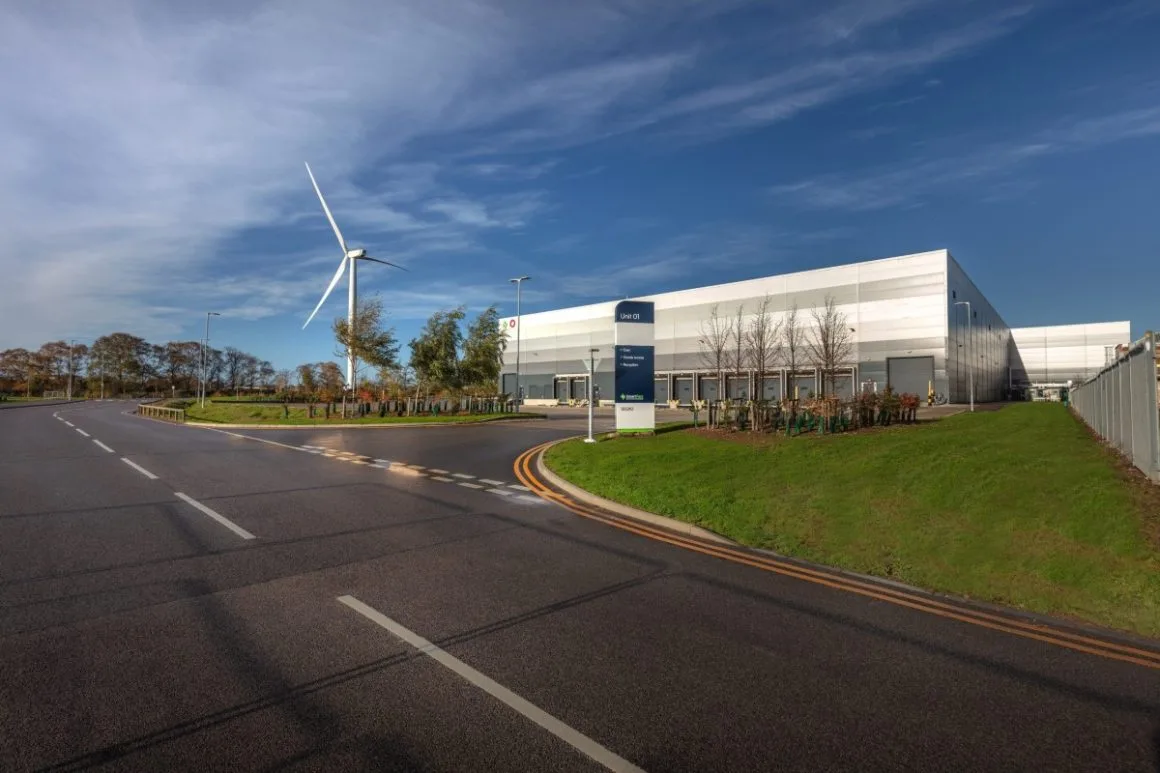
To misquote a well known Vulcan: “It’s manufacturing Jim, but not as we know it.” Well certainly not as most food producers it the UK know it clearly. SmartParc SEGRO Derby is something else, part manufacturing, part logistics – total collaboration.
By Liza Helps, Property Editor, Logistics Matters
To misquote a well known Vulcan: “It’s manufacturing Jim, but not as we know it.” Well certainly not as most food producers it the UK know it clearly. SmartParc SEGRO Derby is something else, part manufacturing, part logistics – total collaboration.
Unit 1, SmartParc SEGRO 1 Holme Lane, Derby, DE21 7HW
Developer: SmartParc/SEGRO
Letting Agents: CBRE and Fisher Hargreaves Proctor
Unit size: 118,244 ft2
Use: Frozen, Chilled & Ambient
Type: Secondhand
Power: 1.15MvA
Sustainability: BREEAM Very Good and EPC A
The sun maybe shining but its blowing a hooley as I am taken round SmartParc Derby to view the immediately available Unit 1 which until recently was let to Hello Fresh before they moved to a bigger facility on the same site.

This is not your typical logistics or indeed manufacturing site – its more than that, and it could be the model for food manufacturing clusters in the UK that will help to build resilience in the food sector which currently so heavily relies on imports (42%) making the UK more vulnerable with regard to food security. For comparison France imports 20%, Germany 17%, Netherlands 13.3% and Italy 11.52%.
The UK Food & Beverage sector contributes £146.7 billion to UK GVA (6.5% of the entire economy), and employs some 4.2 million workers (13% of national employment) but its at the food manufacturing level that the stats are really startling: The manufacturing sub-sector of the UK food and beverage industry alone accounts for £35.1 billion in GVA or 15% of the total manufacturing industry – outstripping both the aerospace and automative sectors combined. With over 12,500 businesses, food and beverage manufacturers employ over 18% of the whole UK manufacturing workforce and have added 38,500 new jobs since 2015. An estimated 98.6% of food and beverage manufacturers are small and medium sized enterprises (SMEs).
A policy document published by SmartParc last year entitled: Reinvigorating the UK Food & Beverage Sector noted that increasing costs especially in energy in the UK (30 to 40% more expensive than the EU average) as well as skilled labour shortages and rising labour costs in addition to regulatory concerns and a lack of government incentives specifically for food and beverage manufacturing have contributed to the 30.5% fall in investment spending since 2019 – in stark contrast to the wider UK manufacturing sector’s 5.4% uptick in investment during the same period.
Another report this time from the Institute of Grocery Distribution (IGD) stated that the UK food system is at risk if manufacturers fail to embrace automation especially with the UK population expected to grow by 7 million in the next 20 years.
According to my host SmartParc chief operating officer Phil Lovell: “The majority [food manufacturers] are in old and unsuitable space and are finding it hard to invest especially in automation let alone new production space.”
Obviously investment levels are low but surely moving into new production facilities cannot be so difficult or expensive. Just move to a new modern Grade A warehouse – there are lots around.
But that is the rub says Lovell, unless they are built specifically for food production it is very expensive and inefficient for food manufacturers to retrofit logistics warehouses into temperature-controlled, food-grade facilities.
For example, thicker steels must be added to suspend the hygienic ceiling panels, surface drainage may be required as well as upgrades to insulation panels and ventilation systems. SmartParc land director Adrienne Howells added: “At the end of a lease period, food businesses then face a whole load of dilapidation charges to get the building back to its original state. A lot of food producers can feel stuck [in inefficient and old space] and it is really expensive to build new.”
Due to the obvious health and safety and cleanliness rules as well as the specialised nature of the use of the building, there are specific water needs and effluent removal requirements – meaning a single food production warehouse can cost four times as much as a standard warehouse – a typical 100,000 ft2 food manufacturing facility costs circa.£45 million to deliver.
Because food producers also need a lot of power and water – six times the amount compared to standard logistics warehouses – this means they do not make good neighbours and cannot be easily integrated into warehousing developments.
So SmartParc Derby. A specifically designed scheme to provide modern Grade A space for food production and to leverage collaboration between occupiers at every level to drive down costs, reduce carbon emissions, encourage innovation, train and upskill workers and nurture start-ups.
A full service food production park envisioned in 2018/19 by SmartParc chief executive Jackie Wild after years of working closely within the sector through her design and construction group, TSL, which she founded in 2002. Developer investor SEGRO bought into Wild’s vision in 2021 to deliver the 1.85m ft2 high-tech food manufacturing and distribution campus on the 112-acre site at Spondon, Derby now known as SmartParc SEGRO Derby.
At its heart is the shared utilities system with every plot connected so rather than each food manufacturer investing in separate energy, water, and waste facilities, SmartParc provides.
It has a central energy centre providing sustainable energy to all tenants through highly efficient systems operating over a PAYU (Pay As You Use) platform. The system allows mass energy balancing across the park and reduces the carbon footprint and energy costs of all tenants. The centrally operated shared heating and cooling system recycles heat from refrigeration plants and reuses it to heat water and offices. In addition, there are roof top PV solar arrays and Smartparc is looking to collaborate with the local energy provider to utilise excess wind power from nearby turbnines. The energy centre has been specially designed with an ability to connect future innovative technologies including wind, nuclear and hydrogen power without overinvesting in any one solution.
Lovell says the scheme also has top up from the grid when needed. It currently has some 41 Mva and can provide up to 70 litres of water per second and is also building a trade effluent system for the whole scheme. In effect all of these services are managed centrally by Smartparc which is also looking at other areas of collaboration from the construction of a shared innovation hub to distribution and training.
Lovell says: “If you are not willing to look at collaboration don’t come here.” He believes passionately that collaboration is the key to drive efficiencies in the food production sector and create much needed resilience.
So an occupier taking Unit 1, isn’t just getting a production facility it is also getting rid of the myriad of headaches associated with running such a facility and will be able to concentrate on core concerns. The costs associated are all rentalised. So in essence this unit is quite literally plug in and play.
For those interested the chilled refrigeration facility that is Unit 1, boasts 104,445 ft2 of warehouse space with production zone, racking area, chilled racking zone, frozen cold store and ambient warehouse space with eight chilled dock and one chilled level access door and two ambient dock and one level access ambient door as well as 13,7999 ft2 of Grade A office space, break out room and toilet and locker facilities .
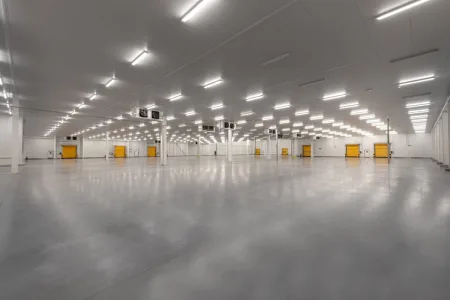
The unit has a chilled picking and storage area with eaves heights ranging from 6m to 10m, a 330m2 freezer chamber, chill ready cladding, 1.15 Mva of power as well as 5 litres per second water supply.
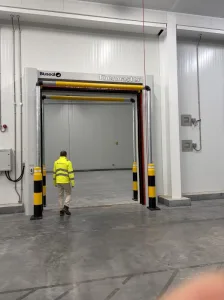
Attention to detail is everywhere, from the protective posts outside the freezer room doors – they are very expensive to replace – to the hand wash facilities for employees outside the production facility doors.
And for those who don’t need something so big or indeed something bigger there are plenty of options currently on offer in units from 18,000 ft2 to 400,000 ft2.
Indeed, with Hello Fresh and Greggs established on the site, the proof of concept has been established and proven to work – right now another production facility is being constructed for an as yet to be revealed manufacturer and there are talks with other potential occupiers in the offing.
Looking to the future then, it’s a case of securing sites for the next Smartparcs – and they are ambitious looking for up to six around the UK bringing modern future proofed production ready facilities to bolster the UK’s food and beverage sector and the nation’s security.