

Ensuring stable power in warehouse automation: the role of buck-boost converters
Warehouse automation has rapidly transformed logistics and supply chain operations, shifting from manual workflows to highly intelligent, interconnected systems.
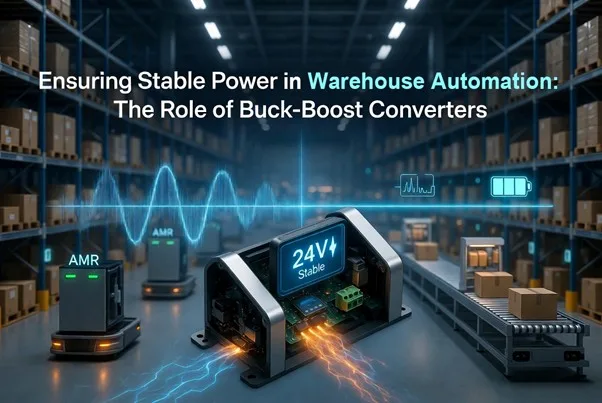
Autonomous mobile robots, high-speed conveyor networks, real-time tracking sensors, and advanced control units now define modern distribution centers. Yet behind all this innovation lies a critical but often overlooked factor: power stability. In an environment where machines must operate continuously with precision and reliability, even minor voltage fluctuations can trigger significant disruptions. Ensuring consistent and regulated power is therefore not just a technical requirement, but a fundamental necessity for operational continuity.
Understanding power instability in dynamic environments
Unlike traditional industrial setups with predictable loads, automated warehouses are inherently dynamic. Robots accelerate, stop, and reroute in milliseconds, conveyors operate at variable speeds depending on throughput demand, and IoT-enabled sensors continuously switch states. Battery-powered equipment introduces another layer of variability, as voltage naturally declines during discharge cycles. These combined factors create unstable input voltage conditions, leading to risks such as unexpected shutdowns, communication errors between systems, reduced lifespan of sensitive electronics, and even safety hazards in mission-critical operations. A simple issue such as barcode scanners misreading packages due to voltage dips can cascade into delays affecting hundreds or thousands of shipments within minutes.
Why buck-boost converters are essential
To address these challenges, buck-boost converters have emerged as a vital component in warehouse power architecture. Unlike conventional DC-DC converters that only step voltage up or down, buck-boost converters can perform both functions seamlessly. This means they can maintain a constant output voltage regardless of whether the input voltage rises above or falls below the desired level. Their operation is based on high-speed switching of electronic components such as MOSFETs, combined with energy storage elements like inductors and capacitors. By precisely controlling the switching duty cycle, the converter ensures that output voltage remains stable even under rapidly changing load conditions. This adaptability makes it particularly suitable for environments where voltage unpredictability is the norm rather than the exception.
Voltage stability directly impacts multiple aspects of warehouse automation. Precision robotics, for instance, rely on tightly regulated power supplies to maintain positional accuracy and repeatability. Even small deviations in voltage can lead to errors in movement, affecting product handling and placement. Communication systems are equally sensitive, as fluctuations can disrupt data transmission between machines, leading to synchronization issues. Battery-powered systems benefit significantly from voltage regulation, as it allows them to utilize a greater portion of their stored energy without premature shutdown. Ultimately, stable power translates into reduced downtime, improved efficiency, and lower operational costs factors that are crucial in high-throughput logistics environments.
A practical example of the importance of buck-boost converters can be observed in automated conveyor sorting systems. In a typical setup, a 36V DC supply powers multiple subsystems, including sensors requiring 12V and programmable logic controllers operating at 24V. During peak operation, when several conveyors start simultaneously, the input voltage may drop significantly. Without proper regulation, this can cause sensors to misread package data and controllers to reset intermittently, resulting in sorting errors and operational delays. By integrating buck-boost converters, each subsystem receives a stable and regulated voltage regardless of input fluctuations. The result is improved accuracy, uninterrupted operation, and a substantial reduction in system downtime.
Advanced product perspective: industrial buck-boost converter modules
Modern industrial buck-boost converter modules are engineered to meet the demanding requirements of automated environments. A typical high-performance unit supports a wide input voltage range, often from 8V to 60V DC, making it compatible with battery systems, renewable energy sources, and industrial power lines. Output voltage is usually adjustable between 3.3V and 48V, with precision regulation maintained within ±1%. Current handling capabilities range from 5A to 20A or higher, depending on the application, allowing support for both low-power electronics and high-demand components such as motors and actuators.
Efficiency is another defining feature, with most industrial-grade converters achieving between 90% and 96%, minimizing energy loss and reducing thermal stress. Switching frequencies typically range from 100 kHz to 1 MHz, enabling fast response times and compact designs. Protection mechanisms are integral to these modules, including overvoltage protection, undervoltage lockout, overcurrent protection, thermal shutdown, and short-circuit protection. These features ensure safe and reliable operation even under extreme conditions.
From a mechanical standpoint, converters are designed for harsh industrial environments, with operating temperature ranges from -40°C to +85°C, vibration-resistant construction, and flexible mounting options such as DIN rail or panel installation. Advanced models also incorporate digital interfaces like I2C or PMBus, enabling remote monitoring and control. Real-time diagnostics provide insights into voltage, current, and temperature, allowing engineers to optimise performance and detect potential issues before they escalate.
Real-time example: autonomous mobile robots (AMRs)
Another compelling example can be found in autonomous mobile robots used in fulfillment centres. These robots typically operate on lithium-ion batteries with voltage levels that decrease as the battery discharges. For instance, a system may start at 48V when fully charged and drop to 30V during operation, while requiring stable outputs of 36V for motor control and 12V for onboard sensors. Without voltage regulation, the system faces risks of overvoltage at full charge and underperformance at low charge levels. By integrating buck-boost converters, the robot maintains consistent output voltages throughout the entire battery cycle. This not only ensures smooth and reliable operation but also extends runtime, reduces charging frequency, and enhances overall productivity.
Implementing buck-boost converters in warehouse automation systems requires careful planning. Engineers must evaluate load characteristics to determine whether they are constant, pulsed, or highly dynamic. Thermal management is critical, as efficient heat dissipation ensures long-term reliability. Electromagnetic interference must be minimized through proper filtering and shielding, especially in environments with dense electronic systems. In mission-critical applications, redundancy may be necessary to guarantee uninterrupted operation. These considerations ensure that the power system performs optimally under all conditions.
The future of power management in warehouses
As warehouse automation continues to evolve, power management systems are becoming more intelligent and integrated. Emerging trends include AI-driven energy optimization, integration with renewable energy sources, and the development of smart microgrids within warehouse facilities. Buck-boost converters are also advancing, with digital control capabilities that allow them to adapt in real time to changing conditions. This evolution is transforming them from simple voltage regulators into intelligent components that actively contribute to system efficiency and reliability.
Conclusion
Stable power is the foundation upon which modern warehouse automation is built. In an industry where precision, speed, and reliability are paramount, voltage fluctuations can no longer be tolerated. Buck-boost converters provide a versatile and efficient solution, ensuring consistent voltage delivery, protecting sensitive equipment, and optimizing energy usage. Whether supporting conveyor systems, robotic fleets, or sensor networks, these converters play a crucial role in maintaining seamless operations. As automation technologies continue to advance, their importance will only grow, solidifying their position as a key enabler of next-generation logistics systems.