

Minimising operational risk with advanced photoelectric sensing
Walk into any busy warehouse today and you’ll notice one thing immediately: everything is moving fast. Conveyor belts run continuously, parcels move in tight sequences, and automated systems make split-second decisions. In this kind of environment, even a small detection failure can disrupt the entire flow.
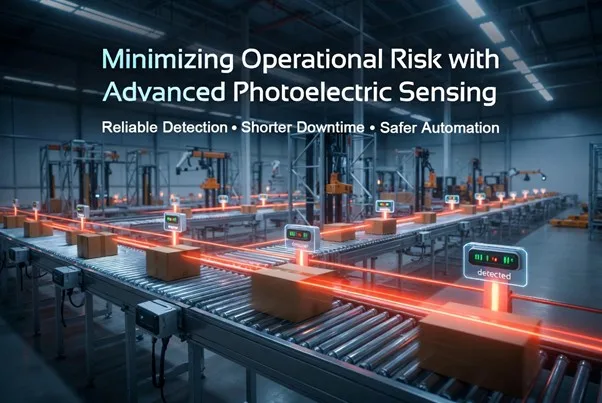
That’s why minimising operational risk has become a daily focus for logistics teams. It’s no longer just about preventing major failures, it’s about eliminating the small, frequent issues that slow things down. One technology that plays a quiet but critical role in this is photoelectric sensing.
Where operational risks start
In real warehouse settings, problems rarely begin as major failures. Instead, they start small:
- A carton passes a checkpoint but isn’t detected
- Two packages overlap on a conveyor
- A diverter activates too late
- A pallet isn’t properly registered in storage
Individually, these issues seem minor. But over time, they lead to mis-sorts, delays, and manual corrections. In high-volume operations, that quickly becomes expensive.
This is where detection accuracy becomes essential.
How photoelectric sensors help
Photoelectric sensors detect objects using a beam of light. When the beam is interrupted or reflected, the system instantly registers the presence of an object and triggers a response.
What makes them effective in warehouses is their ability to:
- Detect objects without physical contact
- Operate at very high speeds
- Maintain consistent performance over time
- Work with a wide range of materials
Unlike mechanical switches, they don’t rely on touch, which reduces wear and improves reliability.
Real-world example: conveyor line failure prevention
Consider a typical e-commerce fulfillment centre.
Thousands of parcels move along a conveyor every hour. At one point on the line, packages must be evenly spaced before reaching a sorting station.
Without proper sensing:
- Packages bunch together
- The system misreads positions
- Sorting arms fail to activate correctly
- The line stops due to errors
With photoelectric sensors installed:
- Each package is detected in real time
- Spacing is monitored continuously
- The system automatically adjusts speed
- Sorting happens accurately without interruption
This simple addition can prevent hours of downtime each week.
Real-world example: automated sorting accuracy
In courier hubs, parcels must be sorted into different routes within seconds.
A leading logistics facility implemented high-speed photoelectric sensors at key checkpoints. Before installation, they experienced frequent mis-sorts during peak hours.
After implementation:
- Detection timing improved significantly
- Sorting accuracy increased
- Manual reprocessing dropped noticeably
Even a small improvement in detection timing made a measurable difference in overall performance.
Product specifications that matter
Not all photoelectric sensors perform the same. Choosing the right specifications is key to reducing operational risk.
Here are some important factors to consider:
1. Detection Range
- Short-range sensors: typically up to 2 meters
- Long-range (through-beam): up to 10–50 meters
For long conveyor systems, extended range ensures reliable detection across wider gaps.
2. Response Time
- Standard sensors: a few milliseconds
- High-speed sensors: less than 1 millisecond
In fast-moving systems, faster response times mean better accuracy and fewer missed detections.
3. Light Source Type
- Infrared (common for industrial use)
- Visible red light (easier alignment)
- Laser (high precision applications)
Laser-based sensors are often used where objects are very small or require precise positioning.
4. Output Type
- Digital output (on/off detection)
- Analog output (distance or intensity measurement)
Most warehouse applications use digital outputs for simplicity and speed.
5. Environmental Protection (IP Rating)
- IP65: dust-tight and water-resistant
- IP67: suitable for harsher conditions
Warehouses with dust, vibration, or temperature variation require higher protection ratings.
6. Mounting and Alignment
Sensors should be easy to install and adjust. Poor alignment is one of the most common causes of detection failure.
Real-World Example: Pallet Detection in Storage Systems
In automated storage and retrieval systems (AS/RS), knowing whether a pallet is present is critical.
A manufacturing warehouse faced issues where pallets were occasionally missed by the system, leading to inventory mismatches.
After installing photoelectric sensors:
- Each pallet position was verified in real time
- Storage errors were reduced
- Inventory accuracy improved
This also reduced the need for manual stock checks, saving time and labor.
Enhancing workplace safety
Beyond efficiency, safety is another major concern.
In facilities where forklifts, robots, and workers share space, visibility is crucial. Photoelectric sensors can be used to create detection zones.
Example:
- A sensor is placed near a restricted machine area
- If someone enters the zone, the machine slows or stops
- Accidents are prevented before they happen
This kind of proactive safety measure is becoming standard in modern warehouses.
Reducing downtime and maintenance
Downtime is one of the biggest operational risks. Often, it’s caused by small issues that escalate like a missed detection leading to a jam.
Photoelectric sensors help reduce this by:
- Detecting irregular movement early
- Preventing system overload
- Reducing false triggers
They also require less maintenance compared to contact-based sensors, since there’s no physical wear.
Supporting smarter warehouse systems
As warehouses become more data-driven, sensors play an even bigger role.
Every detection event provides useful data:
- Item movement tracking
- Flow analysis
- Bottleneck identification
When integrated into warehouse management systems, this data helps improve decision-making and long-term efficiency.
Final thoughts
Operational risks in warehouses are often subtle but persistent. They show up as small inefficiencies that gradually impact performance.
Photoelectric sensors offer a practical way to address these challenges. With the right specifications and proper placement, they improve detection accuracy, reduce downtime, and support safer working conditions.
In a fast-paced logistics environment, reliability matters. And sometimes, it’s the simplest technologies working quietly in the background that make the biggest difference.