

Sustainability in transport an increasing priority in UK
A report from GXO Logistics – The Future of Transport – adds that a growing number admit they don’t know how to translate ambition into action.
THE FINDINGS show 87% of businesses identify emissions reduction as a key priority, up from 81% in 2024, yet nearly two-thirds of respondents admit they don’t know where to start.
Carl Hanson, managing director transport, GXO UK & Ireland, said: “The cost of inaction is no longer abstract. Businesses that don’t address the challenges ahead – optimisation, fleet efficiency, real-time visibility – are paying for it in higher costs, missed deliveries and lost customers.
“The good news is that reducing inefficiency and cutting emissions are not competing goals. They are the same goal. What makes that possible is giving businesses the tools to see clearly and move quickly – end-to-end visibility across the supply chain, access to a collaborative community of transport networks, and the real-time data to make smarter decisions. That is exactly what GXO’s EyeQ digital transport solution was built to do.”
To develop this report, GXO, the world’s largest pure-play contract logistics provider, surveyed over 1,000 senior decision makers in UK supply chain and logistics organisations to uncover how businesses are addressing the challenges of cost resilience, low-emission transport and operational digitalisation.
Cost pressures
89% of transport operators expect costs to rise over the next 12 months, with over a third anticipating significant increases. While the planned 5p fuel duty freeze has been postponed, the broader cost environment remains challenging. Nearly 60% of businesses anticipate a material impact on their operating costs from future duty changes.
More than eight in ten (86%) transport operators now believe collaboration between logistics networks is key to reducing costs and cutting carbon emissions – a significant increase from 65% in 2024.
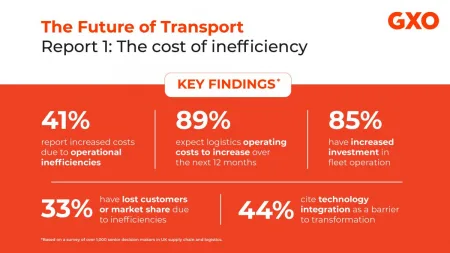
Additionally, 85% reported increased investment in fleet optimisation. The logic is straightforward: fewer empty miles, better-planned routes and optimised loads mean lower fuel consumption and lower emissions.
But when it comes to alternative fuels, just 35% of organisations strongly agree they have a clear strategy and defined timeline for adoption. For the majority of businesses, the shift to alternative fuels that is already under way has no clear plan behind it.
Digital
The research highlights market alignment on digital technologies as the solution. The impact of not having the right transport technologies results in higher maintenance costs (37%), longer delivery times (32%) and higher CO₂ emissions (32%). The right technology solutions provide greater visibility into operations, utilise data to make informed decisions and connect networks to reduce financial and operational burdens to organisations.
The Future of Transport is the first in a three-part series from GXO that explores operational efficiency, sustainability and technology-led optimisation in UK transport. The first report and methodology can be found here.