
AMRs can help smooth factory intralogistics
Often overlooked, a factory’s hidden supply chain plays a critical role in productivity. Mark Gray explores how intralogistics and material flow influence throughput, OEE and labour efficiency, and why optimising the movement of materials is becoming a key competitive advantage for manufacturers.
PRODUCTIVITY IS often associated with faster machines, greater appliance automation, and increased production capacity. While these investments are important, manufacturing performance depends on much more than production equipment alone.
Manufacturers have long spent an enormous amount of effort optimising external supply chains to ensure materials arrive to and from factories efficiently. They then focus on creating highly efficient production lines, investing in state-of-the-art equipment to transform those materials into finished products.
However, even the most advanced production line cannot operate at its peak if materials are not available when and where they are needed. Delays in internal transport, inefficient material handling, inventory bottlenecks, and poor line-feeding processes can reduce factory utilisation and create costly production interruptions.
Why material flow matters
True productivity cannot be achieved solely through optimising external supply chains or investing in the best machinery – it requires a seamless connection between inbound supply, production processes and intralogistics operations.
Once materials enter a facility, they move through a second supply chain – one that exists entirely within the factory walls. Managed through intralogistics, this hidden supply chain is critical to maintaining productivity.
The effective movement, storage, and delivery of materials between warehouses, workstations and production lines ensures manufacturing processes remain uninterrupted, and equipment operates at maximum effectiveness.
The costs of poor flow
Without efficient intralogistics, factories can experience machine starvation and underutilised operators as they wait for the right materials to arrive and production tasks to continue.
Beyond this, materials may sit waiting to be transported, creating excess inventory that must be stored and managed.
Without a clear intralogistics strategy, production floors often see unnecessary material handling, increased manual processes, and excessive forklift traffic.
Together, these inefficiencies can lead to costly production disruptions, reducing throughput, labour efficiency, and Overall Equipment Effectiveness (OEE).
Measuring material flow
As a result, intralogistics has a direct impact on several of the key metrics used to assess manufacturing performance. Ultimately, if manufacturers rigorously measure machine performance, they should apply the same discipline to material flow, monitoring availability, replenishment times and delays.
Efficient material flow helps maximise throughput by ensuring production processes can operate continuously without waiting for materials. It also supports higher OEE by reducing downtime caused by shortages and delays.
Beyond equipment performance, effective intralogistics improves labour efficiency, minimising the time operators spend searching for, transporting, or handling materials and allowing them to focus on higher-value production activities instead.
By reducing variability in material availability and delivery, it also helps create more stable and predictable production operations. And together, these benefits make intralogistics a critical contributor to overall factory productivity.
Solutions in modern manufacturing
Many manufacturers are increasingly looking beyond existing solutions to improve their intralogistics. Technologies such as autonomous mobile robots (AMRs) are helping businesses automate the movement of materials throughout their facilities with greater flexibility.
Unlike traditional automated systems, AMRs can be deployed within a factory floor without having to alter existing infrastructure. This means there’s less downtime in implementation and increased flexibility – when its needed – to respond to changing production demands.
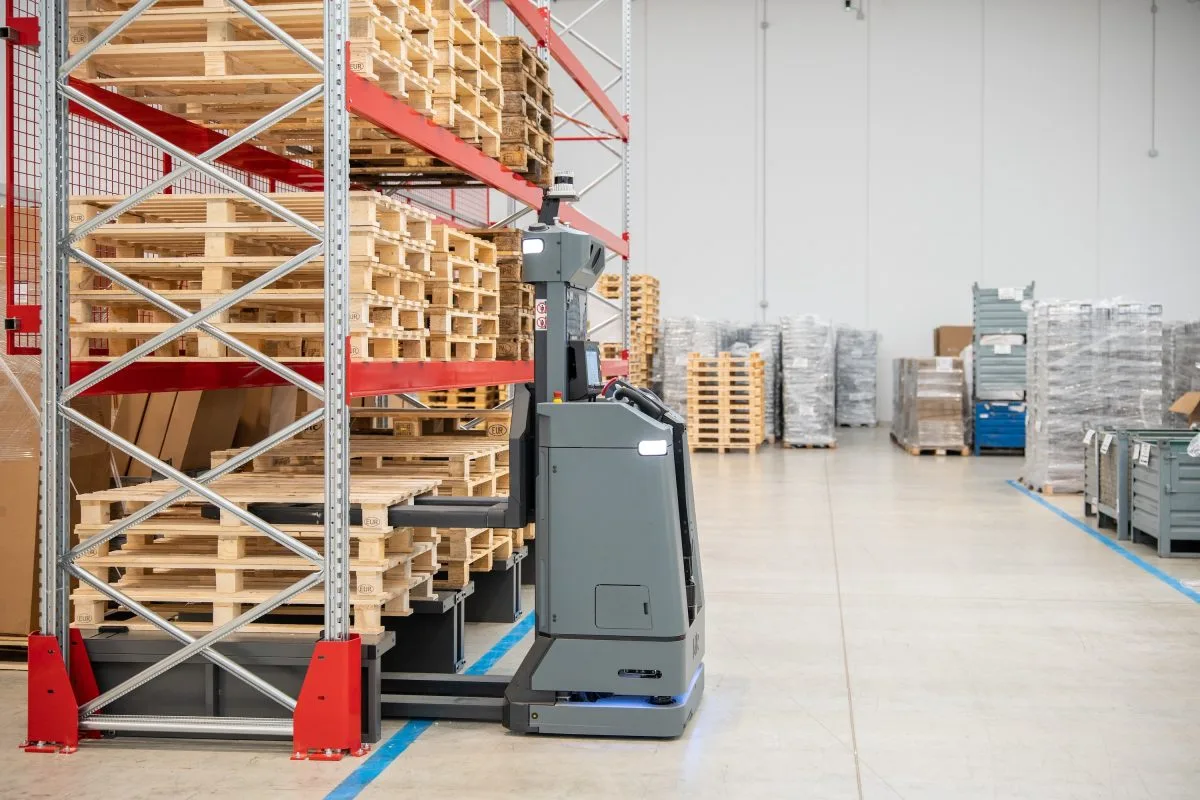
Supporting tasks such as line feeding, pallet transport and the movement of work-in-progress, AMRs help ensure materials arrive at the right place at the right time. The overall result is greater use of the internal supply chain which means better productivity, improved consistency and safer, more resilient operations.
Real world results
The benefits of effective intralogistics are already being demonstrated by manufacturers across a range of industries. As part of a wider strategy to improve material flow, companies are increasingly deploying AMRs to reduce manual transport activities, improve safety and maintain production continuity.
One example is Fermator, which sought to improve both safety and efficiency across its operations.
By introducing AMRs to automate pallet transport and internal material movements, the company was able to move materials more efficiently throughout the facility, without modifying its existing infrastructure.
The intelligent navigation system helped reduce waiting times between processes, improving production continuity, while also increasing internal safety performance from 60% to 90%.
Similar results have been achieved by Italian manufacturer Vibo. At its Trissino assembly plant, forklifts were relied upon to move pallets between production and storage areas, with operators spending significant time on repetitive transport tasks.
To address this, like Fermator, Vibo deployed an AMR solution to automate pallet movements across the facility. Operating safely alongside operators and other vehicles, the system provided continuous material transport without requiring changes to the existing layout.
The result was more consistent material flow, while enabling operators to be reassigned to higher-value activities that further support production.
These examples demonstrate how manufacturers are addressing common intralogistics challenges through automation. By improving the movement and availability of materials, technologies such as AMRs are helping businesses increase productivity, strengthen safety performance, and build more resilient future-proofed operations.
The competitive advantage
Looking ahead, manufacturers will continue to face pressure to remain competitive. In this context, productivity can no longer be viewed solely through the lens of production equipment.
Manufacturers must give their hidden internal supply chain – the intralogistics systems and processes – just as much attention as the production line and external suppliers, if not more.
After all, production equipment can only perform at its full potential when the right materials are available at the right place and at the right time. Without this, machinery and operators are at risk of increasing downtime and lost productivity.
By reducing delays, improving material availability and creating more consistent flow, manufacturers can increase throughput, improve OEE and make better use of both labour and equipment.
The factories that gain a competitive advantage are likely to be those that optimise not only their production lines, but also the hidden supply chain that keeps those lines running.
Mark Gray, UK sales manager, Teradyne Robotics