
Are humanoid robotics the future of warehouse automation?
Will we soon see humanoid robots operating in UK and European warehouses? Russell Hutchinson, business development manager at Daifuku is not totally convinced.
BACK IN 1985, Roger Smith, chairman and CEO of General Motors, had a lightbulb moment. What if the American car giant, under increasing pressure from its more efficient Japanese competition, adopted emerging technology to slash costs and regain leadership in the market? Inspired by what new automation could do, he exclaimed, “Do you know what really impresses me? I saw a robot pick up an egg!”.
Within just a couple of years, the experiment in automation was over. Research* suggests that from 1985 to 1991, when it was introducing significant levels of robotics into its factories, GM’s productivity continued to lag significantly behind that of main rival Toyota. Stories of robots welding doors shut and painting cars the wrong colour were well documented at the company’s new ‘lights out’ operations. GM had reportedly spent $90bn on automation that just didn’t work. By 1995, the corporation pulled the plug on this sobering chapter in its history.
The humanoids are here
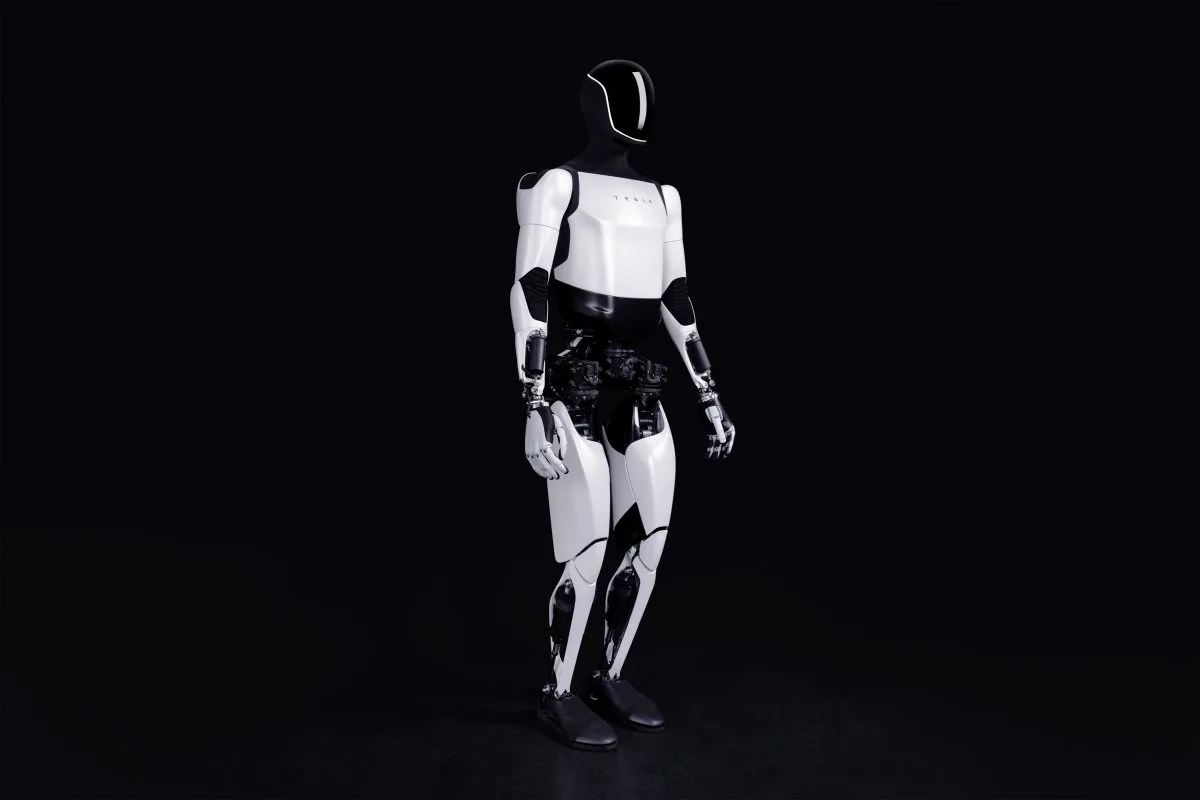
Fast forward to 2026 and we are seeing similar interest with humanoid automation. The internet is awash with examples of clever robots chasing wild boars down a street in Poland; beating a world ranking Chinese player at table tennis or winning a marathon. Similarly, Tesla’s development of its Optimus 3 factory robots has generated huge amounts of media attention with Elon Musk saying the technology will be ‘transformative’.
However, will the excitement and anticipation surrounding humanoid robotics translate into practical warehouse solutions? It’s still too early to say. Nevertheless, there will doubtless be niche operations that will benefit from this type of automation.
The challenges we’re facing
Look at any modern warehouse and you see the same challenges: more orders, increased order complexity, huge numbers of SKUs and far less time to dispatch goods. At the same time, customer behaviour has become harder to predict. Order patterns now produce sharper spikes with fewer warnings, especially in facilities shared between multiple vendors such as 3PL operations, multi-tenant warehouses or Amazon-type fulfilment environments. Facilities that appear manageable one hour can suddenly face a surge of orders that must be processed immediately.
In this kind of environment, flexibility is no longer a nice-to-have. It is essential. Human labour remains the most adaptable resource in the warehouse. People can respond to shifting priorities, changing order profiles and unexpected workflow changes far more easily than any automation system available today. But that flexibility comes with limits. Human-based operations are difficult to scale quickly, and performance is rarely consistent. Throughput depends heavily on operator efficiency, which means planned capacity is not always achieved in practice.
Traditional conveyor systems present the opposite trade-off. They deliver predictability and stable output, but they do so at a fixed rate and cannot easily flex when demand suddenly spikes.
Some look at humanoid robots as the next step, but replacing labour altogether with such technology is not yet a practical answer either. These robots remain expensive and, in most warehouse environments, are still largely unproven.
The lesson here is clear: we should not avoid innovation, but we should be wary of confusing novelty with readiness. Perhaps we need to keep the lessons of the past in mind and resist getting swept along by the excitement of the ‘shiny new toy’ as GM’s Roger Smith did back in the eighties.
Operational elasticity
For fulfilment operations, the real challenge is no longer basic automation, but operational elasticity and built-in redundancy; the ability to expand and contract capacity in response to volatile demand without fixed infrastructure. And this needs to be achieved while avoiding single points of failure.
Given the current rate of technological change, it might be tempting to conclude that humanoid robotics are where it’s at, but our practical experience suggests otherwise. Granted, humanoids will no doubt play a role in the warehouse of tomorrow, but what’s really needed is a solid middle ground, where proven, highly efficient technology delivers the commercial requirement. It’s all about evolution, not revolution.
Responding to demand volatility
One way to address this challenge is to move away from fixed, continuously running systems and toward a model where capacity can adjust dynamically.
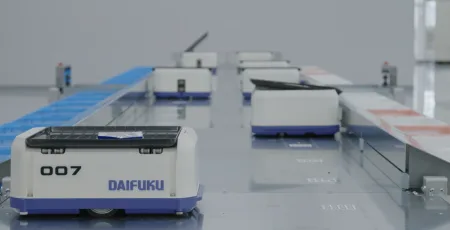
Daifuku’s SOTR-S is designed with this objective in mind. In retail and e-commerce fulfilment, much of the complexity comes at the piece level. Batch picking is widely used, where the same SKUs required by multiple orders are picked together in a single pass, then sorted and consolidated.
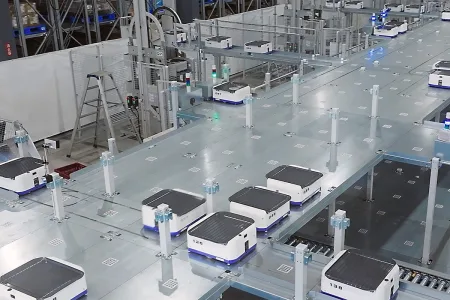
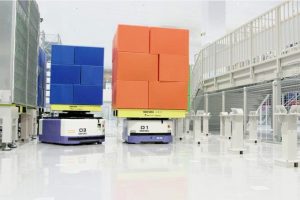
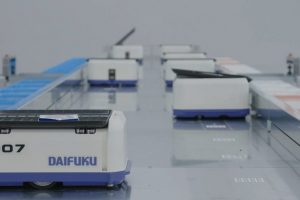
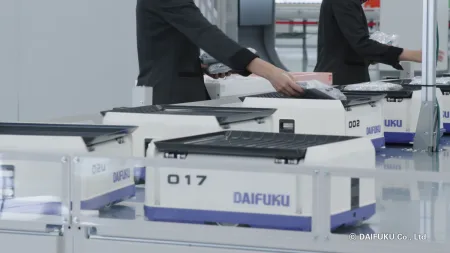
The SOTR-S supports this stage by using a fleet of mobile robots to transport individual items between process points. Operators place picked items onto the robots, which then carry them to their assigned destinations. Unlike traditional sorters, each robot stops for item placement, removing the need for operators to aim at a moving target. This reduces stress and makes the process more controlled and consistent.
Each robot receives its destination from the warehouse control system via an RTC (robot traffic controller), which dynamically assigns tasks and routes. Vehicles operate independently, but are centrally coordinated, allowing the system to continuously adjust to current workload conditions.
A new operating model
By replacing fixed flow with mobile, task-based movement, the SOTR-S introduces the flexibility and real-time adaptability that traditional systems lack.
This difference in design leads directly to a new operating model. With traditional conveyors and sorters, as discussed earlier, systems must be in place regardless of whether they handle peak volumes or minimal flow. While well-designed conveying systems minimize runtime by stopping conveyor zones one by one to avoid unnecessary movement and electrical consumption, some residual and unavoidable inefficient energy use, along with mechanical wear, still remains even when throughput is limited.
The SOTR-S allows capacity to follow demand. Because each robot operates independently, fleet activity is continuously aligned with actual throughput requirements. In practice, only the vehicles required at a given moment are moving, based on real-time workload. This intelligent, task-based control minimizes unnecessary robot movement, leading to optimized energy use and more efficient utilization of equipment. In addition, during extended off-peak periods, such as the months following the Black Friday and holiday season, part of the fleet can be taken offline, further improving overall efficiency.
As a result, the SOTR-S enables a more efficient operating model in which energy consumption and equipment usage are closely tied to actual workload, rather than fixed system capacity.
Sweat the asset
This distributed, multi‑robot operating structure also transforms system resilience. In traditional systems, a single failure can disrupt the entire operation. When a sorter stops, everything stops. With the SOTR-S, loads are distributed across multiple robots and . Failures are therefore localised: if one robot stops, only the load on that vehicle is affected while the rest of the system continues to operate.
The same principle applies not only to unexpected failures, but also to routine maintenance. Individual robots can be taken offline as needed, allowing maintenance to be performed without interrupting the system.
This built in resilience, achieved by isolating impact at the robot level, allows the SOTR-S to maintain continuous operation during both failures and maintenance. As a result, system uptime increases and assets are used more efficiently and predictably.
Focus on automation performance
The SOTR‑S enables a demand‑driven operating model in which capacity, energy use, and system availability adjust continuously to actual workload. Throughput can be matched precisely to actual demand, allowing the system to adapt to volume fluctuations without carrying unnecessary cost. At the same time, because there is no single point of failure, the system continues to run even if one unit stops. The result is a model where resources are used only when they contribute to processing, ensuring efficient performance without waste.
Humanoid robots will no doubt find a place within the warehouse fulfilment environment over the next few years. However, I suspect we may see several examples of rapid deployment – followed by withdrawal – before that day comes.
* Research Gate – The learning bureaucracy: New United Motors Manufacturing Inc, January 1993