

Unlocking value with AI-driven fulfilment
AI is beginning to reshape warehouse operations, with the shift is not simply about adding another analytics layer, it is about moving from execution-focused warehousing to intelligent orchestration, says Westernacher Consulting.
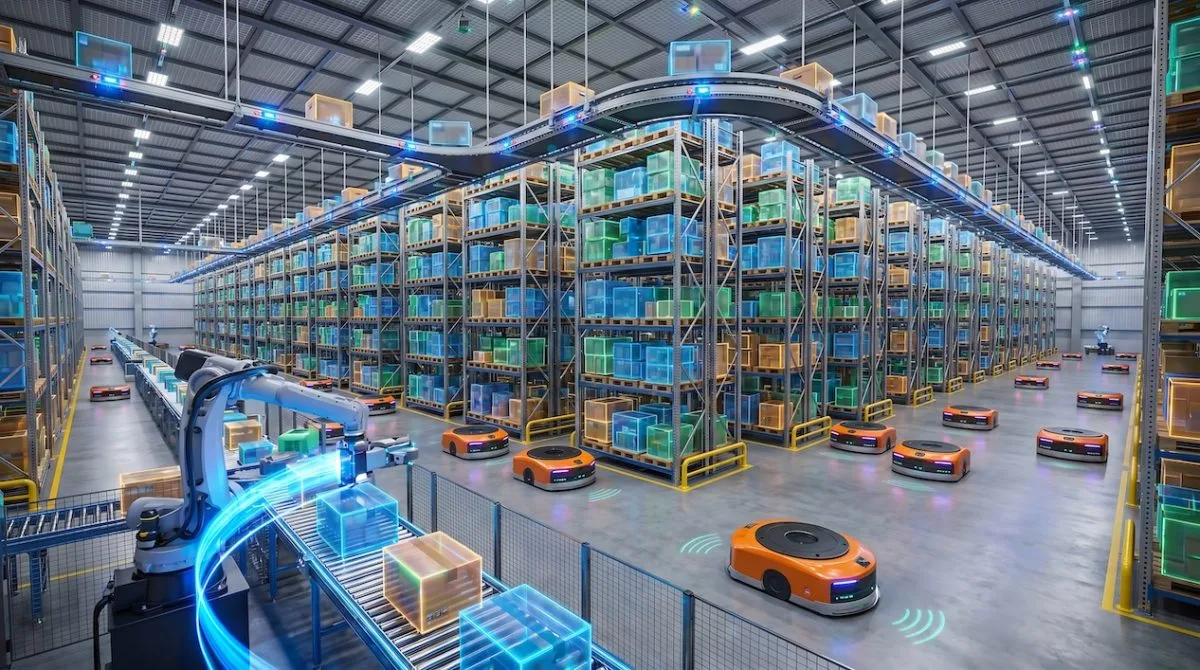
RISING LABOUR costs, volatile demand, tighter delivery windows, and expanding product assortments are forcing operations leaders to rethink how fulfilment centres are run. Automation has already become a strategic necessity, but many warehouses still depend on manual decisions, fixed rules, and periodic adjustments. Supervisors often rely on experience to manage slotting, labour deployment, replenishment, and outbound flow. These methods can work, but they struggle to keep pace with the speed and complexity of modern logistics.
This is where AI is beginning to reshape warehouse operations. The shift is not simply about adding another analytics layer. It is about moving from execution-focused warehousing to intelligent orchestration — where systems continuously sense, decide, and act within the flow of operations.
Process automation in warehousing has evolved in distinct stages. The earliest wave focused on rule-based automation, using predefined logic to handle repetitive activities such as replenishment triggers, fixed picking sequences, or basic packaging rules. The next stage introduced predictive optimisation, where machine learning models improved forecasting and decision-making using historical and real-time data, such as for slotting and rearrangement of products based on predictive ABC analysis. Today, the industry is entering a new phase: agentic AI. In this model, AI-driven systems do not just recommend actions — they monitor conditions, reason across multiple signals, and execute decisions autonomously within defined guardrails.
That evolution matters because many warehouse problems are dynamic. Picking priorities change by the minute. Congestion shifts across aisles and zones. Labour availability fluctuates throughout the day. Static rules can only go so far in these environments. AI offers the potential to make warehouse execution more adaptive, responsive, and efficient.
Yet strong interest in AI does not always translate into measurable business value. Many initiatives stall at pilot stage or fail to scale beyond isolated proofs of concept. One common reason is that optimisation models are often developed without enough connection to operational reality. Algorithms may propose ideal actions, but overlook physical constraints such as storage capacity, equipment availability, workforce skills, or service-level commitments. Another issue is the absence of clear success measures. Without agreed KPIs — such as throughput, cost per order, travel reduction, or dock-to-stock time — it becomes difficult to prove impact. AI creates value only when it improves how work is actually performed — by increasing throughput, reducing labour effort, improving space utilisation, or lowering logistics costs.
This is why many organisations are rethinking how AI value should be defined. Traditional software measures such as licenses, user counts, or consumption metrics say little about operational performance. In a warehouse, the real test is outcome-based: fewer touches, shorter travel paths, better use of storage, lower shipping costs, and more reliable service. The most effective AI programs are built around these business outcomes from the start, rather than around technology for its own sake.
A practical way to adopt AI in warehousing begins with identifying the most manual, repetitive, and decision-heavy workflows. These typically include slotting, optimal packing with cartonisation, pick path planning, labour balancing, inbound validation, exception handling, and replenishment prioritisation. The next step is to understand where inefficiencies occur: where bottlenecks form, where people spend time on low-value decisions, and where fixed rules produce inconsistent results. From there, AI solutions can be embedded directly into warehouse processes, supported by governance mechanisms that allow human oversight for critical decisions and exceptions. The key is to define ROI early and measure it rigorously.
Several warehouse AI use cases are already demonstrating clear value across the industry. For organisations running SAP, SAP Extended Warehouse Management (EWM) serves as the execution backbone across which many of these capabilities are being delivered — both through native product features and through extensions built on SAP Business Technology Platform (BTP).
Inventory slotting optimisation is one of the most established. AI-driven slotting continuously analyses order patterns, velocity shifts, and storage constraints to recommend more effective product placement, reducing travel time, improving pick density, and increasing throughput — replacing periodic manual reviews that often leave fast-moving items in suboptimal locations.
Image-assisted inbound validation addresses one of the most error-prone steps in the receiving process. Cameras or mobile devices capture images of labels and delivery notes of arriving stock, with vision models identifying quantities, SKU labels, and visible damage to support or validate the goods receipt posting. This reduces manual counting effort, lowers incorrect confirmations, and accelerates inbound posting during high-volume periods. SAP EWM’s roadmap includes camera scan-assisted goods receipt as a planned capability, and the pattern is already being implemented across the ecosystem using vision services on BTP.
Beyond individual process steps, AI is increasingly being used to maintain a continuous view of warehouse health — what some practitioners are beginning to call a real-time pulse check. This surfaces bottlenecks, exception risks, inventory imbalances, and process deviations before they escalate into operational problems, replacing the periodic supervisor walkthrough with a persistent, data-driven view of live conditions. This same intelligence feeds directly into how staff interact with the system. Using natural language, operators can query delivery statuses, locate tasks, identify bottlenecks, and trigger actions without navigating multiple transactions or requiring deep system knowledge. In SAP EWM, this is now live through Joule, SAP’s agentic AI platform embedded directly into warehouse workflows — capable of both answering operational queries and, increasingly, acting on them.
Adaptive task orchestration addresses the limits of static wave management when conditions change mid-shift — a dock delay, an unavailable resource, a late rush order. Intelligent orchestration continuously monitors live operational state and re-sequences work to keep the highest-priority task in each operator’s queue. In SAP environments, EWM provides the execution foundation while BTP-based orchestration and process automation services provide the layer through which dynamic adjustments are coordinated and surfaced for supervisor confirmation.
Traditionally, this kind of optimisation in warehouses has been performed in batches. Slotting updates may happen weekly or monthly. Packaging logic is configured in advance and reviewed only occasionally. Pick strategies are tuned manually when problems become visible. Agentic AI changes this operating model. Instead of periodic review, optimisation becomes continuous.
A warehouse may, for example, use an inventory agent that monitors demand changes, stock positions, and operational conditions to adjust slotting decisions dynamically. A packaging agent may evaluate each order in real time, selecting the most suitable carton based on dimensions, cost, and downstream logistics constraints. A fulfilment agent may continuously rebalance picking priorities and route logic based on congestion, labour availability, and service urgency. The real power emerges when these capabilities interact rather than operate as isolated tools. In that model, the warehouse becomes a coordinated system of decision-making services that constantly adapt to changing conditions.
These developments point to a broader transformation. Warehouses are moving toward becoming intelligent, semi-autonomous systems in which decision-making is increasingly embedded within daily execution. Human roles do not disappear, but they do change. Instead of manually steering every operational choice, people focus more on governance, exception handling, escalation management, and performance oversight. The warehouse workforce becomes less occupied with routine decision-making and more engaged in supervising outcomes and resolving complexity.
SEE WESTERNACHER IN PERSON
Matthias Platzer, Transportation Practice Director UK&I, Westernacher Consulting is joining the Session 1 discussion panel.
Presentations focus on the rise of robotics and AI; how the real battleground in WMS transformation has shifted from picking a system to actually deploying it well; and how a real operation flexes between night-time sortation and daytime roll-cage work while holding the line on OTIF performance.
Why attend: This is the only place in the North West this autumn where sector economics, WMS deployment reality and shop-floor resilience are debated side by side, with direct access to the people making key calls. A live panel Q&A lets delegates put their own transformation dilemmas directly to speakers.
Tomorrow’s Warehouse Manchester takes place at the Emirates Old Trafford Cricket Ground. Entry is free, with food and parking included, and CPD points on offer.
Register free at https://registration.tomorrowswarehouse.live/register