

‘New Collar’ worker shortage threatens to stall next industrial revolution
A lack of technical skills in the workforce including those in logistics around automation and artificial intelligence – credited with delivering the fastest GDP growth in the UK for two and a half years only this week – could threaten to stall the technological revolution and hamper economic growth going forwards.
By Liza Helps, Property Editor, Logistics Matters
THE NEW report by industrial and logistics investor developer SEGRO has found that up to half of vacancies in critical technical roles are unfilled, while only 10% of Europe’s current blue-collar workforce has the next-generation industrial skills meaning that the next industrial revolution, driven by Artificial Intelligence and data, could be held back by a shortage of skilled workers and growing competition for locations with the right infrastructure and technology.
In another research report by US investor and developer Prologis out this week, it was noted that nearly two-thirds of UK supply chain leaders say AI is delivering competitive advantage. This plus the news that the recent 0.7% GDP growth in the UK was mainly due to AI growth, highlights the seriousness of any potential technical skills shortage.
The SERGO research analysed more than 400,000 job advertisements across approximately 13,000 companies in eight European countries. It found that between just under a quarter and almost a half of vacancies in critical emerging roles remain unfilled, with some of the greatest pressure in the practical and technical jobs needed to deploy, operate and maintain new technologies.
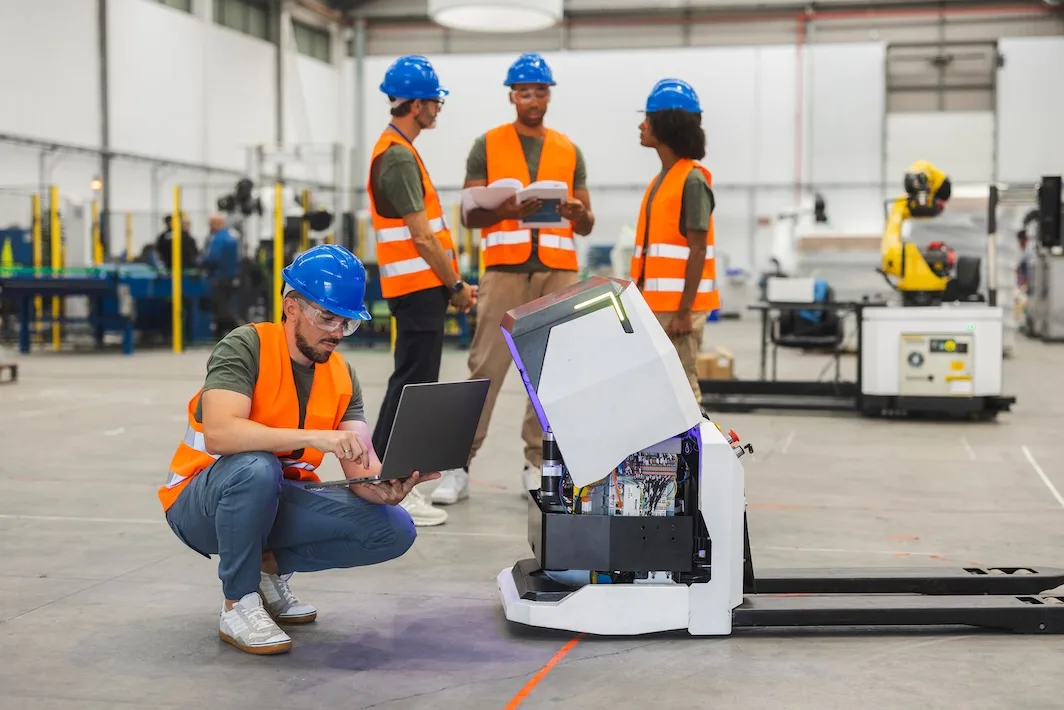
The report describes these roles as the “new collar” workforce, which are defined as people in frontline, operational and technician-level jobs that combine practical experience with automation, digital, engineering or data skills. They include roles ranging from mechatronics and automation technicians to data centre electrical technicians and digitally enabled logistics workers.
The findings suggest that the next phase of industrial growth will depend on businesses having access to the right people and infrastructure, as well as the technology itself. This matters particularly for industries such as advanced manufacturing, logistics, life sciences and data centres, where many of the most sought-after roles have to be performed close to the machinery, systems and physical environments they support.
Across six sector comparisons, around 40% of vacancies for site-dependent roles were unfilled, compared with around 13% for more location-flexible roles, making the practical roles tied to factories, warehouses, laboratories and other physical assets around three times harder to fill on average.
The sectors examined in the report correlate with the five global innovation clusters identified in UK Prime Minister Andy Burnham’s reindustrialisation plan for the country, which could be undermined by the shortage of skills and physical infrastructure highlighted in this report.
The finding adds skills to the factors businesses need to consider when deciding where to invest. Access to land, power, connectivity and transport infrastructure remains critical, but businesses also need sufficiently deep pools of skilled labour within reach of their sites. As competition for that workforce increases, the accessibility and attractiveness of workplaces will become increasingly important too.
SEGRO Operations, Digital and Customer Managing Director Paul Dunne, said: “The next industrial revolution will create enormous opportunities, but technology on its own won’t deliver them. Businesses need people with the skills to install, operate and maintain increasingly sophisticated systems, and they need the buildings and infrastructure where that work can happen.
“For businesses making long-term investment decisions, access to skills is becoming an important part of the location equation alongside land, power and connectivity. The places best equipped for future growth will be those that can bring the workforce, infrastructure and innovation together.”
The research suggests that much of the potential new collar workforce already exists. Electricians, mechanics, maintenance technicians, warehouse operatives and other workers in adjacent occupations often have practical experience that can provide a foundation for more specialised technical roles. Yet less than 10% of Europe’s current blue-collar workforce has the next-generation industrial skills identified by the research.
The jobs are there and so are the people. The missing ingredient is skills. Rather than relying on recruitment alone, the report calls for clearer routes to help existing workers build on the skills they already have and move into emerging occupations.
Competition for these skills also extends across sectors, with industries increasingly reliant on the same pool of technical capabilities and workers. The report warns that employers cannot solve the problem simply by competing harder for the same limited pool of people.
The report from Prologis and The Harris Poll which surveyed 262 UK supply chain decision-makers as part of a global study of more than 1,800 business leaders, noted that nearly two-thirds (65%) of UK respondents said AI and automation were helping their organisations gain an edge or pull ahead of competitors. By comparison, 13% said competitors’ adoption of AI was diminishing their market position. The most commonly cited uses of AI were improving operational efficiency (61%), supporting workforce decision-making (53%) and improving customer experience (49%).