
Online retail pioneer outlines logistics secrets to its success
The French eCommerce pioneer vente-privee.com has chalked up staggering growth over the last decade. With earnings of less than one million euros in 2002, the company turned over €1.3 billion euros in Europe last year.
Just how has the supply chain managed to keep up? I spoke to Jean-Michel Guarneri, the European Supply Chain Director at vente-privee.com to find out the secrets to this success.
He revealed that a flexible, ever-evolving automated handling, picking and storage system was crucial to supporting the company during this period of expansion.
“My philosophy has always been to design an intralogistics system that is able to evolve while production is live,” explains Jean-Michel, who held a key role with automated systems supplier Savoye, working with vente-privee.com from the other side of the table for many years.
He continues: “The key is flexibility. When we work with suppliers we ask them to provide detailed analysis for a number of scenarios and then we sit down and discuss them. We are dealing with an unpredictable market and the customer / supplier partnership must be prepared for a number of contingencies, to be able to cope with a wide variety of throughputs and know what steps to take to quickly meet needs.”
This need for flexibility is deeply ingrained in the supply chain philosophy of vente-privee.com and it is little wonder. Let’s consider the unusual business model of the company. It specialises in online flash sales. That is, it secures an agreement with a supplier, say a premium fashion brand, and offers a limited number of its products for a few days at a huge discount to its members. It repeats this type of flash sale thousands of times across the year, involving thousands of brands and many product types from food and drink, to electronics, to clothes and much more.
How does Jean-Michel deal with such a varied product range?
“Obviously, you don’t manage food logistics the same way you manage fashion logistics. We design systems that are adapted for each type of product.
“Furthermore, because of the nature of our business I don’t know if my shoes activity will grow faster than my textile activity. I need to have a system that understands this and will adapt in real time to changes no manger can predict.”
For Jean-Michel, the starting point is the WMS. He sees this as the brain that allows the customer to understand product flows and plan investment in other equipment.
He says: “Some people implement many conveyors and sorters, but the first thing, for us, is a WMS with an RF system. With that we understand what we have to work with and we can evaluate the equipment needed to handle different product types and levels of activity.”
Although automation is important for vente-privee.com, it is not a default. The company starts manually with a given product type and switches to automated systems for volume activity.
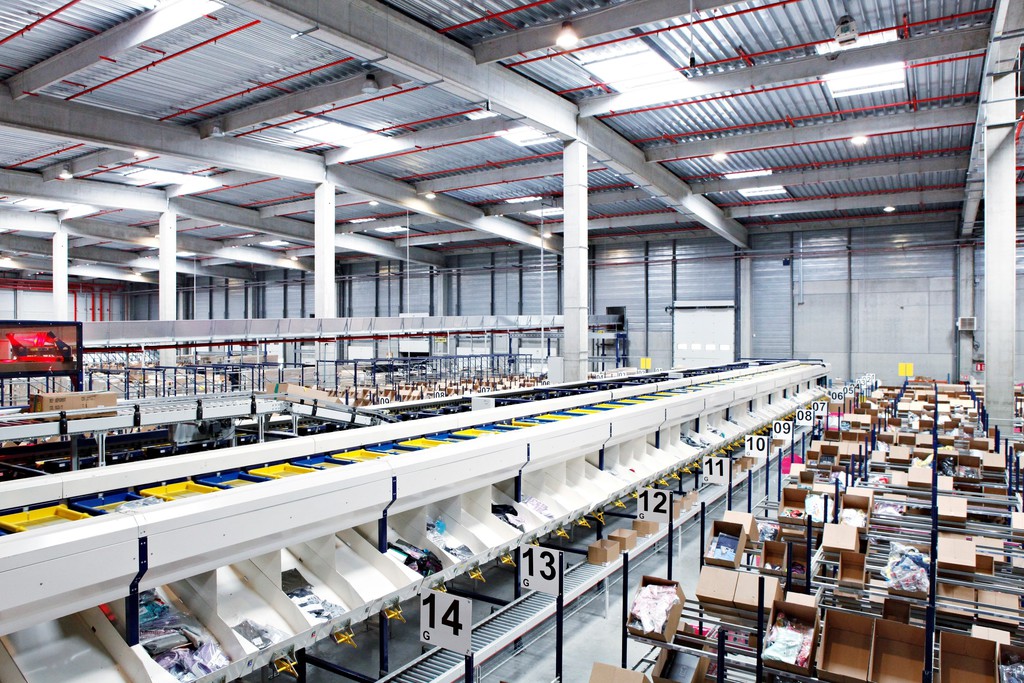
A system that is soon to go live for the retailer will use a mix of conveyors and picking stations, and deploy high speed sorters, as well as hanging sorters for fashion.
Jean-Michel has been particularly excited about his company’s use of goods-to-man picking, which has offered the capacity to take an order and within five minutes have a product ready to ship.
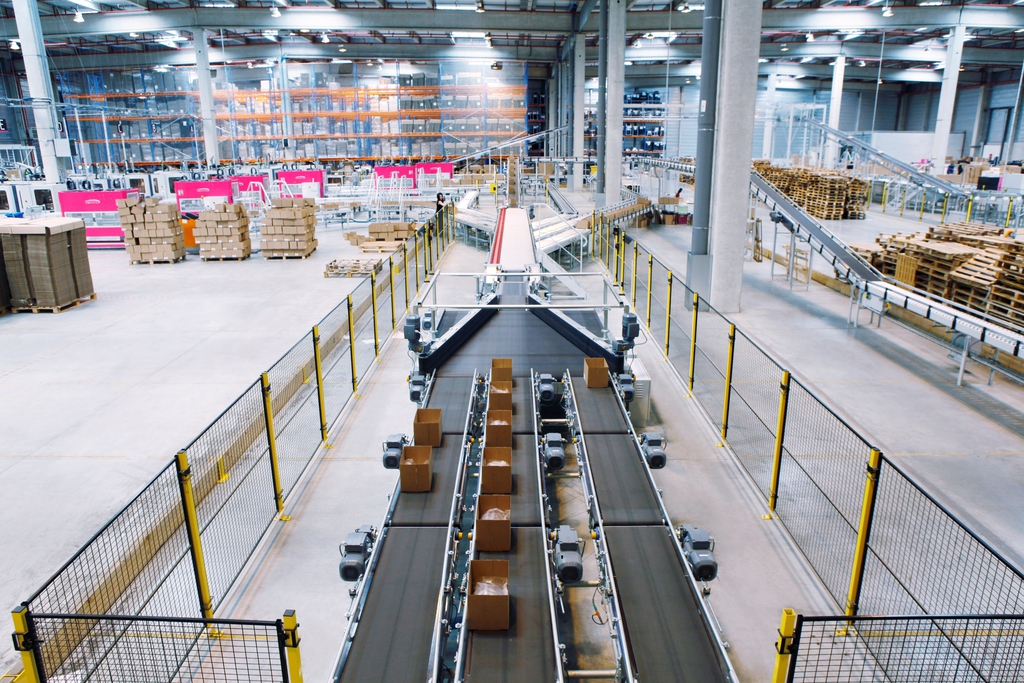
So, at what level of volume is it worth switching from manual to automated handling? Jean-Michel answers: “When a company is delivering over 1,000 orders per day that contain multi-SKUs and split boxes, I think that it is a good time to look into automated handling.
“Consider both number of SKUs and number of people handling orders. If you have 1,000 orders being handled by 20 people, there is no need for automation but if you have 50 people handling 1,000 orders then automation has a place.”
To take two examples, if a company has 5-10,000 SKUs and often prepares split boxes with between 10-20 different SKUs in each box, automation should be looked into. If a company has 20 different wine brands that it is dealing with everyday with up to 1,000 boxes prepared, but of the same SKU, then automation is not necessary.
“This may seem like a ‘no-brainer in terms of logic,” says Jean-Michel, “but always remember that in logistics, logic comes before technique.”
While volume is an important consideration when deciding whether to automate handling and picking, it is by no means the only factor.
Jean-Michel says quality and once again flexibility must be taken into account, as well as the return on investment.
“If manually we are not able to create the required level of quality for delivery, we will automate. This is especially important for our kind of business. Customers will not come back if you don’t get it right.
“Automation also helps with flexibility. Some days we are preparing 50,000 orders, at peak it can be 150,000 orders, and for me automated equipment helps to manage this variation in activity better.”
vente-privee.com wants to achieve return on investment on automated equipment within 2-3 years.
Jean-Michel acknowledges that it can be difficult to gauge ROI at the outset when buying equipment simply because market volumes for certain products types are so hard to predict.
{EMBED(338682)}
“ROI is not an easy game,” he says. “But, going back to our central philosophy, we design systems so that we are able to upgrade without stopping operations. A system that has to to stop to grow is simply not viable. This road is the best one to fast ROI.”
Savoye was an important supplier for vente-privee.com in achieving this. Jean-Michel worked at Savoye on the vente-privee.com account from 2001.
“We worked on research and development together to create a supply chain to support this new concept of the online flash sale. The advantage for vente-privee.com of me working for them is that I provide insurance that we are getting the right system for our intralogistics. We invest millions of euros in automation and want to be sure we make the right decisions.”
{EMBED(332871)}
The R&D that began when Jean-Michel was in his previous position more than a decade ago continues today. One example is exploring on the use of robotics for picking.
“It’s coming. I have seen fantastic robots in action. We have discussed this with suppliers and I plan to start a R&D programme with them looking into this.”
The robots use imaging technology to recognise a product type, select a tool to lift the product and pick it. The problem in eCommerce is that products have such widely varying characteristics in terms of size, weight etc, there is a complex challenge for the technology to overcome.
“The problem at the moment is that the technology works best with products that are in boxes of predictable and uniform size and weight.
“It is important for us to create a system that doesn’t place too many criteria on suppliers. This is the opposite of the flexibility which is key to our business model.”
This flexibility is a quality vente-privee.com is keen to maintain and it is this, along with the bold ambition and investment of CEO Jacques-Antoine Granjon, and fellow company founders that sets the company up for the future.