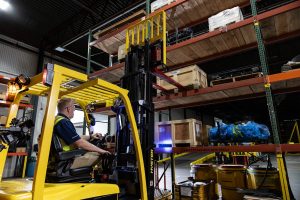

Top 20 tips for buying a reach truck
Reach trucks are a key ingredient for warehouses in all industry sectors. Robert O’Donoghue, senior product strategy manager, NMHG, provides 20 useful tips on what to look for when buying or hiring a reach truck in today’s marketplace, explaining why some features play such an important role.
Robert O’Donoghue has worked for NMHG for 11 years and is responsible for the product development strategy and introduction of new products across the Hyster warehouse range. Here are his expert tips for buying a reach truck.
Check residual capacities today
Residual capacities change with new truck designs, so it is important to check the very latest statistics from the manufacturer. Purchasers are aware that the rated capacity decreases at height but, for example, with the new Hyster 1.6 model, the full 1.6 tonnes lift is possible to 9m. In comparison, other manufacturers may require a higher capacity model to achieve the same weight/height, which could lead to a larger battery and charger, and wider aisles.
Aisle widths
Aisle widths help define the truck choice, but if more space is needed, could a smaller truck be used to decrease the aisle widths and increase the number of aisles per warehouse.
Mast height / range
Most reach trucks have a 3-stage mast and while lift height is important, the lowered height of the mast is also critical. Make sure it is not too tall for internal doorways and tunnels in the racking. The external door may also be a factor. Check the ratio of closed height (h1) to top lift height (h3). The new Hyster Reach Truck lifts to 12.5m. Check to see if the mast is noisy through the stages.
Travel speed
A good travel speed is important, but many operations have speed limits, which makes the top speed irrelevant. The new Hyster Reach Truck offers a top speed of 14km/h and excellent acceleration.
Lift speed
Look for lift speeds in the region of 0.8m/s. Over the course of a day, seconds add up to valuable minutes.
Operating environment
If required in the cold store, check that the manufacturer has an integrated cold store solution.
Usage
If the truck is going to be used in intensive 24 hour operations, check that the truck is tough enough to do the job. Reliability is critical, so make sure that the battery and battery management meet the requirements.
Visibility of fork tips
Although reach trucks can lift to set heights, floor conditions can affect the actual fork height. Visibility of the fork tips is essential. Compare the total channel width of different brands, but make sure you are comparing like for like according to residual capacity. Cameras and lasers can make operating easier for the driver, at height.
Access for the operator
Statistics show that an operator will get on and off a reach truck at least 5 times an hour. Over the course of a shift this soon adds up. Look for a reach truck with a wide and low step with easy to grip handles. You will be surprised how this varies between brands and what a difference it makes to a driver.
Driver comfort
Drivers are expected to sit in a reach truck for most of their shift so make sure it is comfortable to minimise fatigue, which can affect their overall performance.
Construction
Make sure that the truck is tough and robust. The build quality of the chassis and mast is crucial to make sure that it can withstand daily stresses and provides rigidity at height.
Steering column
Steering wheels vary in size and position across brands, but our research shows that drivers do not like steering wheels that are too small or have an offset angle. They need to be very tough, as many drivers use them to get on and off the truck. Adjustability must be easy or the driver won’t use it. Get your own driver feedback.
Display
The visual display provides important information to the driver and comes in many different formats. Test them to see if they are intuitive and easy to read. Hyster is now the first manufacturer to offer a touch screen display option enabling access to many new features.
Controls
Mini levers or Joystick? Driver preference or site history may decide which way to go, however always try the options and test how easy it is to activate tilt and sideshift, for example.
Pantograph or moving mast
This is a practical decision to determine whether a Pantograph Reach Truck (scissor design reach mechanism to extend the forks) or a moving mast is appropriate, particularly if double deep racking is used. Check the performance of each for your specific operation.
Double deep racking
When used in double deep racking, a narrow body chassis will often be needed, so it is important to select a manufacturer who offers this as a standard option rather than a “special”.
Common components
It is a good idea to select a manufacturer that can prove the quality and reliability of the components. Common controls across warehouse products help the drivers to switch trucks easily.
Service access
Check to see how easy it is to access major components as this will help to minimise service costs.
Cost of ownership
Check that the reach truck is energy efficient, has long service intervals, proven reliable components and helps deliver productivity.
Support
Let’s not forget that quality local support plays a crucial role in ensuring that the truck performs at its best throughout the contract period.