

Adapting to safety trends
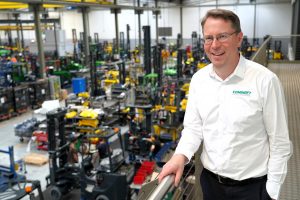
HSS Editor Simon Duddy caught up with Combilift managing director Martin McVicar at the recent Safer Logistics event at the NEC to hear how increasing safety awareness is changing material handling habits and how Combilift is developing its walk-behind products.
The initial appeal of multi-directional forklifts was handling awkward loads efficiently while saving space. But over the years, health & safety has increased as a priority for companies and has joined space-saving as a major purchasing factor.
Combilift managing director Martin McVicar explains: “Awareness has grown that it is much safer to handle long loads as low to the ground as possible, rather than using forklifts to ‘aeroplane’ loads. In the UK in particular, there has been a drive towards handling long product more safely, keeping it low to the ground (within 12 inches) in the last few years. This is starting to become the norm in peoples’ minds.”
Another major trend has been the move away from sit-down forklifts to walk-behind models where possible.
“A great example in the UK is Cummins, who are a big customer of ours,” adds Martin. “They have taken at least 12 of our walk-behind products in the UK over the last 18 months and that is very much driven by health & safety.”
Bunnings boost
This trend is also very much in evidence with DIY chains, where customers are in the same vicinity as MHE.
Combilift’s entry into the walk-behind market came through responding to customer needs.
“Bunnings is a DIY chain in Australia (its parent firm also owns Homebase) and they are a long standing customer of ours,” explains Martin. “Six years ago they came to us, asking us to look at developing pedestrian products. So the first Combi Walkie product – the Combi WR – came about this way, with us airfreighting the prototype to Australia. They now operate more than 100 pedestrian products from us.”
Indeed Homebase in the UK has ordered 60 walk-behind products from Combilift and the company recently inked a major deal with the Kingfisher Group in France to deliver Combi-WR walk-behind machines, as well as Aisle-Master VNA articulated forklifts.
{EMBED(839094)}
Martin acknowledges there is a trade-off with productivity in some respects for those companies that have a high safety focus and finds they are generally willing to make the sacrifice. The extent of the trade-off can be over-stated though, he adds.
“In some warehouses, you see forklifts running around like taxis with no load and you wonder where they are going. On a pedestrian truck, the operator is more efficient in the sense that there is less travel for the sake of it, operators tend to taken the shortest route possible.
“Furthermore, the speed of a forklift is only one measure of efficiency. In terms of picking products, a Combilift pedestrian truck is as efficient at taking product out of the rack.”
For larger plants where travel speed is important Combilift has a fall down platform for models so the operator can stand on it for long distance driving.
Take a sideways look
To protect the operator from getting backed up against racks or walls, Combilift invented/developed and patented a multi-position tiller arm that revolves through 180 degrees. This allows the operator to stand to the side of the machine and control it. The feature also boosts visibility as the worker does not have to look through the mast and the greater maneuverability it affords allows the vehicle to be used in tighter aisles.
“We have developed the features and capacity of our pedestrian trucks considerably over the several years we have taken them to market, but within the next few years you will see a more extensive range of pedestrian products coming from Combilift,” says Martin.