


Almost 75% of UK economy warehouse-dependent
The UKWA’s 2026 National Conference reinforced the essential role of warehousing in the UK economy, with speakers warning of major challenges ahead but expressing confidence in the sector’s long-term resilience.
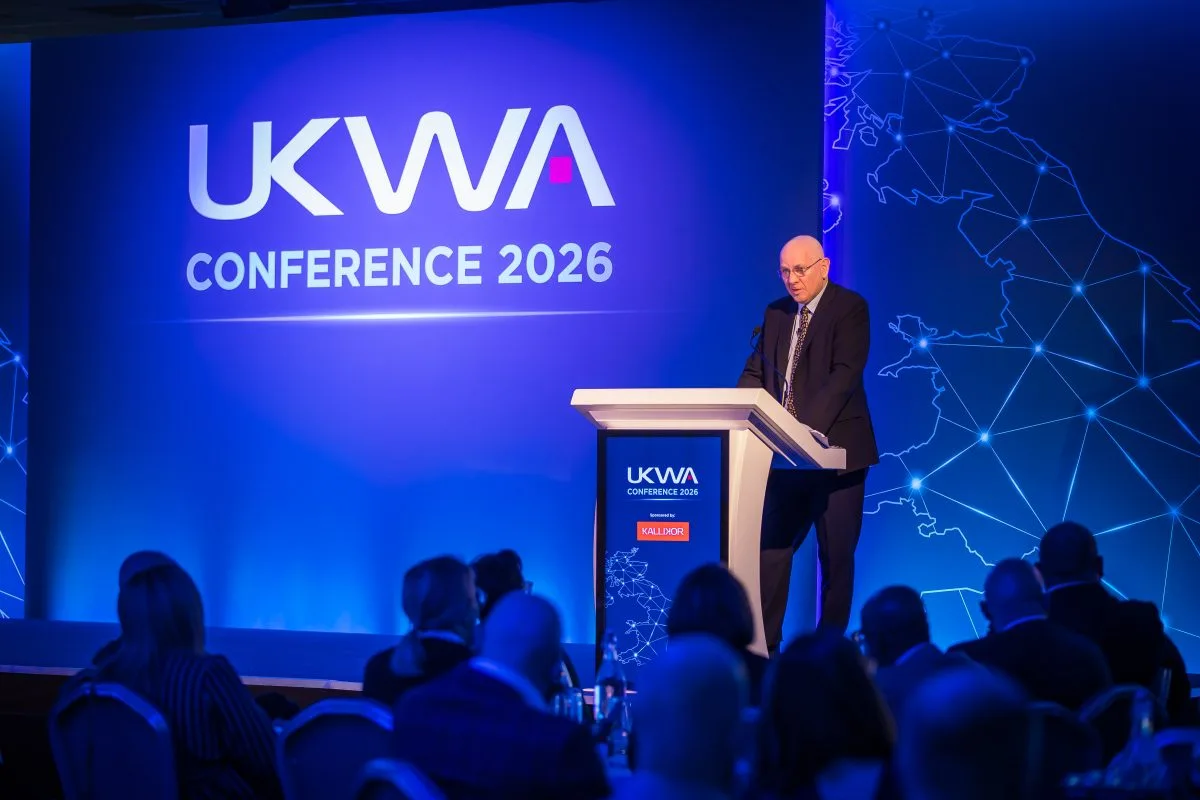
ALMOST 75% of UK economic activity is warehouse-dependent, according to Dr Walter Boettcher, Head of Research and Economics at Colliers UK, and keynote speaker at the UKWA’s 2026 National Conference on 4 March 2026.
Despite some difficult truths – including the fact that Government lacks a national strategy for logistics – Boettcher reassured the operator audience that “in the long term you have nothing to worry about,” pointing to the resilience of global trade and the ongoing need for well-located, well-run warehouses.
The event reinforced a central message: warehousing is not just the backbone of British logistics – it is national infrastructure powering growth, jobs and communities. Boettcher’s insight on regional development and infrastructure linked investment in transport and new industrial clusters to higher productivity, better wages and major regeneration projects such as those in Teesside.
Property, power & policy
Analysis presented by Savills showed that 33 million sq ft of warehouse space was transacted in 2025, demonstrating strong occupier demand. However, 64 million sq ft remains empty because it’s in the wrong place, doesn’t fit requirements, or lacks sufficient power.
Kevin Mofid, Head of EMEA Logistics Research at Savills, explained that the occupier mix has shifted significantly. Fifteen years ago, the market was dominated by grocers; by the end of the last decade, it was dominated by online retailers. Today, 3PLs account for around 25% of the market.
Danny Kennedy, Senior Property Strategy & Development Manager at Ocado, joined Mofid on stage, and took the opportunity to highlight the growing challenge around power and property. “We’ve done a huge amount inside the shed on automation and efficiency, but the reality is that most of our carbon footprint now sits in the last mile,” he said. “At our biggest facilities, we’re looking at roughly a 50/50 split between power for the building and power for vehicle charging. Standard warehouse power just doesn’t cut it anymore.”
Digital twins aid contract decisions
Kallikor CEO Jonathan Barrett and former Morrisons executive Ross Eggleton joined UKWA CEO Clare Bottle to discuss how digital twins and simulation environments are helping boards “rehearse” capital projects and contract options before committing, and model the impact of volume shifts, product range expansion and automation.
The automation panel – which included speakers from Unipart and SSI Schafer – warned the audience against underestimating lifecycle costs, power requirements and implementation disruption.
“Whatever timeline the vendor gives you, add 18 months. Their number is a starting point, not a promise,” said Obinna Njoku, Head of Automation at Hellermann Tyton. He added that while warehouse automation in the UK remains an evolution, in countries such as Poland and Romania it is a revolution.
Knights of Old cyber attack
“The threat is real.” Paul Abbott, former Group Director of Knights of Old, shared his experience of a ransomware attack that forced the business to close despite having procedures and insurance in place.
Panellists stressed that cyber risk is now a board-level issue, not just an IT concern, and that financial, insurance and operational factors must be integrated into a resilient strategy.
Julian Meyrick, Partner & UK MD at Eraneous, warned: “The conflict with Iran will significantly increase cyber risk for UK organisations, especially those with operations or entities in the Middle East.”
Julia Myram, Head of Cybersecurity & Risk at GXO, added that it is “a case of when, not if.” Gallagher’s Georgia Price Hunt encouraged operators to speak to the National Cyber Security Centre if they needed support.
People & purpose
Lynn Brown, HR Director at XPO Logistics, highlighted how lengthy job descriptions for entry-level roles often deter applicants, including career changers and ex-military candidates. She stressed the importance of accessible recruitment and suggested offering different ways to apply – from QR codes to paper forms.
Amazon Operations Manager Lawrence Watson discussed the company’s partnership with the Creating Tomorrow Project, demonstrating how inclusive recruitment can be a powerful workforce strategy.
Speakers across the day called for a fundamental rethink of business rates, arguing that logistics must be recognised as essential infrastructure rather than an easy tax target. UKWA also outlined its growing policy voice, from campaigning on business rates to engaging on planning, power availability and fairer treatment of logistics in local plans, supported by a new Ambassador referral programme.
The conference made clear that while the sector faces challenges – from power constraints and cyber threats to planning and policy gaps – warehousing and its people remain indispensable to the UK economy.