
Combilift notes upsurge in factories seeking to maximise space
Increased social distancing requirements are leading to more inquiries for space-saving forklifts and storage systems, according to manufacturer Combilift, as companies try to increase safe space for production employees.
In the wake of the Covid-19 pandemic, specialist forklift manufacturer Combilift says it has seen many manufacturing customers struggling to get back to regular operations.
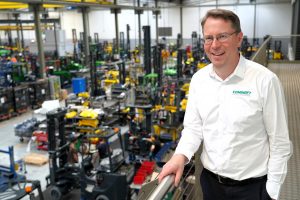
Martin McVicar, CEO and co-founder of Combilift said: “Factories need more space in production to allow employees to work safely and comply with social distancing requirements. This means many companies are trying to squeeze the amount of space devoted to storage in the production setting.
“We are in the business of saving our customers space. We see that as our purpose more than as a forklift manufacturer.”
To develop such leads, Combilift has successfully deployed digital communication tools.
Martin explained: “Normally we visit a client’s premises and carry out a survey of the area they want to make more space-efficient. This gives us the data to prepare details on what the solution will be, including 3D animations.

“Obviously in the current climate, many clients do not want visitors to their sites.
“To get around this issue, we have been carrying out FaceTime and WhatsApp conversations with clients while they walk around their storage premises. This gives us a virtual tour, allows us to take snapshots and make an assessment of the premises and outline how much space can be gained while storing the same amount of material.
“We’ll combine this with measurements from the client and we can proceed with the quote, creating animations for the client.
“We have found companies have been happy to engage with us in this way, and happy with the process.”
Keeping production flowing
Combilift has implemented a number of measures at its innovative manufacturing centre in Ireland to ensure continued production.
Martin explained: “Traditionally, we have had a single shift operation, but we have introduced 2 shifts in response to the crisis. This means we have no more than 300 employees on site at any one time.
“The factory is spread out over 46,500 sq m (500,000 sq. ft) so creating social distance while staff are working is fairly easy. Canteen areas were the biggest challenge, as that is where employees congregated. We have closed the hot canteen, and created eight smaller canteens.”
Combilift opened the huge factory in 2018 and has now introduced thermal cameras that scan employees as they arrive on-site.

“The key benefit of the system is that it is non-intrusive,” said Martin. “It is connected to an alarm system, and employees and the HR team are notified if an employee’s temperature is above normal.”
The manufacturer has also switched from fingerprint clocking-in to a touchless fob system, which is same process used for opening doors to certain parts of the plant. The company also keeps doors open where it can.
In addition, surfaces have been given copper coverings, as viruses perish much faster on copper surfaces than, for example, steel.
{EMBED(1162683)}
Wearing face masks is also mandatory for employees as they work and move around the plant.
Martin said: “By integrating these measures, we’ve instilled confidence and made sure employees know we have a system in place that has their best interests at heart.”
Business continuity
Another challenge for Combilift has been when component suppliers have faced difficulties. This is particularly applicable to Northern Italy – hard hit by the virus and home to 26 component suppliers to Combilift.
“This was a worry,” said Martin. “But a lot of our suppliers kept working, even if it was at a lower capacity. We do carry a buffer of raw materials and this has helped us out a lot.”
Brexit flexibility
The UK Government recently confirmed, despite early indications to the contrary, that there will be customs checks between mainland UK and Northern Ireland as part of the UK’s Brexit process.