

From conveyor belts to AMRs: where BLDC motors deliver the biggest efficiency gains
Modern warehouses have evolved far beyond rows of conveyor belts and manual forklifts. Today’s logistics facilities rely on intelligent automation, autonomous mobile robots (AMRs), high-speed sortation systems, and precision material handling equipment to keep products moving around the clock. Behind much of this progress is a technology that rarely gets the spotlight: the brushless DC (BLDC) motor.
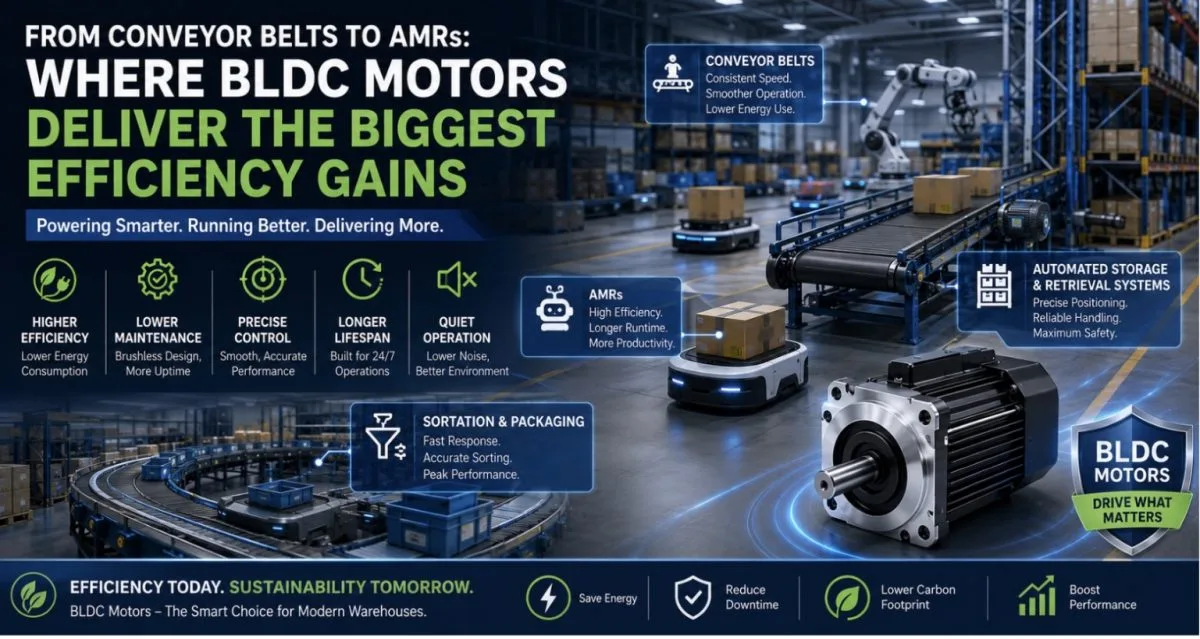
WHILE MOTORS have always been fundamental to industrial operations, BLDC motors have become increasingly important as warehouses pursue greater efficiency, lower maintenance costs, and higher reliability. Their advantages extend well beyond robotics, influencing nearly every stage of automated material handling.
Why BLDC Motors Are Different
Unlike conventional brushed motors, BLDC motors eliminate physical brushes and commutators. Instead, they use electronic controllers to manage motor operation. This seemingly simple design change significantly reduces friction and wear while improving efficiency and precision.
For logistics operators, these characteristics translate into equipment that can operate continuously with fewer maintenance interruptions—an essential advantage for facilities running multiple shifts or 24-hour operations.
Conveyor Systems: Improving Continuous Operation
Conveyor belts remain the backbone of many distribution centers, transporting thousands of packages every hour. Although conveyors appear simple, they demand consistent speed control and dependable operation.
BLDC motors are increasingly being adopted in conveyor applications because they offer:
- Higher energy efficiency
- Smooth acceleration and deceleration
- Lower operating temperatures
- Reduced maintenance requirements
- Better speed accuracy
For example, large e-commerce fulfillment centers often operate conveyor networks spanning several kilometers. Even small improvements in motor efficiency can lead to meaningful reductions in electricity consumption over an entire year.
As companies continue investing in warehouse modernization, selecting efficient motor technologies has become part of broader sustainability strategies as well as operational cost reduction.
Autonomous Mobile Robots Depend on Efficient Motors
Perhaps the most visible example of BLDC motors in logistics is the rapid growth of autonomous mobile robots.
Companies such as Amazon use thousands of mobile robots inside fulfillment centers to transport inventory between storage locations and picking stations. Similar robotic systems are also deployed by organizations such as DHL and Ocado.
AMRs spend much of their operating life accelerating, stopping, turning, and navigating around people and other equipment. BLDC motors are particularly well suited for these demanding duty cycles because they provide:
- Precise motion control
- High torque at low speeds
- Quiet operation
- Excellent battery efficiency
- Long service life
Since battery capacity directly affects robot productivity, efficient motors help extend operating time between charging cycles, allowing more work to be completed each shift.
Automated Storage and Retrieval Systems
Automated Storage and Retrieval Systems (AS/RS) have become common in facilities where warehouse space is limited and inventory turnover is high.
These systems require precise vertical and horizontal movement while handling valuable inventory safely. BLDC motors offer accurate positioning and rapid response, reducing the likelihood of positioning errors and minimizing mechanical stress on lifting equipment.
As warehouses continue increasing storage density, precise motor control becomes even more valuable for maintaining both speed and safety.
Packaging and Sortation Equipment
High-speed sortation systems must identify, direct, and transport thousands of parcels every hour. Every actuator, diverter, and drive mechanism must respond instantly without sacrificing accuracy.
BLDC motors support this requirement through consistent speed regulation and fast electronic control. Their ability to maintain stable performance under varying loads helps reduce jams and keeps packages flowing smoothly through automated sorting lines.
This consistency is particularly valuable during seasonal demand peaks, when equipment operates under maximum capacity for extended periods.
Lower Maintenance Means Less Downtime
One of the strongest business cases for BLDC motors is reduced maintenance.
Traditional brushed motors eventually require brush replacement due to mechanical wear. In a modern warehouse operating hundreds or even thousands of motors, scheduled maintenance quickly becomes both costly and time-consuming.
Because BLDC motors eliminate brushes entirely, they require fewer routine service interventions. Maintenance teams can instead focus on higher-value preventive maintenance activities, while warehouse operations experience fewer unexpected stoppages.
For facilities where every minute of downtime affects customer deliveries, improved reliability can be just as valuable as energy savings.
Supporting Sustainability Goals
Many logistics companies have committed to reducing energy consumption and lowering carbon emissions across their operations.
Although warehouse sustainability often focuses on LED lighting, solar installations, or electric vehicle fleets, motor efficiency also plays an important role.
Efficient motors consume less electricity while generating less heat, reducing both operating costs and overall energy demand. When multiplied across hundreds of conveyor drives, robotic platforms, and automated handling systems, these incremental gains become significant over time.
As environmental regulations tighten and energy prices remain unpredictable, selecting efficient motion technologies becomes both an operational and strategic decision.
Looking Ahead
Warehouse automation continues to evolve rapidly, with robotics, artificial intelligence, and intelligent control systems reshaping how goods move through supply chains.
As these technologies become more advanced, the importance of reliable and efficient motion systems will only grow. Whether powering conveyor belts, autonomous mobile robots, automated storage systems, or high-speed sortation equipment, BLDC motors have become an essential component of modern logistics infrastructure.
For engineers evaluating motion solutions, understanding the capabilities of modern BLDC motors can help guide equipment selection for future automation projects, balancing efficiency, reliability, and long-term operating costs.
Rather than serving as just another component, BLDC technology is increasingly becoming a competitive advantage for warehouses seeking higher productivity with lower maintenance and energy consumption.