

Industry 4.0 for small warehouses
By now, most people have heard of the many benefits of Industry 4.0 for warehousing and distribution. It is now clear why companies should embrace this fourth industrial revolution. Until now, it seemed these products were only applicable for larger businesses. However, many of the benefits of I4.0 extend to small operations too.
Shane Faulkner, Head of Sales at Swisslog in the UK, defines I4.0 very broadly. "The term encompasses the Internet of Things, big data, artificial intelligence, machine learning, and collaborative robotics," he says.
True Plug & Play
The problem with traditional automated material handling systems has always been that they need a significant amount of project specific engineering. Conveyor systems, for example, often need specific PLC code to optimise behaviour such as priorities at a merging point to get maximum throughput. These “traffic rules” are different for each layout and also depend on the user’s exact processes.
The costs of customising, installing and commissioning a system do not have a linear relationship to the size of the system. While the overhead may be manageable on large systems, on smaller systems those costs can represent up to 40% of the total solution. This has always made automating small operations cost prohibitive.
By combining IoT principles with artificial intelligence and machine learning, this problem can be overcome. "Imagine that you will simply place conveyor elements (or any other automated equipment) on the floor," says Shane. "Each element will automatically identify itself to all others and “connect” to its neighbours. This way the system is able to map itself and understand how it looks."
Meanwhile, applying big data analytics to the current, still manual operation will provide an understanding of the warehouse user processes. This allows the establishment of a first, base-line logic for running the new automated system. Once the physical automated systems are placed and used, machine learning will quickly determine how to use the equipment better and set the right traffic rules to match the system’s layout and user processes.
"This means that no more project-specific coding of controls and software will be required," Shane continues. "The overhead costs reduce to a level where automation becomes compelling for small operations."
Smart systems adapt to warehouses built for humans
Most warehouses, especially small ones, are designed to be operated by humans. They have rows of shelving and people with trolleys walking through them to collect orders. Until recently, implementing automation would require these processes to be completely replaced. Until now, automated systems, such as robots, required a clearly defined environment that was free of unexpected interruptions. While a manual warehouse may look very organised, there are many small deviations that are easy for people to deal with, but not for robots. Imagine a larger product protruding a few centimetres into the storage location of the product next to it, or a worker leaving their trolley in the aisle for a few minutes to use the restroom.
Changing such a warehouse like that is a big step that can easily cause disruptions and risk.

Now, a new generation of collaborative robots is emerging. These robots are not only safe to work alongside humans, but also use advanced sensors and artificial intelligence to adapt to changing circumstances.
"Companies can now simply deploy one or two collaborative robots within their current operation," Shane explains. "Humans will work alongside the robots, eliminating the need for drastic changes to the warehouse or the processes. Over time, more and more robots can be added to gradually increase the level of automation."
Small companies don’t want to stay small
Many of the small companies in the field of logistics plan to grow, sometimes very quickly. Most early stage e-commerce companies have big ambitions, but exactly how fast, or in what direction they will develop is uncertain. This means any automation will need to be flexible so the company can start small, but scale fast when growing.
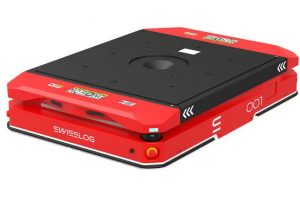
"New technology such as autonomous mobile robots are perfect for this scenario. You can start with only a few," says Shane. "Due to peer-to-peer communication and intelligent software these vehicles are easy to implement, providing payback even in small numbers."
When the time comes to expand, it is as easy as buying (or leasing) more vehicles, placing them in your warehouse and powering them up. The new vehicles will identify themselves to the existing ones and the entire fleet will adapt and optimise itself to make best use of its new robot-colleagues.
Summary
Shane concludes: "The real growth in warehouse automation will not be with traditional, large systems. While those systems will always be there and also become infinitely smarter, they will be fewer in quantity while there are thousands of small warehouses that have historically been too small to automate. With Industry 4.0, size will no longer matter.
Read more at www.swisslog.com/blog
{EMBED(1067033)}
Related posts