
Linde releases lithium-ion powered counterbalance trucks
The forklift giant has used its latest World of Material Handling exhibition to announce its latest innovations in energy efficient trucks.
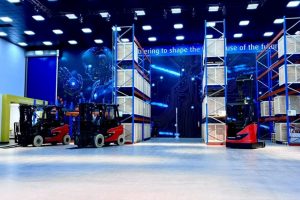
At the inaugural World of Material Handling event two years ago Linde made the bold prediction – when many commentators believed that lithium ion would be confined to smaller format forklifts – that within two years it would have lithium-ion powered counterbalance trucks in the market.
Linde has made good on that prediction.
Visitors to WoMH have been test driving the new lithium-ion powered trucks. These trucks, including its warehouse technology truck, can be charged fully within one to two hours. The truck also allows for interim charging without compromising its service life. The lithium-ion batteries run at a continuous 95% level of charged performance without slowing down on a low battery, eliminates the need for replacement or battery changes in multiple shift operations which saves time, space and money.
The lithium-ion battery does not give off any harmful gases meaning employees don’t need to handle conventional battery acids during charging. It is also maintenance-free, and can be charged anywhere on the company’s site.
Tobias Zierhut (pictured), Head of Product & Service Marketing at Linde said: "As a result of this, the trucks are particularly suitable for food manufacturing and other sensitive industries."
Pallet stackers and counterbalanced forklift trucks
Linde will also showcase a pallet stacker and counterbalanced forklift truck with load capacities of 1.4 to 1.8 tonnes. In addition to its existing 24 V battery, the company has developed a 48 V battery with nominal voltage for heavier loads. Depending on usage, the operator can choose between two battery sizes and chargers with 9 or 18 kW power outputs.
Considered system integration
Mr Zierhut added: "During the development process we really focused on the careful system integration of truck, battery system and charger, in order to ensure a high level of efficiency and safety. The battery communicates with the truck and charging system and notifies them, among other things, of its precise charge status in hours and minutes and also of potential malfunctions."
The lithium-ion batteries and chargers are specially developed for use in forklift trucks to protect them. Shock sensors on the battery cause a safety mode to activate in the event of very strong vibrations.

Linde is continuing to expand its range of electric forklift trucks with lithium-ion batteries and is also working on developing charging technology so that they can be charged inductively. One of the highlights of the latest innovation to be shown at WoMH will be a new charging plate that trucks can drive onto and begin recharging automatically.
Sustainable and efficient energy systems are now playing a larger logistics role, particularly where electric forklift trucks are concerned. Charging, maintenance and battery changes on forklifts all take time and Linde has developed trucks with alternative systems offering rapid charging and refuelling, in addition to better energy efficiency. Both the lithium-ion and hydrogen fuel cells have increased truck availability and productivity in intralogistics.
Operators are constantly looking to achieve shorter downtime periods. Changing or recharging batteries can lead to costly delays. To combat this issue these time periods can be significantly reduced with trucks powered by hydrogen and lithium-ion batteries compared to trucks with conventional lead acid batteries
Christophe Lautray, Chief Sales Officer at Linde Material Handling said: "We want to provide our customers with the most efficient energy system for their specific applications. In order to do this, we are furthering the development of those technologies which offer the greatest advantages."
The fuel cells – clean and efficient
In addition to lithium-ion batteries, Linde will also be showcasing its hydrogen powered fuel cells. Forklifts operating using this alternative energy source are already in operation at DB Schenker, BMW and Daimler.
The event will feature the hydrogen powered T 20 SP pallet truck, used in DB Schenker’s Linz warehouse for the last three years in multiple shift operations.

Mr Zierhut said: "The fuel cell really comes into its own when a truck is in constant use, because the system is at full capacity again within minutes. Hydrogen technology can already be implemented in a cost-effective way under certain conditions and is also a real alternative to conventional technology from the sustainability point of view if the hydrogen is manufactured using renewable resources.”
At the event, visitors will have access to advice on ways they can reduce costs and develop sustainable hydrogen generation, as well as information on the necessary infrastructure needed for refuelling.
The future of intralogistics: WoMH demonstrates a wealth of ideas and solutions
Under the title ‘Linked Perspectives’, World of Material Handling will provide answers to the biggest questions which intralogistics will face in the future, including networking, individualisation and energy systems in addition to automation.
Manfred Höhn, Head of Marketing Communication and Branding, at Linde MH, said: “Following on from the comprehensive exhibition two years ago, we are concentrating this year on the four most significant areas of expertise which will be of vital importance for our customers in the very near future.”