

Open day, open talk at Jungheinrich
Logistics Matters editor Simon Duddy travelled to Warrington to take in the Jungheinrich Open Day.
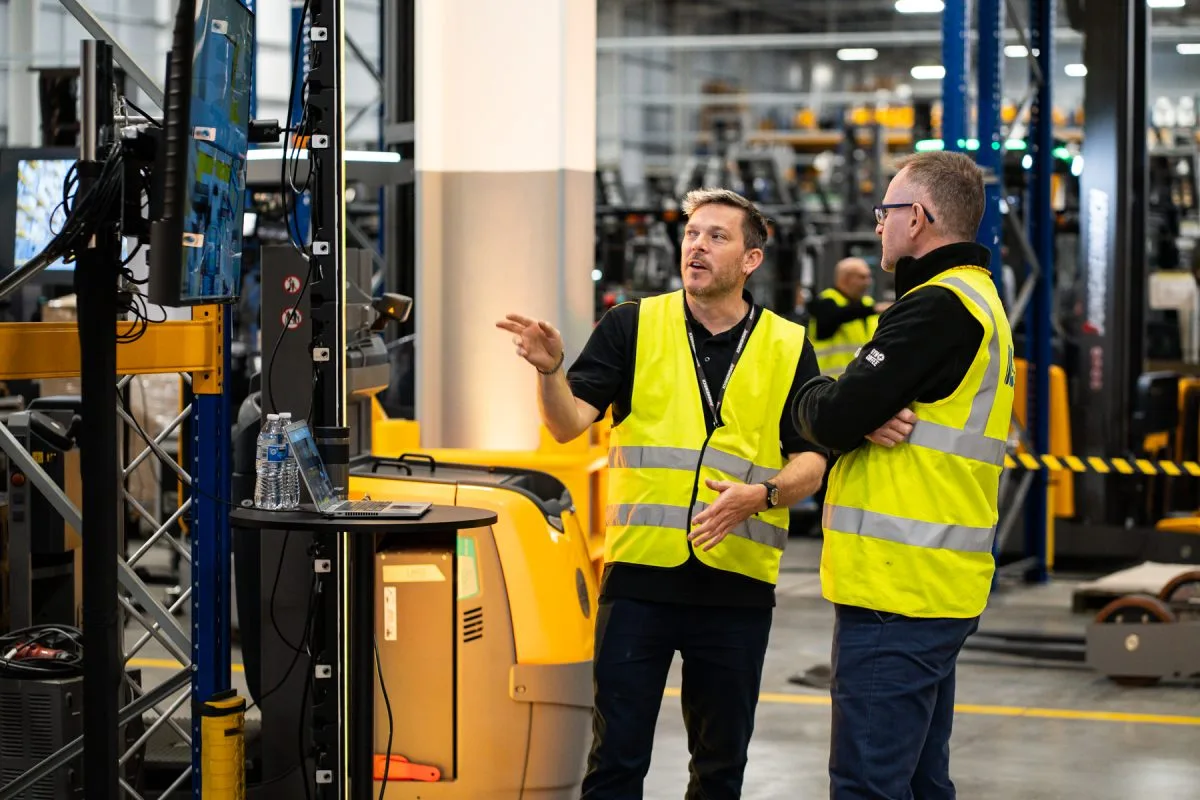
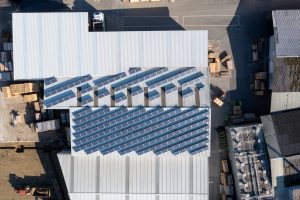
THE HUGE MHE warehouse holding Jungheinrich stock in Warrington provided a very fitting backdrop to a day focused on forklift learning.
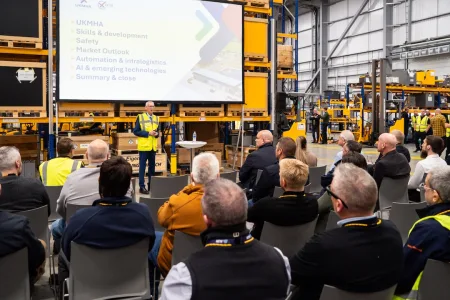
It was great to catch up with old friends, such as UKMHA chief executive Rob Fisher, who gave an address on safety to the audience of Jungheinrich customers.
“Safety is a shared responsibility,” said Rob. “While technology can help, companies must work on building a proactive culture. When an incident happens, it is too late to be thinking about the robustness of your safety processes, and the financial penalties can be very severe depending on the size of the company and the level of culpability.”
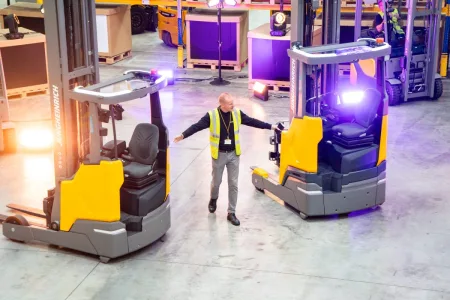
Attendees were also introduced to Jungheinrich’s new EFG 2 and 3 series electric counterbalance trucks, alongside AntOn by Jungheinrich, its value range of electric material handling equipment designed for everyday operational requirements.
As well as catching up on the latest kit, there was the opportunity to gain insights from Jungheinrich’s leadership team.
Christian Hanke, account management, rental and sales operations director at Jungheinrich, estimates that around 80% of the UK market runs on long-term rental. Contract hire terms have stretched from five to seven years, he says, because lithium-ion batteries let trucks work for longer. For seasonal peaks, customers can combine a core fleet with planned peak hire and ad hoc short-term rental.
Despite its role in lengthening contracts, lithium-ion still meets resistance. Hanke says some customers regard the technology as unsafe, and approval can involve local fire authorities, with requirements varying by region. Insurers are part of the conversation too. A supermarket chain recently brought its insurance broker to Jungheinrich to help understand the risks.
Hanke points to a large retail distribution site that changed supplier and moved to lithium-ion in a single programme, which now acts as a reference site for operators weighing the same switch.
Robots? Hold on, says the boardroom
Warehouse operators considering automation are more likely to be held back by their own sign-off processes than by the technology, according to Spencer Goss, automation and warehouse equipment director at Jungheinrich.
The problem comes when the quote lands. “As soon as you say robotics, then the exec and the C-suite go, ‘Whoa, hold on,’” Goss says. Senior teams then ask whether the solution is portable across sites and fits the wider network, and projects that customers wanted “tomorrow” can stall for six to nine months.
His advice is to map decision-makers at the outset. Jungheinrich now introduces its own project structure to customers and asks to see the equivalent on their side, so the people who will ultimately approve the spend are involved from the start.
Scoping is another weak spot. Goss says customers commonly focus on the flow from goods-in to goods-out and overlook three or four other processes that belong in the project. Jungheinrich’s answer is a material flow review, starting with a four-to-six-week high-level sketch of the customer’s data and processes, followed by a paid, more detailed analysis if the customer wants to go further.
Goss is candid about the risk. A broken-down manual truck can be moved aside and the work picked up another way. “When your automation goes down, the business continuity and the business impact is very significant very quickly,” he says. For end users, that makes the service arrangement as important as the hardware.
He has also seen faults rise once a supplier’s commissioning team leaves site, while operators are still learning the system. Jungheinrich now places its after-sales engineers in the commissioning team and runs a “hypercare” period, watching the customer operate the system and stepping in when needed.