

Sale ends soon…
An uptick in enquiries and viewings in London & the South East means occupiers may only have a short window of opportunity – Liza Helps investigates.

By Liza Helps, Property Editor, Logistics Matters
THERE ARE rumours of major incentives from ‘early access’ to 6-12 month rent free periods, capital contributions and on very rare occasions rent discounts but with agents indicating a huge uptick in enquiries and viewings, canny occupiers only have a short window of opportunity and that may only be feasible in certain locations.
Looking across the whole region, it is easy to see supply is definitely up with all property consultancies and respective research departments in agreement.
According to Savills latest Big Box Briefing, using data to the end of 2025, the amount of industrial and logistics space across London and the Southeast is up 14% year-on-year at 12.7 million ft2 in 73 units over 100,000 ft2.
Colliers director Tim Harding agrees: “We’re circulating supply figures at around 12 million ft2 for buildings over 100,000 ft2 in the wider Southeast and London now, which is higher than previous years.”
Taking a wider view and including small and midbox units over 20,000 ft2 property analyst CoStar’s Director of Market Analytics Grant Lonsdale notes: “There is 42.7 million ft2 of industrial and logistics space available across all grades – roughly 9.2% up from 8% a year ago and two times the mid 2022 low of 4.5%.”
Of this he notes 15.5 million ft2 of space available is less than five years old out of total stock of 33.9 million ft2. This puts availability for this stock at nearly 40%.
Looking at units over 100,000 ft2 CoStar’s latest figures produced in February 2026, run similar to Savills’ at 11.6 million ft2 across 69 units – this may reflect deals already done this year or indeed slightly differing regional parameters. Indeed, Savills noted there was some 273,686 ft2 of space under offer across two units at the end of 2025.
Latest deals which may or may not have completed before the end of December last year, include the letting of Prologis’ 124,223 ft2 Brooklands DC1 unit in Weybridge to specialist automotive storage provider Birch on a 15 year lease; the letting of Goodman’s 124,000 ft2 warehouse at its Crossways Commercial Park in Dartford, Kent, to recycling company Enva as well as the letting of Kirklington Property Developments’ 151,040 ft2 temperature controlled facility at Progress Park in Bedford to Chinese ecommerce company JD.com on a 10 year lease.

When analysing the current supply of warehouses of 100,000 ft2 plus by grade, Savills research indicates that at the end of 2025, 53% of available space was Grade A speculative development, with 20% of second-hand Grade A space, 11% of Grade B space, and 16% of low-quality Grade C space.
In effect high-quality Grade A space accounts for 73% of the available supply.
By unit count, there were 54 units within the 100,000–200,000 ft2 range at the end of 2025, representing a 15% increase in the last twelve months, 14 units within the 200,000–300,000 ft2 range, representing an 8% increase in the last twelve months, three units within the 300,000–400,000 ft2 range, which is on par with the level seen twelve months ago, and two units within the 400,000–500,000 ft2 range, representing a 100% increase in the last twelve months.
There is now also one unit over 500,000 ft2 – Valor’s 505,955 ft2 Ultrabox facility in Purfleet which is currently undergoing an extensive refurbishment. The property has a staggering 3.2 MvA power supply as well as providing 451,148 ft2 of warehouse space with 12m eaves as well as 42 dock and four level access doors served by a 50m yard with 79 trailer spaces. There is 51,055 ft2 of three storey offices as well as a 3,752 ft2 two storey transport hub. The property is being refurbished to achieve BREEAM Excellent and an EPCA rating. It sits on its own 30-acre secure site. Joint letting agents are Savills, DTRE and Cushman & Wakefield.
SEGRO’s head of London director Bonnie Minshull says: “[Looking at Greater London] there is no massive supply in any one sub market. It’s all kind of between 5 and 10% but it feels like there has been a bit more vacancy over in the east.”
Newmark’s partner and head of the UK national industrial and logistics agency team Charlie Seaton adds: “While locations such as Park Royal are saturated from an occupier basis with not a lot of new build [coming forward], the east of London market has a more readily available supply – there is a significant amount of big box units.”
Lonsdale says: “There is 1.6 million ft2 available in Park Royal made up of two big boxes, five single tenanted mid boxes and the rest multi-let.”
While in East London taking in Bexley, Greenwich, Havering, Lewisham, Newham and Barking & Dagworth, there is 5 million ft2 of space. Lonsdale notes that the average building size (taking in big, midbox and multi-let units) is roughly the same in both west and east London at circa. 22,000 ft2 however he adds: “The east has more available big boxes than the west (11 vs. 5).”
Indeed, HBD’s Associate Development Director Jonathan Boddington says: “East London generally offers more options for occupiers, with larger, modern units than you typically find in the West. When you factor in things like transport, labour availability, and operational efficiencies, the overall cost of running a facility can be significantly lower than in West London.
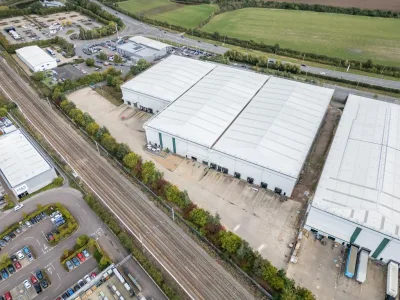
“The East London big sheds market presents occupiers with a highly compelling proposition compared to other sub-regions of London and the wider M25. One of its standout advantages is access to a substantial labour pool, particularly strong in blue-collar skills, which is a major benefit for many labour-intensive operations.”
In East London, as well as the aforementioned Ultrabox, there is also Goodman’s 343,281 ft2 Purfleet 343 warehouse, the BREEAM Excellent EPC A+ rated property has 18m eaves and is available through joint agents Cushman & Wakefield and JLL, as well as Tritax Big Box and Bericote’s 304,196 ft2 unit on the former Dartford Power station site, known as 350 The Powerhouse, which is on the market through Colliers, DTRE and JLL. In addition, there is Mirastar’s Bulk 250 property, a 250,850 ft2 warehouse due to undergo refurbishment available through agents DTRE, JLL and Glenny.
HBD and Barings’ 380,000 ft2 Momentum scheme includes two units over 100,000 ft2 (one of 171,000 ft2 and another at 101,000 ft2) – the BREEAM Excellent, carbon neutral development is being marketed by CBRE, Glenny and DTRE and there is also the 121,029 ft2 recently refurbished Orbital East warehouse on Sandpit Road, Dartford, being marketed by JLL and DTRE.
While it is not contested that supply is high, Newmark’s Capital Markets Analytical Research Team partner Will Laing notes: “The market has reached peak vacancy as there is very little by way of pipeline coming forward.”
According to Knight Frank’s latest LOGIC report for London & The Southeast speculative space under construction fell 30% year-on-year to 2.5 million ft2 in units over 50,000 ft2 down from 3.6 million ft2 in 2024.
Looking at units over 100,000 ft2 Savills’ director and National Head of Industrial & Logistics Toby Green says: “There are just five units under construction across the region totalling 671,005 ft2 – two being built in the Inner M25 and three in the Southeast. There are no units over 200,000 ft2 under construction.”
Knight Frank partner London & Southeast Logistics & Industrial Agency Gus Haslam says: “Enquiry numbers have remained robust throughout the year [2025] easily eclipsing 2024.” However, despite that, occupiers were reluctant to commit with transaction numbers down.
The latest Newmark research notes that quarterly take-up in London was down 26% in Q4 2025; and in the wider Southeast especially the east subdued This has made landlords nervous prompting some to re-set quoting rents. Others have been more generous with lease terms.
Marq Logistics Managing Director Real Estate Logistics Equity Europe Bruce Topley notes: “What we are seeing is a clear split between the best connected locations and everything else. In established corridors and gateway markets, good quality space that is well specified and realistically priced continues to attract high demand. By contrast, in sub markets where supply has built up in similar size ranges, customers have more choice and whilst headline rents are holding incentives have pushed out.”
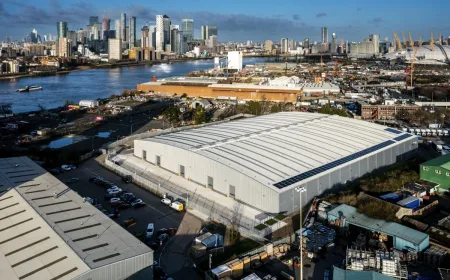
Indeed, Prologis UK director of Capital Deployment Simon Perks adds: “Insights from Prologis Research’s Rent Index show that rental performance is increasingly polarised. Buildings closest to major demand centres, with strong transport links and modern specifications, continue to outperform the wider market.”
In terms of lease incentives, Lonsdale says: “Anecdotally [these] have gotten more generous with new builds that are taking longer to lease up. However, there are many recent examples of 6 months or less on a 10-year lease for the best located units and Heathrow and other key logistics sub-markets.”
For Green the situation is thus: “Like many areas where there is a lot of stock, while landlords and investors will hold to headline rents, there is room for incentives at present. Possibly last year they were more generous, but with stock being taken up [and not replaced] the market will harden.”
Therefore, right now occupiers have an opportunity – if they can be pragmatic and footloose.
This certainly seems to be a trend, especially for occupiers that don’t need to be located within the M25 and explains why for the last three years the wider Southeast has actually fared better than Greater London in terms of take-up.
In 2025, according to Savills, take-up in units over 100,000 ft2 totalled 4.46 million ft2 across 21 transactions, which is up 43% on take-up in 2024. Of these transactions, 95% occurred within the South East, which equates to 19 transactions totalling 4.21 million ft2, and 5% occurred in the Inner M25, reflecting two transactions totalling 242,614 ft2 and a return to transactional activity over 100,000 ft2 in the Inner M25 region, which, while up on 2024, is 80% lower than the pre-pandemic average (2007–2019) of 1.22 million ft2. In comparison, the South East take-up is 14% higher than the pre-pandemic average (2007–2019) of 3.7 million ft2.
The two Inner M25 deals in question saw InPost take investor Railpen’s City Box 120, a 120,000 ft2 fully refurbished last mile warehouse in Greenwich, which made it at the time the largest deal in London in two years. The property had been marketed at a rent of £22 per ft2 through letting agents Hollis Hockley, DTRE and Cushman & Wakefield. Savills advised InPost.
The second big deal saw Worldwide Flight Services securing a BREEAM Excellent and EPC A+ rated cross docked 122,400 ft2 build-to-suit within the Heathrow cargo area on a 20 year lease from investor developer Tritax Big Box. This will be the first air cargo facility to be developed on London Heathrow since 2006.
Newmark’s Seaton notes: “The traditional western corridor from London is definitely getting longer with locations such as Heathrow and Park Royal filling up with little or no new space to replenish supply because of that we are seeing migration further westwards towards Reading, Maidenhead and Oxfordshire. These locations can provide better quality space with good access to London and at a rent discount.”
For Colliers Co-Head of Industrial and Logistics Len Rosso: “We are seeing a lot of occupiers from North London and Hertfordshire looking to migrate further out because rents have grown so much, so quickly [during the pandemic] that it has become almost unaffordable for some. We are taking inquiries in places such as Milton Keynes, Beford and Luton.
“Occupiers have looked at these locations and thought, we can run our networks from a little bit further out and massively decrease our overheads in terms of the buildings that we operate within.”
Perks agrees ands says: “Premium rents and land constraints mean customers are increasingly looking beyond the capital if they do not need to be in London itself. We have seen this first hand, including a glass manufacturer relocating from Park Royal to Milton Keynes. Even so, demand remains firmly focused on efficient, sustainable buildings in the best-connected locations.”
In addition, the buildings are often larger outside the M25, due to less space constraints and easily accessible to the wider Southeast region and beyond.
This is of particular note as many occupiers look to consolidate. SEGRO’s Minshull says: “We are seeing a lot more consolidation as occupiers, hit by a myriad of costs from national insurance, minimum wage, rents and rates as well as being hit by higher power prices, look to take better quality, bigger buildings, to drive more efficiencies to their bottom line.”
Newmark’s Laing says: “Demand [in the Southeast] continues to be focused on cost-effective refurbished space within reach of London and major transport corridors.”
However, he notes, ‘the relatively strong rent growth across the Southeast has narrowed the gap with London locations’ while occupiers in London continue to be highly cost-conscious [rents range between mid to high 20s and a little discounted in the east] several London-based firms cannot defer relocations or lease events indefinitely and must make decisions soon, the issue will be is it actually cheaper to remain centrally located?
For Savills’ Green: “Ultimately that’s the story, the Home Counties have been going strongly over the last three years while London has been parked. And I suppose the question now is, is now the time where the transport savings of being in London versus the rent differential being located outside London makes sense to occupiers or should to stay put?”
JLL’s director Industrial & Logistics Tessa English notes: “According to recent global research by JLL regarding gridlock, London is in the top five metropolitan areas in the world with the worst, for occupiers that have time constrained delivery windows therefore being in London may be the only recourse particularly with all the roads at 20 miles an hour now despite its high rent levels.”
Perks says: “The South East is likely to remain a premium logistics market, with rents holding firm in the best-connected sub-markets and ongoing pressure on land supply, including logistics land being lost to alternative uses. As higher rents push customers further out of London, we expect the ripple effect to continue into locations such as Hemel Hempstead. Over time, this could bring the market to an inflection point where London rents begin to look more competitive again and some customers move back closer to the capital.”
Rents
Law firm Forsters commercial real estate team counsel Paul Grayson says: “Rental pricing will always be a challenge for tenants, particularly in relation to land acquired by landlords at the top of the market who will therefore be looking to maximise rental income.”
Indeed, top of the market prices for prime sites in London such as those found in Greenford, Bow and Park Royal hit between £19.8 million to £22.7 million an acre in 2021.
While those land prices have almost halved today, rent levels have not.
While the hike in rent levels in recent years can be attributed to the pandemic warehouse space boom of a couple of years ago fuelled by high land prices and build costs, the continued growth in rents albeit at a slower pace throughout the region, is more likely to be attributed to increased rent levels in towns outside the M25 such as High Wycombe, Milton Keynes, Maidenhead and Reading which have seen increased levels of take up over the last three years.
Looking down the M4 corridor Haslams research puts rent levels heading north of £20 per ft2 in Reading for the best product with the pre -letting of a 37,000 ft2 unit at Reading Logistics Park securing £20 per ft2. It says that a particular driver of demand is from more traditional warehouse and industrial occupiers seeking to relocate as a result of data centre displacement. The largest letting in 2024 was the pre-leasing of 46,000 sq ft at Suttons Business Park (on the eastern edge of Reading) to Synergix Logistics which had been displaced form space in Iver. While this does seem high, the rents are more attractive than West London (£25-£30) or even Slough (high £20s).
Rents in Milton Keynes according to Bidwells’ M1 South Databook are hitting £14.50 per ft2 with expectation that during 2026 rent will top £15 per ft. Meanwhile in Bedford quoting rents for Grade A modern warehouse space are hitting £13.50 per ft2. In Luton rent levels according to the latest LSH rent index are at £15 per ft2.
Rent levels in the South M25 Quadrant, and Surrey and Sussex have been subdued. SHW partner and head of agency Tim Hardwicke notes: “As we move to an occupier’s market [following an uptick in availability across most areas] there has been rental pressure and we have seen more incentives/longer rent free’s given as landlords focus on landing the active occupiers in the market.”
SHW research records Croydon rents remaining static at £22 per ft2 with those in Sutton, Chessington, Epsom and Leatherhead dropping slightly to £24 per ft2. An increase in rent levels was seen in Shoreham and Lancing with rents hitting £25.50 per ft2.
Back in London prime rents, according to Knight Frank’s latest LOGIC report for London & the Southeast, in West London remained unchanged in Q4 2025 at £28 per ft2 following a 6.7% decline in Q2 with elevated supply prompting some landlords to cut quoting rents to minimise voids. In north London rents increased 2% to £25 per ft2 in Q4 2025.
Rent levels especially in the south and eastern M25 area have been almost fixed at £21 and £20 respectively for units over 50,000 ft2 with landlords and developers being more flexible on lease terms and incentives rather than compromising on headline rents.
Average rents are forecast to grow 3.8% in London in 2026 with 3.2% growth expected for the Southeast region.