

Space race
Viewings are up, take up is up, and so are enquiries – after a stop start couple of years occupiers seem to be biting the bullet and committing to new space but is there enough to satisfy this demand? Liza Helps investigates.
By Liza Helps, Property Editor, Logistics Matters
JLL HEAD of UK Big Box Logistics Tom Watkins says: “I think the activity level has seen a significant uplift compared to previous years, with a lot more viewings and enquiries.”
Indeed, in some areas, says Colliers Co-Head of Industrial and Logistics, Len Rosso: “We have seen more viewings so far this year than we have seen probably in the last 18 months.”
Across the board agents on a national basis have reported an uptick in viewings with some pointing to an increase of up to 25%. And as Savills Logistics Research Analyst Kiran Bhalla notes: “Ultimately, deals [can] only happen when there are viewings in the first place.”
And for the first half of 2026, there has obviously been a lot of viewings as there has been a lot of space let. Savills logistics research Associate Lewis Rapley notes take up in big box warehousing units over 100,00 ft2 reached 15.4 million ft2. “This is down 10% year-on-year over the same period but is still 17% above the long term average.”
If that were not enough, DTRE’s Head of Research, Data & Insights Robert Taylor, says: “There is a further 11.7 million ft2 already under offer, setting up a strong H2.”
Excluding build-to-suits freehold deals the figure is around 4.5 million ft2 to 5 million ft2 under offer.
For Colliers UK Head of Industrial & Logistics Research Deirdre O’Reilly the jury is still out on whether take up in 2026 will match that in 2025. “We’re still very much on course to meet the levels that we saw last year but will it surpass that? It is too soon to say.”
What has been noticeable is the number of very large deals being transacted. O’Reilly adds: “So far this year we have had at least 10 deals over 300,000 ft2, with others believed to be under offer.”
Even developers have noticed the trend with HBD Director James Walters noting: “2026 headline take-up figures have certainly been encouraging; however, activity has been geared towards big box transactions rather than a broad-based increase across the market.”
Property analyst CoStar Director of Market Analytics Grant Lonsdale adds: “The average deal size is definitely getting bigger at roughly 250,000 to 300,000 ft2 somewhere in that range.”
Rosso puts this down to a ‘flight to larger accommodation’ be that through consolidation, expansion or even acquisition and mergers. “The only way you can really make money is by scaling up and leveraging your supply chain to get economies of scale.”
It’s a trend that SEGRO’s head of National Markets Dan Holford is coming across a lot especially for the XL facilities: “The rise in 500,000 ft2+ facilities reflects the scale and shifting needs of modern logistics, from consolidation and efficiency to more automated, power-intensive operations.” He cites Yusen Logistics 1.3 million ft2 build-to-suit facility at SEGRO Logistics Park Northampton as an example of the size of current requirements.
Developer Panattoni’s Southern England & London’s Head of Development James Watson agrees: “Large facilities allow occupiers to consolidate operations, support automation and improve productivity.”
For James Clements, Director and Co-founder of Box4 Real Estate: “The return of the 500,000 sq ft plus transaction is one of the defining stories of H1. However, the market hasn’t become reliant on mega sheds alone. While six transactions exceeded 500,000 ft2, 36 of the 55 transactions in the Midlands we recorded were below 200,000 ft2. The recovery has been evident across the full spectrum of building sizes. Notwithstanding that we are tracking several transactions [over 500,000 ft2] which we are expecting to be announced before the end of the year.”
Colleague Director and Co-founder of Box4 Real Estate James Goode notes that in the Northwest the mega shed [deal] is less common with only 4 available buildings: “However we are seeing developers responding to requirements for 500,000 + buildings with companies such as Panattoni speccing 675,000 ft2 building at Hardwick Grange , Warrington. Developers will deliver what the market demands, and as the market moves to a higher prevalence of demand for buildings of this scale, we are sure to see them becoming a more common feature of the Northwest market.”
It seems as if the big box take up push has come out of nowhere, but property solicitor Forster’s commercial real estate Senior Associate Alexandra Townsend-Wheeler has other ideas: “The take-up figures out of the gate in 2026 have been very strong – particularly at the larger end of the market – and that clearly reflects deals that were paused in 2024/2025 coming back through.”
It is a sentiment that Brookfield’s Head of Portfolio Management European Logistics Will Prewer holds as well: “We have definitely seen an increase in occupier activity, partially due to the dearth of deals or dearth of decision making through the past two years coupled with the realisation that these cannot be put off anymore be that through the buildings no longer meeting ESG requirements or that the functional operation of the supply chain is changing.”
In general, says Holford: “It feels like occupiers have started to accept that macro and geopolitical uncertainty is the new ‘norm’ and after delaying expansionary activity over the past few years they are now feeling pressure to push forward with plans as there’s little excess capacity in their operations and distribution networks which is resulting in a very active pipeline of pre-let conversations.”
Townsend-Wheeler warns: “Characterising this trend as a simple return to pre-Covid volumes or even mid-cycle conditions, fails to show the whole story. What we’re really seeing is pent-up demand being released, alongside those longer-term structural drivers, but still against a backdrop of economic and geopolitical caution. This is therefore more normalisation than reset – activity has come back, but the market is still very much carrying the legacy of the last few years, particularly in terms of cost pressures, occupier behaviour and a more constrained development pipeline. Occupiers are active, but they’re not carefree. Deals are happening, but they’re taking longer, with much more focus on total occupational cost and on the quality and efficiency of the building. So, it feels like we’re in that middle ground – demand is there, but decision-making is slower and more selective, and developer caution is still shaping what actually gets delivered.”
And this is where the issue lies…
According to JLL’s Associate Director Eoghan Morgan: “Preliminary big box supply at the end of H1 2026 shows that there will be c. 41.9 million sq ft space available, which is 5% lower than at the end of Q1 2026.”
BNP Paribas Real Estate research points to the fact that the vast majority of units over 100,000 ft2 (64.7% at the end of Q1 2026) is accounted for by secondhand space while the strong demand for Grade A assets is resulting in a reduction in available supply of new stock.
BNP Paribas Real Estate Industrial Research Lead Josh Arnold says: “Best in class assets continue to attract the lion’s share of demand with Grade A units forming 72.7% share of take-up in Q1 – equating to 5.5 million ft2.”
Townsend-Wheeler notes: “On supply, headline vacancy has come up from historic lows, which gives the impression there’s a lot of choice. But in practice, the good Grade A space in the right locations is still pretty scarce, and there just isn’t the same level of speculative development coming forwards.
“So, occupiers may have more theoretical choice, but less of the right product in the right places – something that’s particularly noticeable in the large box and mega shed space.”
Panattoni’s Watson agrees: “There is availability in the market, but not enough Grade A space in the locations occupiers want. Modern buildings with strong ESG credentials, significant power capacity and excellent connectivity remain in short supply, particularly in established logistics corridors. That shortage is becoming more apparent as occupiers move from planning to execution and seek immediate solutions.”
According to DTRE research as at the end of May the supply of warehouse units over 300,000 ft2 reached its lowest level since December 2024 with just 39 properties available nationally equating to just 15 months supply.
Overall, Colliers O’Reilly notes: “When you look at the larger scale buildings nationally there are only maybe eight or nine over 400,000 ft2 that are immediately available and probably 20 – 25 in the 250,000 ft2 to 400,000 ft2 size range. When that gets broken down to regions and sub markets there really is not that much with some regions being more challenged than others.”
Knight Frank research reported in Q1 this year that the largest segment of the warehouse market by size accounted for the smallest proportion of take-up and says Knight Frank Partner and Head of UK & European Industrial Research Claire Williams: “That’s due to the lack of available stock of good quality sheds of that size. Units of 400,000 ft2 + in Q1 accounted for just 15% of the market compared to 23% of the market in the same period in 2025.”
This is leading to take up being constrained by a lack of available good quality space in the right places. Investor developer Marq Logistics Managing Director, Bruce Topley says: “The lack of availability of big buildings means that customers must invariably consider logistics space that is not necessarily in their preferred location in order to meet their commercial goals.”

Newmark’s National Industrial & Logistics partner Sebastian Moseley adds: “Securing space is a real challenge with a genuine lack of up and built stock in preferred locations, so in order to fulfil contracts and grow, occupiers are having to be more agnostic not just on location but sometimes on specifications.”
He points to the recent Farmfoods deal at Logicor’s 800,000 ft2 plus Logicor Park Daventry scheme in the East Midlands. Farmfoods could not find big enough single unit in their preferred location so had to take a whole three unit campus of buildings in order to make that location work being agnostic in the configuration of their building – in effect amending the business plan to meet requirements for future growth.”
Newmark UK’s Head of National Industrial and Logistics Agency team Charles Spicer says: “The lack of speculative development seems to be out of sync with occupiers, so they are targeting existing units and taking them out of existing supply.”
Basically, says Colleague Moseley: “What we are seeing developing is a race to take that final existing building especially in the 3PL sector.”
Already he notes the market is starting to see early pre-lets with the news that Chinese fast fashion brand SHEIN or logistics partners acting on its behalf is set to take developer PLP and Indurent’s 645,000 ft2 plus warehouse facility in Sawley, Derbyshire. Contractors only started construction at the beginning of the year with practical completion scheduled for December.
Set to achieve BREEAM Excellent and an EPC A+ rating, the 645,285 ft2 cross dock building will boast 18m eaves, have 60 dock and seven level access doors with parking for 224 HGVs and up to 5.4 MVA of power for automated sorting equipment.
Savills and Apex Real Estate Advisors are acting as joint agents on the scheme.
The market is ‘hot’ says DTRE’s Equity Partner and Head of Industrial & Logistics Client Relations, Mark Webster: “We have experienced gazumping where terms have been agreed and another occupier has thrown in an offer to pay better commercial terms and the landlord has to decide. This feels like a real race to secure existing stock.”
The obvious answer has to be to build more space speculatively. As SEGROs Holford notes: “The development pipeline has slowed materially, with speculative development activity falling back to some of the lowest levels in recent years.”
BNP research notes that the speculative development pipeline for Big Box units reached 7.8 million ft2 in Q1 2026. This remains 28.6% below the long-term average of 11 million ft2.
“It is interesting to note,” says Rapley, “that while there are growing requirements for 400,000 ft2 plus facilities, of the 32 units currently under construction there are only six nationally that are over that size.”
But here’s the rub says CBRE Head of UK Industrial & Logistics Capital Markets Jack Farmer: “While occupiers continue to seek larger, more complex facilities, which is supporting demand for ‘mega sheds’, there still appears to be a disconnect between the occupational and investment markets, with limited liquidity for bigger lot sizes and fewer buyers for large core assets.”
“Capital raising also remains more weighted towards core plus and value-add strategies, while funding for build-to-suit, particularly for bespoke or operational assets, is more challenging.”
Colliers Industrial and Logistics Associate Director William Fox agrees and adds: “Over the last few years, the capital that has been here has been focussing on smaller mi-box scheme to diversify risk rather than focussing on one big box.”
Indeed, Townsend-Wheeler adds: “The mood on speculative development is still cautious. Debt remans relatively expensive, build costs are high and wider geopolitical risk is still feeding into pricing and sentiment.”
Prologis UK Regional Head and Senior Vice President Paul Weston notes: “Geopolitical tension, economic uncertainty and ongoing pressure on costs are creating a more complex environment for businesses and investors alike.”
And it does not look as if this will let up, BNP Paribas Real Estate Industrial Research Lead Josh Arnold notes: “We anticipate continued pressure on construction costs which could influence development timelines. While some developers are continuing to progress with new schemes, many others are adopting a more cautious approach to speculative projects.”
Indeed, Topley says: “While demand for well-located, high-quality space continues, the priority is identifying sites that can genuinely support modern logistics operations aligned to road networks and energy infrastructure.
“At the same time, financial pressures of higher construction costs and softer prime yields linked to Gilt/bond rates and rental growth are adding further complexity to the viability of speculative developments.”
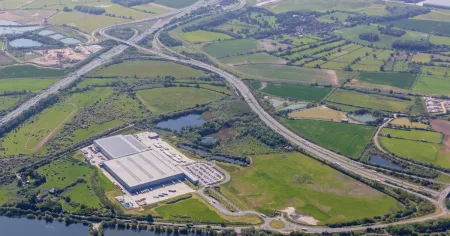
According to BNP research, there is currently over 14 million ft2 of Big Box projects proposed (either with, or awaiting, planning permission). Many of these schemes are unlikely to start on site without either the security of a pre-let tenant, or economic factors supporting viability (most notably inflationary pressures easing and interest rates falling).
DTRE’s Taylor adds: “Build cost inflation, limited committed capital and planning delays are reducing the amount of pipeline development contributing to the conditions for an over correction in 2027.”
If that were not enough, Holford says: “The pool of sites with the right infrastructure is limited which is increasing competition for the best locations and pushing occupiers to commit earlier or pursue build-to-suit solutions.”
One of the biggest reasons for such a dearth of suitable sites is the current planning regime.
Watson says: “Planning remains one of the biggest constraints on supply. Too often, nationally important industrial and logistics developments face lengthy delays despite delivering jobs, investment, and economic growth. The increasing reliance on appeals reflects a disconnect between national economic priorities and local planning decisions, creating uncertainty, extending delivery times and ultimately restricting the amount of new space available to occupiers.”
Even where development have occupiers in tow and willing to commit early, Townsend Wheeler notes: “The process of getting schemes through planning can be slow and uncertain, which creates a lag between demand and delivery and adds to the reliance on pre-lets for these larger schemes. It feeds into the broader theme across the sector, which is that we’re not in a supply-constrained crisis, but we are in a product-constrained market, particularly at the prime and large-box end.”
Farmer adds: “That said, different investor groups are behaving in distinct ways. Larger, well-capitalised developers and specialist landlords remain the most active in funding large scale schemes. We also expect core investors such as infrastructure funds, LGPS and DC capital to begin playing a greater role as they look to deploy capital into larger, stabilised assets.”
That being said, CBRE Head of UK Industrial & Logistics Occupier Services Jonathan Priestley concludes: “The limited availability of [big shed] is expected to continue through Q3 and Q4 2026.”
With Newmark’s Capital Markets Analytical Research Team Partner Will Laing predicting ‘an 18 – 24 month gap before we get redevelopment’.
So, for the short term, occupiers can expect increasingly slim pickings with regard to existing stock and a subsequent push in rent levels across the Grade A spectrum.
Trending
Other notable trends in the first six months of the year have to be the increasing predominance of Chinese ecommerce, 3PL and courier companies setting up base or expanding out of the Southeast and Midlands and the re-emergence of Amazon as a major player through means direct and indirect.
Box4 Real Estate’s Director and Co-founder of Box4 Real Estate James Clements says: “Transaction volumes and take-up have improved significantly during H1 2026, but the nature of demand has shifted.
“Instead of being driven by a wide range of occupiers, a smaller number of large-scale commitments particularly within the Amazon supply chain and Chinese e-fulfilment sector have played a significant role in overall take-up.
“The most notable trend has been the continued expansion of logistics ecosystems rather than individual occupiers. Bleckmann, CEVA and ID Logistics all secured major facilities supporting Amazon’s network, whilst Chinese e-fulfilment occupiers completed nine transactions across the Midlands. Together, those two ecosystems accounted for close to 3.5 million ft2 of take-up in the Midlands market alone during H1.”
Colleague Director and Co-founder James Goode adds: “The Chinese e-fulfilment sector in particular is now making the long awaited move into the Northwest, with J&T Express taking Cabot’s remaining 87,000 ft2 building at their Kingsway Rochdale scheme and JD.com out viewing buildings of 200,000 ft2 plus across Greater Manchester and surrounds.
While Chinese 3PLs and retailers are not necessarily new to the UK, Tritax Big Box Head of Client Engagement, Mark Fergusson says: “[They] are now emerging as a rapidly growing source of international demand, driven by e-commerce growth, supply chain localisation and rising consumer expectations around delivery speed and service.
“Increasingly, operators are investing in UK fulfilment infrastructure to support long-term market growth, rather than relying solely on cross-border trade. This demand is already translating into real estate decisions and infrastructure investment across the UK logistics market.”
In 2025 Chinese firms leased almost 3 million ft2 of UK warehouse space, accounting for approximately 6% of total logistics take-up. According to Newmark’s Capital Markets Analytical Research Team Partner Will Laing: “Asian occupiers accounted for 12% of Q2 2026 take-up alone and 8% of total demand over the past 12 months, highlighting a growing source of inward demand.
Colliers UK Head of Industrial & Logistics Research Deirdre O’Reilly concurs: The amount of take-up last year and in the first quarter this year accounted for by either Chinese occupiers directly or linked to them has been quite significant – 23% of 3PL and retail and 8% of UK take up (2025 & Q1 2026 combined) And I don’t see that waning this year either.”
While JD.com’s stated aim that it is looking to directly rival Amazon’s dominance in the UK ecommerce market, there has been no direct confirmation that Amazon’s seemingly sudden return as an active acquisitor of warehouse space is anything but upgrading older space and facilitating growth.
JLL’s Associate Director Eoghan Morgan notes that: “Over the last 10 years there has been c. 48.4 million ft2 of big box take-up from Amazon. In the same period, Chinese e-commerce firms as a whole have taken c. 7.6 million ft2 which shows the size of ambition required by Chinese firms to challenge the strength of infrastructure Amazon already have in the UK.
“Most of that Chinese e-commerce space was taken within the last 5 years which does show that they have been ramping up their big box requirements.”
It should be noted that the ability of these Chinese firms to continue with the pace and size of take-up will depend on the willingness of landlords to let units to them in a market of diminishing supply.
In the end that will depend on strength of covenant and the length of lease negotiations, with supply on a downwards trajectory landlords may begin to be more selective.