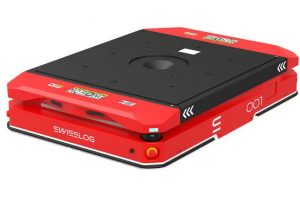


Swisslog debuts fully automated mixed pallet creation solution ACPaQ
Creating customised mixed pallets for individual stores from single-SKU pallets is one of the most important areas of successful retail warehouse operations, and has long been a monotonous manual task for retailers. Intralogistics specialist Swisslog has addressed this challenge by unveiling a robot-based solution designed to fully automate and potentially triple the speed of the palletising process.
The ACPaQ solution is the next milestone in the successful cooperation between Swisslog and KUKA. While Swisslog has already installed many systems around the globe with fully automated mixed-carton picking and palletising, the company has seen its collaboration with KUKA enable them to provide an enhanced solution with improved technology.
This world-class intralogistics innovation is the latest development to emerge from the bundled robotics know-how of the two leading providers. Swisslog showcased this system for fully automated mixed-carton picking and palletising for the first time at the recent LogiMAT exhibition in Germany.
{EMBED(849226)}
The new innovative palletising system has a highly modular design, combining robotics solutions for depalletising and palletising with CycloneCarrier shuttle technology. It enables a fully automated process controlled by the SynQ warehouse management software which, compared to traditional methods, doubles or even triples the speed of picking cartons in distribution centres based on store layout, item groups or item classes.
At the core of the ACPaQ solution is the RowPaQ cell featuring a state-of-the-art 5-axis jointed-arm KUKA robot. It is equipped with a flexible gripper with adjustable forks which allows it to pick up as many as four cartons at a time even if they don’t have the same size or weight. A RowPaQ cell is capable of setting down up to 1,000 cartons per hour in the exact location predefined by the palletising software. The solution is completely scalable and additional RowPaQ cells can be added to the system to increase throughput as required.
Networking new and proven technologies
Robot-based palletising builds on an intelligently organised process. Before cartons can be palletised in sequence, they are first separated, loaded into trays and stored temporarily in the highly dynamic CycloneCarrier shuttle system. Even before the warehouse management system issues the palletising order, Swisslog’s software autonomously performs a complex calculation process based on product parameters to determine the best way to load the pallet.
The cartons are then transported in the exact sequence from storage to the RowPaQ cell. After palletising is complete, it is shrink-wrapped and transported via conveyor directly to the right shipping station.
“ACPaQ is the perfect combination of KUKA and Swisslog know-how in one solution,” says Dr. Christian Baur, Chief Operating Officer of the Swisslog Group and CEO of Swisslog Warehouse & Distribution Solutions. “As a result, our customers benefit from a solution that significantly outperforms manual palletising processes, not only in terms of packing density and dimensional stability, but also in terms of cost effectiveness and ergonomics.”
Robots collaborating with human operators
Swisslog is a world leading automation specialist for robotic and data-driven intralogistics solutions and is at the forefront of the new frontier, dubbed Industry 4.0.
It believes logistics managers should consider the advantages of automation and the opportunities it brings to the table. “Robotics and automation clearly offer more opportunities than risks, but only if we embrace them as drivers of future growth,” states Dr. Christian Baur, COO of the Swisslog Group and CEO of the Division Warehouse & Distribution Solutions.
While the wider belief is that warehouse automation means removing human interaction, Swisslog’s AutoPiQ solution is based on a shared picking principle: The robot picks the items that it is able to pick – which can be up to 95% of a company’s product range – and a worker finishes the order.
According to Kirt Laeske, Product Manager for Robotics at Swisslog, there are definitely signs that the work environment of logistics centers are changing. “Today, robots no longer need to work in isolated safety areas. They perform their tasks side by side with humans, and are already able to take over the simple and repetitive tasks of unskilled workers during order peaks and personnel bottlenecks.”

Laeske believes that there is no reason to fear that robots will replace the work of humans in logistics centers. “Machines are better than people at performing repetitive and uniform tasks, but they lack the elementary cognitive skills required for many logistics activities.”
In its pursuit of optimization along the value creation chain, Swisslog sees little benefit in deploying robots as stand-alone solutions, but rather to carefully combine the skills of human beings and machines.
It is important to openly discuss the opportunities that come with advancement in automation, says the company, while equally assessing the wider impact on staffing, corporate responsibilities and the wider public perception.
“Industry 4.0, big data software solutions, robotics and automation pave the way for greater process efficiency in logistics,” stresses Dr. Christian Baur. “Machines are ready to work 24/7 and support considerable volume increases and improved utilization in spite of the persistent trend toward smaller order sizes. These effects ultimately lead to increased delivery speed, improved delivery reliability, greater flexibility and higher customer satisfaction,” states Baur. “All these things bring about greater efficiency in logistics, driving the creation of new roles and alternative jobs such as in systems programming and support.”
{EMBED(849227)}
Harvard economist James Bessen has recently shown in a working paper that merely one of the 270 detailed occupations listed in the 1950 US Census has since been abolished at the hands of automation. The only occupation listed that has taken a hit from the rise in automation in the past sixty years is an elevator operator – hardly an indication of a technological uprising.
A recent study of the Swiss employment market performed by the Deloitte auditing and consultancy firm came to a similar conclusion. Although automation did replace certain jobs over the last 25 years, overall it boosted demand for labour. “Work will not disappear,” stated the study. “On the contrary, technological progress in Switzerland is estimated to generate approximately 270,000 new net jobs by 2025.”
The human touch
So, will there only be two types of human roles in the future, as some believe, either telling a robot what to do, or doing what one tells you to do?
“The truth is that progress always aims to reduce the cost, simplify, speed up and improve the efficiency of complex or repetitive operations,” concludes Dr Baur. “Yet, so many of society’s roles require the human touch. Aircraft can land themselves, algorithms can diagnose disease, and software can provide legal advice, but we still see the value in pilots, doctors and lawyers. We are not ready to give up humanity just yet, but we are able to release them from some of the more onerous tasks.”
The experts at Deloitte agree, citing the complementary effects of automation versus what it calls ‘pure substitution effects’. Rather than simply put people out of work, these (human) experts believe that the current technological upheaval will shift jobs within and between sectors, simultaneously generating risks and opportunities for employees.
“This distinction is important because it implies very different economic outcomes,” James Bessen wrote in a Vox column last year. “If a job is completely automated, then automation necessarily reduces employment. But if a job is only partially automated, employment might actually increase.”
Regardless of what the expert economists think, future-proof professions, for today at least, include all those in which creativity, adaptability and interaction with people or machines play a critical role.

Related posts