

The growing importance of DC power conversion in smart warehouses
Warehouse automation has advanced rapidly over the past decade. What was once a facility dominated by forklifts and manual picking is now an interconnected environment where autonomous mobile robots (AMRs), barcode scanners, IoT sensors, automated storage systems, and intelligent conveyor networks work together to keep goods moving efficiently.
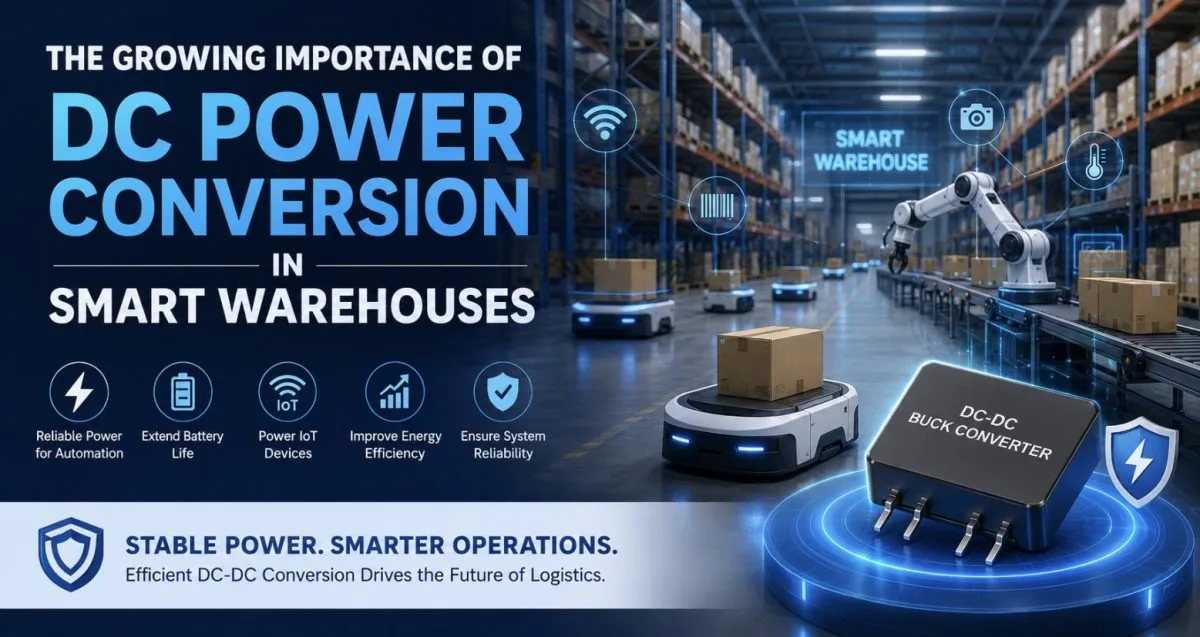
AS ATTENTION often focuses on robotics and artificial intelligence, one critical technology tends to remain behind the scenes: DC power conversion. Without reliable power regulation, even the most advanced warehouse equipment cannot perform consistently. As smart warehouses become more dependent on electronic devices, efficient DC power conversion is becoming an essential part of modern logistics infrastructure.
Why DC Power Matters More Than Ever
Many of today’s warehouse devices operate using low-voltage DC power rather than alternating current (AC). Sensors, industrial controllers, wireless communication modules, robotic systems, cameras, and embedded computers all require stable voltage to function correctly.
However, the power supplied by batteries or industrial power systems is rarely delivered at exactly the voltage each device requires. Voltage fluctuations, battery discharge, and varying electrical loads can all affect equipment performance.
This is where DC-DC converters play a vital role. They efficiently adjust one DC voltage level to another, ensuring connected devices receive stable and appropriate power regardless of changes in the input supply.
Supporting Autonomous Mobile Robots
Autonomous mobile robots have become one of the fastest-growing technologies in warehouse automation. Companies including Amazon, DHL, and GXO Logistics continue expanding their use of robotic fleets to transport inventory throughout distribution centers.
These robots rely almost entirely on battery power. Yet individual components inside an AMR rarely operate at the battery’s output voltage. Navigation computers, LiDAR sensors, cameras, wireless communication modules, and motor controllers often require different voltage levels.
Efficient DC power conversion enables each subsystem to receive the correct voltage while minimizing energy loss. Even modest improvements in conversion efficiency can extend battery operating time, reducing charging frequency and increasing overall productivity.
Reliable Power for Industrial IoT
Smart warehouses depend heavily on Industrial Internet of Things (IIoT) devices that continuously monitor equipment performance, inventory levels, environmental conditions, and asset locations.
Thousands of connected sensors may be installed throughout a single facility. These devices typically consume relatively little power, but they require highly stable voltage to maintain reliable communication.
Power interruptions or unstable voltage can lead to communication failures, inaccurate sensor readings, or unexpected equipment alarms. Reliable DC power conversion helps maintain consistent operation across these distributed monitoring networks.
Conveyor Systems Require Stable Electronics
Conveyors remain one of the busiest systems inside modern warehouses. While the motors receive much of the attention, today’s conveyor systems also include programmable logic controllers (PLCs), photoelectric sensors, variable-speed drives, human-machine interfaces, and safety equipment.
Each electronic component depends on regulated power for accurate operation.
If voltage drops unexpectedly or fluctuates beyond acceptable limits, sensors may produce incorrect readings or control systems may experience unnecessary interruptions. Stable DC power helps ensure conveyors maintain consistent throughput while reducing the likelihood of costly production delays.
Cold Chain Logistics Presents Additional Challenges
Temperature-controlled warehouses introduce another layer of complexity.
Facilities storing pharmaceuticals, vaccines, or fresh food often operate around the clock under demanding environmental conditions. Electronic monitoring systems continuously record temperature, humidity, and equipment status to ensure regulatory compliance.
Because many of these monitoring devices operate from DC power, dependable voltage regulation becomes particularly important. A power-related sensor failure could trigger unnecessary product inspections or even result in inventory losses if environmental data becomes unreliable.
Improving Energy Efficiency
Energy efficiency has become a strategic priority across the logistics sector. Rising electricity prices and sustainability targets encourage warehouse operators to optimize every aspect of facility performance.
Although lighting and HVAC systems typically receive the greatest attention, power conversion efficiency also contributes to lower energy consumption.
Modern DC-DC converters reduce wasted energy during voltage conversion, generating less heat and improving overall electrical efficiency. While savings from an individual converter may appear modest, large warehouses often contain hundreds or thousands of electronic devices operating continuously.
Across an entire facility, these efficiency improvements can contribute to measurable reductions in operating costs.
Preparing for Future Automation
Warehouse automation continues to evolve with artificial intelligence, machine vision, collaborative robots, and increasingly sophisticated control systems. As more electronic devices are added to warehouse operations, the demand for reliable power infrastructure will continue growing.
Future facilities are likely to include even greater numbers of connected sensors, edge computing devices, automated guided vehicles, and intelligent safety systems. Each of these technologies depends on consistent DC power to perform reliably.
Selecting efficient DC-DC buck converters and other power conversion solutions has therefore become an important engineering consideration—not simply for powering equipment, but for supporting long-term system reliability, energy efficiency, and operational resilience.
Final Thoughts
Smart warehouses are built on more than robotics and automation software. Behind every autonomous vehicle, conveyor controller, barcode scanner, and IoT sensor is a carefully managed power system that keeps operations running without interruption.
As warehouses become increasingly connected and automated, efficient DC power conversion will continue to play a foundational role. Investing in robust power management today helps logistics operators improve equipment reliability, extend the life of electronic systems, and create the resilient infrastructure needed for the next generation of warehouse automation.