

Turning up the heat: why UK warehouses are not built for a 30 deg C reality
The conversation around the future warehouse typically centres on automation, humanoid robotics, labour shortages and e-commerce growth. Increasingly, however, there is another factor shaping performance, heat. In the UK, this is not about Mediterranean-style extremes, but something more subtle and arguably more dangerous: a logistics network built for a temperate climate that is now regularly operating outside its design envelope. Tristan Holiday comments.

I WAS reminded of this recently when thinking back to a project early in my career. Around 2010, I was involved in the development of a large automated facility. At the time, I raised the idea of compartmentalising key working areas, particularly picking and packing zones, so they could be treated differently from the wider warehouse. The thinking was simple: create spaces that felt less like an industrial tin can and more like controlled, human-centric environments. Not only would this improve the day-to-day experience for operatives reducing noise and dust, but it would also allow for climate control, keeping those areas warmer in winter and, crucially, cooler in the summer. The idea was ultimately rejected due to cost.
At the time, from a project CapEx point of view, that decision made sense. The UK climate didn’t demand it, and warehouse design followed a familiar, efficient blueprint: large, open, ambient buildings optimised for flow and cost. But looking back now, with the UK experiencing more frequent, longer and hotter periods of extreme heat, it raises an important question, was that a missed opportunity, and is it now time to rethink that approach? Because the reality today is that UK warehouses are increasingly operating in conditions they were never designed for.
Unlike southern Europe, the UK does not need sustained 40°C temperatures to feel the impact. Warehouses here were largely designed to operate efficiently in the 15–25°C range. When internal temperatures move beyond 30°C, as they now regularly do during heatwaves, the effect on both people and performance is immediate.
The human impact is well documented. Studies show that productivity drops by around 2–3% for every degree above 20°C, while surveys indicate that more than 1 in 7 workers exposed to high heat report symptoms such as heat exhaustion. In a UK warehouse context, that matters.
At 30°C, this is not just about discomfort. It manifests operationally:
- Fatigue sets in earlier
- Concentration drops, increasing error rates
- Physical strain increases, particularly in manual roles
- Safety risks rise as reaction times slow
HSE guidance reinforces this, highlighting symptoms such as dizziness, dehydration and an inability to concentrate, each of which directly impacts picking accuracy, scanning speed and overall throughput.
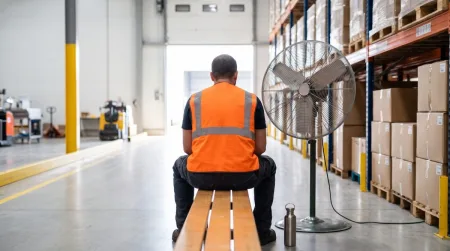
Heat, in other words, is not just a welfare issue. It is a performance issue.
What makes the UK context particularly challenging is the lack of structure around it. There is no legal maximum working temperature, only a requirement to maintain a “reasonable” environment. In practice, this leads to reactive management. When temperatures rise, supervisors introduce extra breaks, rotate staff, or informally ease performance expectations.
These interventions are necessary, but they come at a cost. They introduce variability. In a sector built on consistency and predictability, heat becomes a disruptor. Throughput fluctuates, planning assumptions break down, and service levels become harder to maintain. The issue is not just reduced productivity; it is unpredictable productivity.
Hydration and rest requirements compound this further. In hot environments, workers are advised to drink regularly, up to 250ml every 15 minutes, and take frequent breaks to recover. Historically this was for tasks like blast furnace operatives, however going forward this might be applicable for operatives working on the top floor mezzanine or for those working on inbound unloading a sea container. These increased breaks reduce effective working time per shift, often requiring additional labour to maintain output. At exactly the point where performance is under pressure, costs begin to rise.
And then there is the building itself. While older UK warehouses were often poorly insulated and prone to extreme temperature swings, even modern facilities are not immune. Today’s buildings are far more efficient and sustainable, but many are still large, high-bay environments with limited cooling in operational areas. During warmer periods, solar gain, internal heat loads and restricted airflow can still lead to elevated temperatures, especially in mezzanines and dense picking zones where people spend most of their time.
In other words, the environment amplifies the problem. This is where the earlier idea of compartmentalisation becomes increasingly relevant.
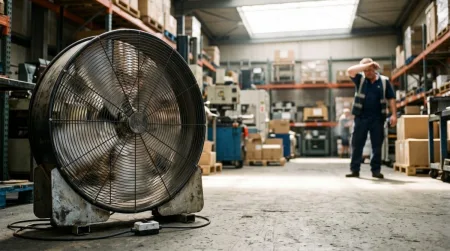
Not every part of a warehouse needs to be treated the same. Core activity zones such as picking, packing are typically where operations have the highest headcount, these areas can be relatively easily enclosed and controlled, creating spaces with balanced temperatures and improved comfort.
Done well, this does more than manage heat. It changes the perception of the warehouse environment entirely. One of the most common refrains in the industry is that “people don’t want to work in warehouses.” But that assumption is rarely challenged. If the core working environment felt more comfortable, more stable in temperature, less exposed, more considered, would that perception begin to shift?
A picking or packing area that is climate-controlled and designed with the operator in mind could feel very different from the traditional warehouse floor. It could be quieter, more consistent, even more “human.” While not every function can be addressed this way, a large proportion of activities in modern, automated facilities could benefit from this approach.
Over the years, I’ve visited many facilities, and most follow the same design format. That consistency has driven efficiency, but it has also limited innovation in how we think about the physical environment. As the climate changes, that may need to change too.
Automation will continue to play a critical role in the future of warehousing, but it does not remove the need to design for people. In fact, as systems become faster and more demanding, the environment those people operate in becomes even more important.
Fifteen years ago, compartmentalising workspaces for comfort and climate control felt like a “nice to have.” Today, it looks increasingly like a necessity.
The UK does not need to wait for 40 deg C heat to act. The challenge is already here. Warehouses are already operating above the conditions they were designed for. The question is no longer whether heat will impact performance, but whether the industry is willing to rethink the environments it creates for the people at the heart of its operations.
Tristan Holiday, senior manager, BearingPoint
Tristan has spent 25 years working across a variety of businesses, specialising in Warehouse Design, Automation and Continuous Improvement. Alongside his projects background, he has spent 7 years in operational management roles leading a large-scale automated facility within the FMCG sector. For the last four years he has worked for BearingPoint working for the Operations team specialising in supply chain solutions with a focus on automation.