

Why your semi-trailer lighting system is costing your fleet more than it should
A roadside inspection. A failed rear light. A vehicle off the road while a technician spends most of the morning tracing a fault through a wiring loom that was never built to be serviced quickly.
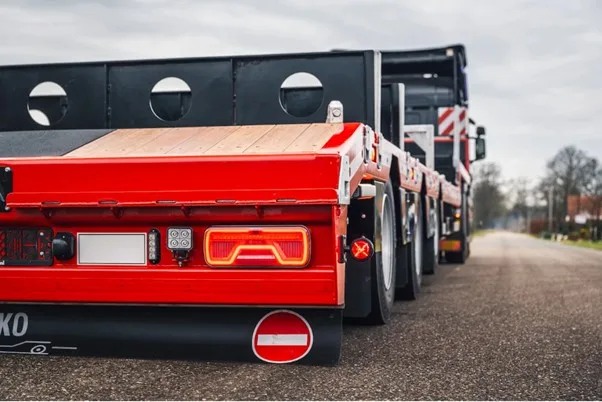
FOR FLEET operators running semi-trailers across the UK and Europe, that scenario is not unusual. In our work with trailer manufacturers and transport companies, we regularly see wiring faults that take under ten minutes to fix in a properly integrated system take three to four hours to locate in a traditionally wired trailer. Especially when connectors from different suppliers have been mixed up over successive refits. The fault itself is usually trivial. Finding it is not.
The problem is almost never the light. It is the system behind it.
The real cost of semi-trailer lighting failures
A lighting defect on a semi-trailer costs more than just the repair. Under ECE regulations applicable across UK and European markets, including ECE R48 which governs lighting installation, a vehicle with non-compliant lighting can be taken out of service at a roadside inspection on the spot. That is a direct operational loss: a stationary vehicle, a delayed load, a driver waiting.
What makes this frustrating for fleet managers is that most of these failures are preventable. The majority of lighting faults we see in the field are not product failures. They are installation failures. Mismatched connectors, incorrect cable gauges, junctions that were never properly sealed against moisture. Problems that take minutes to prevent during the build and hours to diagnose six months later on a wet layby somewhere outside Doncaster.
Procurement decisions are too often made on component price rather than system cost. The difference only becomes visible when vehicles start coming back to the workshop.
What a 24V plug-and-play system actually changes
The idea behind a plug-and-play lighting system is straightforward: standardisation at every connection point. Lights, wiring harnesses, junction boxes and connectors are designed to work together as one system. Every component connects in one way only. Cables are pre-tested and clearly labelled so that installation produces the same result regardless of which technician does the work.
For a workshop team this is significant. A faulty component gets identified and replaced in minutes rather than tracked down over hours. For a fleet manager, that means higher vehicle availability. Which is ultimately what determines whether a fleet is profitable or just busy.
There is another benefit that experienced operators tend to value just as much: consistency across the fleet. When every trailer is built to the same lighting specification, maintenance becomes predictable. Parts are standardised. Workshop training is simpler. When you are managing thirty or fifty trailers across multiple depots, that predictability is worth considerably more than a small saving on a cheaper connector.
One thing worth pointing out here: the most common cause of semi-trailer lighting failure at European roadside inspections is not a faulty light. It is a corroded or incorrectly seated connector. A fault that takes under five minutes to prevent during installation but can take several hours to locate after the fact. Connector quality and system integration are where the real reliability gap sits, and a properly designed plug-and-play system addresses this directly.
Compliance that travels with the vehicle
ECE certification is not just something to tick off at first registration. It is a continuing assurance that a lighting system performs to a defined standard in every market where a vehicle operates.
For operators running semi-trailers into Europe, through the Channel, into the Netherlands, Germany or further east, a lighting system certified to ECE R48 and ECE R10 carries the same compliance assurance at a German weighbridge as it does leaving a depot in the East Midlands. That matters more than it used to, given how frequently technical roadside checks are carried out across European corridors.
Specifying a certified system rather than individual certified components shifts responsibility to the supplier at the design stage. For fleet procurement teams managing a lot of variables already, that is a meaningful risk transfer.
A system-level decision, not a product decision
The move toward integrated 24V lighting systems reflects how the most operationally mature transport businesses now approach vehicle specification. Reliability gets designed in rather than managed reactively in the workshop. The question is no longer which rear light is cheapest, but which lighting system gives the lowest total cost of ownership over the vehicle’s service life.
That shift changes supplier selection, specification writing and maintenance planning at the same time. At TRALERT, we build complete 24V semi-trailer lighting plug-and-play solutions for trailer manufacturers and bodybuilders, covering wiring harnesses, connectors and ECE-certified lighting in one integrated package. Designed for production environments where repeatability and compliance are non-negotiable. If you are reviewing your fleet’s lighting specification, starting at the system level rather than the component level tends to make a significant difference to the numbers.
Frequently asked questions
What is a 24V plug-and-play lighting system for semi-trailers?
A 24V plug-and-play lighting system is a fully integrated solution where all components, lights, wiring harnesses, connectors and junction boxes, are engineered to work together as a single unit. Components connect in a standardised way, which reduces installation time, eliminates common wiring errors and makes fault diagnosis much faster. For fleet operators the main benefit is higher vehicle availability and lower maintenance cost per trailer over the service life.
Do plug-and-play semi-trailer lighting systems meet ECE regulations?
Yes, when supplied by a certified manufacturer. ECE standards including R48 and R10 govern light function, positioning and electromagnetic compatibility across UK and European markets. A properly certified integrated system carries compliance assurance at the system level, meaning operators are not dependent on individual components being compliant in isolation. That is particularly relevant for trailers operating across multiple European jurisdictions.
Running semi-trailers across UK and European routes? TRALERT builds complete LED lighting solutions for trucks, semi-trailers and heavy transport vehicles.
Find out more at tralert.com/en