

Cubic capacity counts reports Knight Frank
Knight Frank’s latest industrial Future Gazing report launched in London yesterday emphasised the need for investors, developers and landlords to look closely at the cubic capacity of their industrial and logistics stock as a means to attract and keep tenants, avoid obsolescence and increase returns.
By Liza Helps, Property Editor, Logistics Matters
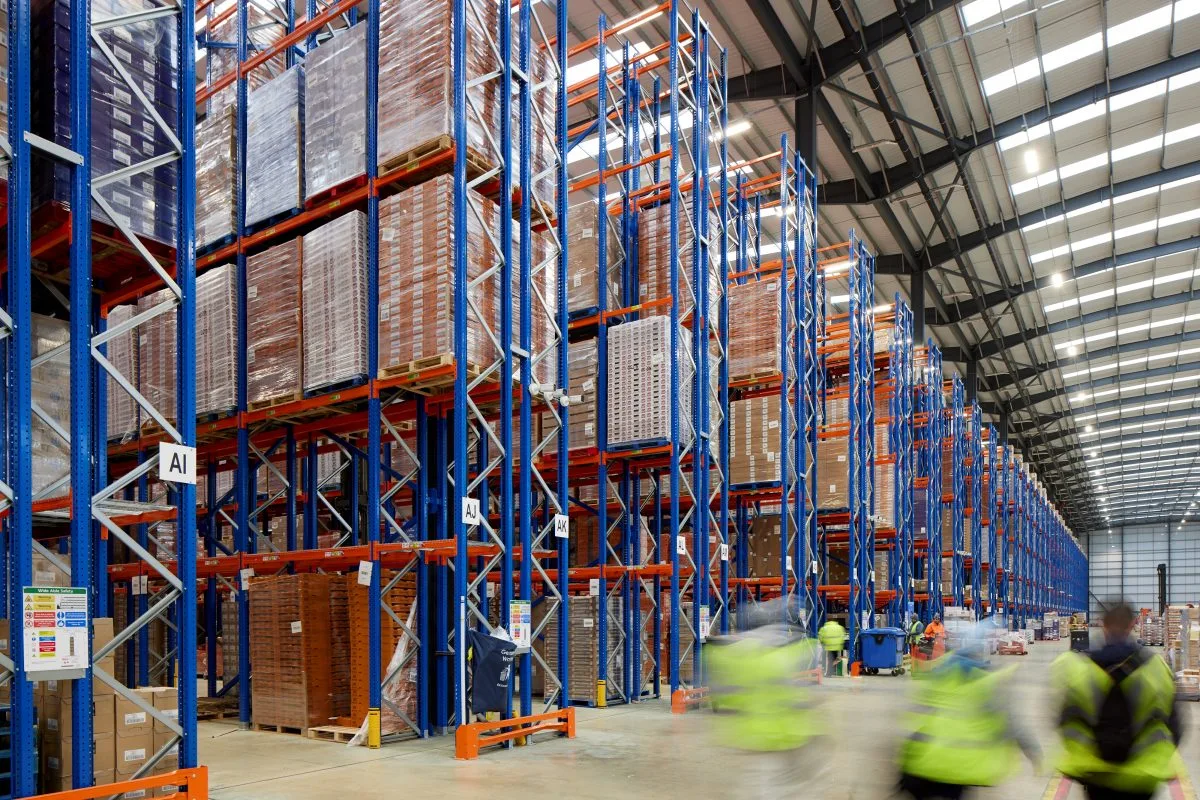
ACCORDING TO Knight Frank head of UK and Industrial research Claire Williams said: “Warehouse heights have risen 50% since 2005 to average 11.5m and this push is due in large part to occupiers’ need to minimise costs while maximising operational efficiency. As land and labour costs continue to rise and automation becomes more affordable, the economic case for building upwards rather than outwards strengthens.”
As part of the launch attended by Logistics Matters, there was also an in depth panel discussion where panellist Prologis UK Senior Vice President and Head of Capital Deployment Robin Woodbridge reminded the audience that logistics occupiers ‘are completely focussed on volumetric space’.
Fellow panellist TMX Transform director Matthew Wallis added that when occupiers are confronted by political, economic, technological, legal and environmental issues causing massive instability across all areas. “[In this environment] the supply chain will look to store stock and create resilience as well as looking for a strategic advantage.”
He added this would encompass using height to increase throughput either via high bay automation or use of mezzanines. To get more out of a building in effect to ‘sweat the asset’.
Taller buildings give occupiers an operational edge and drives down costs Williams said: “Taller buildings can facilitate cost savings and operational efficiencies, particularly when paired with investment in supply chain automation.”
“Automation is the great enabler when it comes to making use of greater clear heights. Technology such as Automated Storage and Retrieval Systems (AS/RS), Autonomous Mobile Robots (AMRs), and Automated Guided Vehicles (AGVs) make ultra-high-bay storage feasible, unlocking efficiencies that manual operations cannot achieve. These systems can reduce aisle widths, increase storage density, and boost speed and accuracy, all of which are critical for ecommerce fulfilment.
Taller structures enable significantly greater pallet capacity by accommodating multiple levels of racking within the same footprint.
Cubic capacity is a measurement of the interior volume of a structure that can be used for product storage. It is calculated by multiplying the length, width, and height of a space. For example, a 50,000 ft2 property with (11m) 36 ft clear heights has 50% more cubic space than a structure with the same footprint but only (7.3m) 24 ft clearance.
How valuable vertical space is depends on the occupiers’ ability to use this space effectively. For high bay warehouses, this often relies upon technology and automation to ensure that goods can be stored and accessed as easily on a vertical axis as on a horizontal one. For multi-storey warehouses, this means that the building configuration and the access to upper floors, work for occupiers.
Cubic capacity is becoming increasingly important from an operational perspective. Supply chain specialists and automation technology firms are focused on maximising how operators make use of this space.
The shift toward more vertical development has significant implications landlords and investors as well as occupiers. As well as enjoying lower average vacancy rates, properties with high clear ceiling heights can also command a higher rent and therefore increased capital values.
Knight Frank analysis shows that each additional foot of clear height adds approximately £0.08 per ft2 on average to rent.
“However,” said Williams, “the relationship is not linear. Increasing clear height from 30 ft to 40 ft would generate a c.£1.04 per ft2 rental uplift, while increasing from 40 ft to 50 ft clear height would see a smaller uplift of c.£0.51 per ft2and an increase from 20 ft to 30 ft would support an uplift of c.£1.58 per ft2.
Taller, well-specified buildings also offer strategic advantages that go beyond immediate income returns. Increased clear height supports automation, higher throughput and operational flexibility, which can strengthen tenant covenants and reduce obsolescence risk.
Knight Frank partner Johnny Hawkins, said: “Height is increasingly a defining feature of logistics facilities, playing a key role in driving value and performance. For investors, taller buildings can improve income resilience, support long-term value growth and reduce obsolescence risk. Those who integrate vertical thinking into their investment, development, and operational decision-making will be best placed to mitigate cost increases and land availability challenges, as well as capitalising on the opportunities presented by a warehouse market that trends increasingly skyward.”
Williams, added: “Warehouse heights will not continue to rise in perpetuity, as planning restrictions, building regulations and the limits of automation systems result in height thresholds.
“However, the vertical shift in industrial and logistics operations represents a significant trend with potentially profound implications for investors across the sector. Given the importance of cubic capacity and its increasing value to occupiers, the industry needs to develop a better understanding of its role as a property metric and its relationship to rents, values, and vacancy rates to gain additional perspective and capture the opportunities of a logistics market that is 30 ft high and rising.”