


UKWA calls for urgent skills reform for warehousing sector
Marking National Apprenticeship Week, the UK Warehousing Association (UKWA) has published a policy paper calling on the Government to take urgent action to address the skills crisis facing Britain’s warehousing sector.
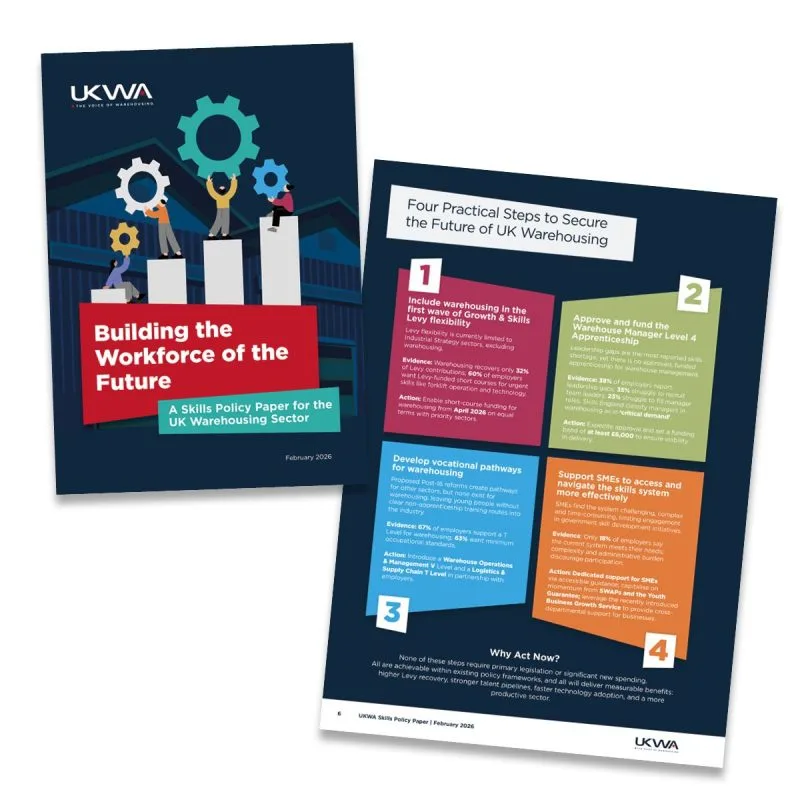
THE PAPER – Building the Workforce of the Future – sets out four practical recommendations to ensure the sector can continue to power the UK economy.
The logistics sector contributes £28.5 billion in Gross Value Added to the UK economy, warehousing specifically employs more than 650,000 people, and has grown its footprint by over 61% in the past decade. Yet according to UKWA’s Skills Survey 2025, only 13% of warehousing employers report no difficulty recruiting staff, with over half anticipating critical skills shortages in automation and robotics within five years.
The paper argues that “the warehousing sector is the backbone of the UK economy, yet it faces a skills crisis that, if left unaddressed, will constrain productivity, hamper technological progress, and weaken the supply chains on which British businesses and consumers depend”.
The paper reveals a stark funding gap at the heart of the problem: for each pound warehousing employers pay into the Apprenticeship Levy, they recover only 32 pence in funded training.
With unemployment at its highest level since the pandemic and 12.7% of young people aged 16 to 24 not in education, employment or training, UKWA argues that warehousing offers a significant opportunity to address national skills challenges while meeting the sector’s growing demand for talent.
The policy paper sets out four recommendations for the government.
First, UKWA calls for warehousing to be included in the first wave of Growth and Skills Levy (formerly the Apprenticeship Levy) flexibility from April 2026. Currently, levy flexibility is limited to government-defined Industrial Strategy sectors, excluding warehousing despite its foundational role in the economy. UKWA’s survey found that 60% of employers want levy-funded short courses for urgent skills including forklift operation and technology training.
Second, the paper calls for expedited approval and funding of the Warehouse Manager Level 4 Apprenticeship at a minimum funding band of £6,000. Leadership gaps are the most reported skills shortage, with 38% of employers identifying deficiencies in leadership and management capabilities, yet no approved, funded apprenticeship exists for warehouse management. Skills England’s latest Occupations in Demand report has classified warehouse managers as being in “critical demand.”
Third, UKWA recommends the development of vocational pathways for warehousing, including a Warehouse Operations and Management V Level and a Logistics and Supply Chain T Level. The survey found that 67% of employers support introduction of a T Level for warehousing, while 63% would benefit from minimum occupational standards. Current post-16 reforms create pathways for other sectors but leave young people without clear non-apprenticeship training routes into warehousing.
Fourth, the paper urges Government to simplify the skills system, particularly for SMEs which comprise 99.7% of logistics businesses. Only 18% of employers say the current apprenticeship system meets their organisation’s skills development needs well. UKWA recommends faster apprenticeship standard development, streamlined Trailblazer processes, and dedicated support for smaller businesses navigating the system.
A sector in transformation
As warehouses increasingly adopt automation, AI-driven systems, and robotics, the gap between available skills and employer needs continues to widen. The demographic challenge compounds this pressure, with nearly a quarter of the logistics workforce aged 55 or over, meaning a wave of retirements will accelerate knowledge loss unless training pipelines are established immediately.
Oxford Economics estimates that optimising logistics policy could unlock up to £8 billion per year in productivity gains. UKWA’s paper argues that getting skills policy right will allow the warehousing sector to continue offering high-quality employment, driving technological innovation, and making vital contributions to the economy.
A window of opportunity
With Skills England still taking shape, the Growth and Skills Levy not yet finalised, and technical and vocational qualification pathways being designed, UKWA argues there is a narrow window to ensure warehousing is not left behind by what it describes as the biggest shake-up to UK skills policy in a generation.
UKWA chief executive Clare Bottle, says: “Every product on every supermarket shelf, every parcel delivered to your door, every component in every British factory passes through a warehouse. These facilities are now highly automated, data-driven operations, but the UK skills system has failed to keep pace. In many cases, it is not training the workforce for modern warehousing at all.
Warehouse work is largely ignored, or reduced to images of repetitive manual labour in draughty sheds. The reality is that today’s warehouses are modern, welcoming workplaces, reliant on robotics maintenance, data analysis and advanced supply-chain technology. These are skilled, productive and well-paid careers, but without clear government-led pathways, too many workers will continue to miss out.”
UKWA has committed to working with Government to implement these recommendations and stands ready to support the development of new qualifications and training pathways for the sector.
UKWA – Skills Policy Paper for the UK Warehousing Sector – download here