
A question of culture
Metsä Wood UK operations purchasing manager Gary Isherwood tells HSS editor Simon Duddy that he puts the safety of employees first when buying forklifts.
Nordic forestry giant Metsä Wood has a strong safety culture and this informs its buying decisions. I visited Gary Isherwood at Metsä Wood UK’s head office in Boston, Lincolnshire and was impressed that even in these cost-conscious times, safety was the key procurement criterion.
“Safety is the top procurement priority and this was reflected in our forklift choice,” Gary explains. “The aim was to get the right equipment on the trucks to make them as safe as we possibly can.
“Our tender process had a specification that was issued to seven companies and independent materials handling business, Windsor, was awarded the long-term nationwide MHE contract.
Windsor director Jason Reynolds adds: “We surveyed the way the equipment was being utilised across all the sites, and felt there were several ways we could enhance safety and operator experience, as well as adding flexibility and efficiency.”
{EMBED(608620)}
As a result, the Metsä Wood fleet includes GPS driver access and monitoring devices, and a host of safety, environmental and ergonomic improvements. Online fleet management allows Metsä to monitor equipment usage and accidental damage, stay up-to-date with costs and access service records.
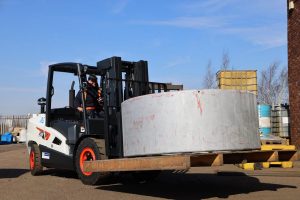
The fleet comprises Doosan counterbalance trucks, Baumann sideloaders, JCB Workmax site vehicles and Nilfisk cleaning equipment, with over 50 units being replaced.
“We went for a much higher specification than usual on the trucks,” explains Gary. “The fleet management system from FTC system, for example, was included as well as a closed cabin to keep operators warm at work.”
The FTC system includes features such as speed limitation, transmission & tyre saving systems and web-based fleet management.
GPS tracking deployed on each truck means that managers know where every vehicle is on the extensive Metsä Wood sites. They can keep track of them using the online management system, which can be accessed via smartphones as well as PCs and laptops. In addition, the vehicles are equipped with a panic button, so in the event of a serious incident, an operator could hit the button and managers could use the GPS system to pinpoint the employee in distress and move quickly to assist.

The FTC systems also improved access control. Unlike the old access system, the FTC product limits operators to driving vehicles they are licensed to drive.
“It’s also more flexible,” adds Gary. “If an operator can’t use a truck for whatever reason, he or she can use another, as long as they have the correct qualifications. Using the previous system, the operator would have had to contact the manager to get a fob to access another vehicle.”
If operators are not qualified to use a vehicle, the system will not let them use it, and will record that the operator tried to drive a truck they were not authorised to use.
Further proof of the high, safety-focused specification is the deployment of Blue Spot technology, which is particularly useful at Metsä Wood’s sites, which feature extensive, tall timber storage areas.
“We’ve added the Blue Spot technology for blind corners. When we put the tender together, we carried out an in-house process, to see where we wanted to improve. One of the areas was – if a guy is working in a bay there was always the chance that he could back out and someone might not see him. The blue light alerts pedestrians has made a difference.
“With the sideloaders we’ve taken it further, we’ve got the lights back and front, because it works in a different way to the forklift. Our criteria was pre-set.”
As well as making sure forklifts are seen by pedestrians, the timber specialist was determined to improve visibility for truck operators. With previous models, operators were sat quite far back in the cab.
“What we’ve done with the new forklifts is move the seats forward,” says Gary. “We also specified better seats, and took them higher so drivers can see better.
“If you look at the front of the truck, you can see we’ve taken out the horizontal bars, they are all angled now, so instead of seeing a flat bar to block operator visibility you will see a narrow strip.
“This isn’t just about safety, it helps with damage to product as well. If you can’t see the product clearly you are more likely to hit it.”
Metsä Wood takes a thorough approach to procurement, not just for big ticket items such as forklifts but with consumables such as PPE.
Gary is carrying out an ongoing process of refining how the company procures PPE.
“As a company, we do spend an awful lot on employee PPE. We’ve developed from a point where we could pick a pair of boots from a catalogue as long as they met certain criteria, to narrowing it down to 16 types of boots. These are not the least expensive, they are at the high end of the market.
“We’re also looking for longevity so we know the footwear will last. If you get something inexpensive, it fails quite quickly.”
Compliance is a key issue for the team. If an employee should wear a certain boot or glove for a task, they must wear that particular PPE.
{EMBED(608621)}
“A glove could have had three or four different roles within the business, now we’re being more specific. Each task should have a worker using the most appropriate glove for the job.
“To get to that point we got PPE specialist Polyco to audit our sites and usage. We’ve done the same with footwear as well. We bring in experts to work alongside our own and together we decide on the best fit for each task.”
Health and safety is taken very seriously at Metsä’s sites. Every incident is investigated by dedicated health and safety managers, while most of the managers on site have been trained on accident investigation.
As I walked around the site with Gary, I saw pedestrian and vehicle areas well segregated, one of the many signs of a healthy safety culture.
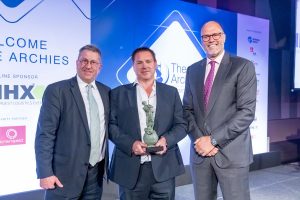
It is no surprise Metsä Wood achieved a Highly Commended accolade in the Safe Site category of the Fork Lift Truck Association Awards for its approach to forklift safety. This covered the care taken with forklifts and at sites, as well as the establishment of an Operator of the Year competition for its staff.
“We’re hoping the improved trucks and safety initiatives will go some way towards reducing lost time accidents (LTAs). The aim of our safety programme is to get as near to zero as we possibly can,” Gary concludes.