
Closing the automation gap in parcel hubs
BEUMER Group, examines how advances in robotics, vision and intelligent controls are helping CEP operators close the automation gap and bring greater consistency to complex parcel flows.
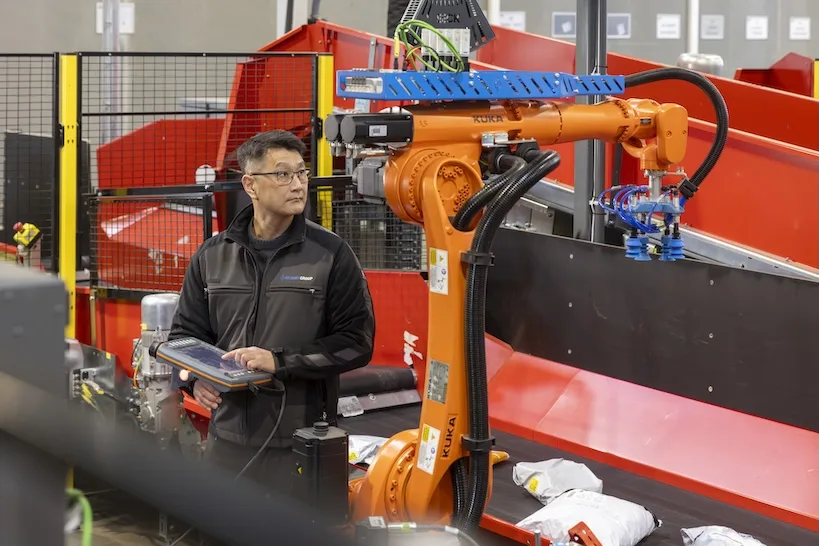
Robotics, intelligent controls and human expertise work together to bring greater consistency to parcel handling. (Photo credit: BEUMER Group GmbH & Co. KG.)
THE ADOPTION of automation across parcel hubs is anything but equal. While high-speed sortation and other downstream processes have become increasingly sophisticated, upstream operations can still rely heavily on manual labour to turn unpredictable bulk arrivals into a controlled flow of individual parcels.
This automation gap is becoming harder to justify. Growing parcel volumes, increasingly diverse parcel streams and persistent labour shortages are placing greater pressure on courier, express and parcel (CEP) operations. At the same time, investment in high-performance downstream automation can only deliver its full potential when parcels reach it in a consistent, automation-ready flow.
The good news is that closing this gap is becoming a realistic prospect as automation technologies, such as robotics, mature and their capabilities expand. The opportunity for CEP operators is to identify where these technologies can make the greatest difference – and understand what it takes to deploy them successfully.
Where robots can close the gap
Parcel hubs encompass many different processes, from unloading and inbound handling through singulation, induction and sortation to internal transport and outbound operations. Robots are particularly well suited to repetitive, labour-intensive tasks where parcels need to be handled consistently and continuously.
As the technology has matured, the opportunities have expanded. Robots can support the unloading of incoming parcels, separate and orient items during singulation, feed parcels into automated sortation and move bags or containers around a facility using autonomous mobile robots (AMRs) or automated guided vehicles (AGVs). Newer applications extend into areas such as palletising and exception handling.
Where robotics can add most value depends on the operation. Parcel volumes and characteristics, process predictability, facility layout, available space and existing equipment all influence what can be automated effectively. The challenge is therefore to identify the processes where robotics can address a genuine operational constraint, and advances in technology are widening that field.
Singulation: automating variability
Singulation is a case in point. Before parcels can be efficiently inducted into automated sortation, an unpredictable bulk stream must be transformed into a controlled flow of individual items.
For people, identifying and separating overlapping parcels is intuitive. For an automated system, the task is much more demanding. Parcels arrive in different orientations and can vary widely in dimensions, weight, packaging and surface characteristics. Cartons may be mixed with bags and polybags, and items can overlap or partially obscure one another.
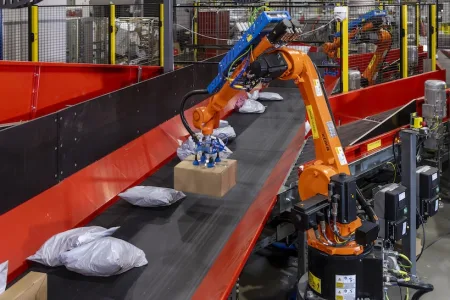
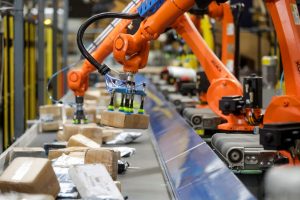
Handling mixed streams of cartons and polybags requires robotic singulation to adapt to differences in parcel size, packaging and orientation. (Photo credit: BEUMER Group GmbH & Co. KG.)
The consequences of poor upstream handling extend beyond the singulation process itself. A high-performance sorter depends upon a reliable supply of correctly presented parcels. An inconsistent feed can therefore constrain downstream performance even where the sortation technology itself is capable of much higher throughput.
Singulation therefore illustrates one of the central challenges for the next phase of parcel automation: how to automate a process characterised by constant variability rather than predictable, repetitive inputs. Doing so depends not only on what a robot can physically handle, but on how effectively the system can interpret and respond to what it encounters.
Intelligence behind the machine
Automating this highly variable process requires much more than a robotic arm. The system must be able to interpret a constantly changing stream of parcels, decide what can be picked and how, and coordinate each movement with the wider material flow.
Machine vision provides the information needed to identify individual parcels, determine their position and establish suitable pick points. Intelligent controls use this information to coordinate the robot’s movements with the conveyor flow, while gripping technology must adapt to different parcel sizes, shapes, surfaces and packaging. Software also plays an important role in determining how items are handled and what happens when a parcel cannot be processed as expected. Together, these technologies enable the system to adapt its behaviour to the parcel in front of it rather than simply repeating the same predefined movement.
Artificial intelligence (AI) is extending this capability further. AI-based object detection can support the identification of parcels within complex bulk flows, helping automated systems distinguish between items and interpret differences in their size, position and presentation. This creates further potential for robotics to handle the complex and unpredictable parcel flows that have traditionally made some CEP processes difficult to automate.
Putting robotic singulation into practice
These advances are now moving robotic singulation from technical possibility towards practical deployment. One of the latest developments in this field is BEUMER robotpick, a fully autonomous robotic picking and singulation solution designed to transform bulk parcel streams into a continuous flow ready for automated sortation.
The system brings together BEUMER-owned computer vision, intelligent robot controls, vacuum gripping technology, parcel feeding and system interfaces. Rather than operating as a standalone robot, these technologies form a complete picking and singulation system capable of handling formats including cardboard boxes, carton bags, polybags and letters.
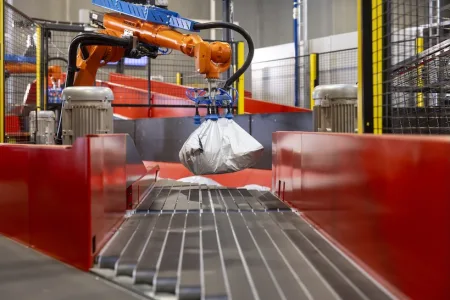
BEUMER robotpick combines computer vision, intelligent robot controls and adaptive vacuum gripping to pick and place individual parcels for downstream processing. (Photo credit: BEUMER Group GmbH & Co. KG.)
The practical challenge is not only making successful picks but also maintaining the wider parcel flow. BEUMER robotpick uses intelligent recirculation to give unpicked parcels another opportunity to be processed, while non-pickable items can be handled without unnecessarily interrupting operations. Individual cells also operate independently, allowing maintenance or software updates to be carried out on one while others remain in operation.
The system can process up to 1,600 parcels per hour per robot cell, with one to four cells in a standard configuration and the ability to add further cells as demand grows. BEUMER robotpick has already processed more than 1.75 million parcels in a live customer environment and, with the correct parcel mix and operating conditions, has demonstrated automation of 99.9% of bulk parcel singulation.
BEUMER SCADA and BG Insight provide greater visibility into system performance, helping operators identify opportunities for optimisation and use data-driven maintenance to support availability.
Choosing where automation adds value
Market direction suggests robotic picking will become increasingly commonplace. Recent research forecasts that the robotic picking market could almost triple by 2030, reaching approximately $4.6 billion (Warehouse Automation Report by Interact Analysis, 2026).
As robotic picking becomes more widely adopted, the question for CEP operators is likely to shift from what robots can do to where they can deliver the greatest operational value. A growing range of technical possibilities does not mean that every process – or every parcel hub – presents an equally strong business case. Operators need to consider utilisation, scalability, integration requirements and the effect of automation on the wider flow, rather than assessing the performance of an individual robot in isolation.
Closing the automation gap will therefore be an incremental process rather than a wholesale replacement of existing operations. As robotics, vision, AI and controls continue to develop, processes once considered too complex or unpredictable for automation are becoming viable candidates. For CEP operators, the opportunity lies in targeting those advances where they can deliver the greatest operational value and strengthen the performance of the entire parcel hub.
For further insight, download our new e-book Hands down: Why robots are a smart investment: https://www.beumergroup.com/knowledge/cep/download-e-book-hands-down-why-robots-are-a-smart-investment/