



10 benefits of using professional haulage services
Professional haulage services have become an essential asset for businesses seeking efficiency and reliability in their logistics operations.
Professional haulage services have become an essential asset for businesses seeking efficiency and reliability in their logistics operations.
The world of global logistics is undergoing a radical and significant transformation, shifting away from a reactive past towards a future defined by predictive intelligence. Deutsche Telekom IoT shares its vision for a more connected and efficient supply chain. Logistics Matters Editor Simon Duddy interviews Simon Boyd and Szilard Baradits, both of Deutsche Telekom IoT.
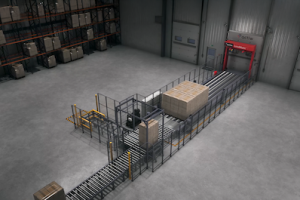
Zero touch production lines and super slick warehouse operations enable manufacturers to quickly ramp up for major sporting event promotions and other timely opportunities to tap into massive global demand.

Late-stage packaging gets a bad press. Most coverage treats it as firefighting: the rushed relabelling job, the promotional kit that lands on a Friday and has to ship on Monday. Fair enough. That is often exactly what it is.

Warehouse automation has advanced rapidly over the past decade. What was once a facility dominated by forklifts and manual picking is now an interconnected environment where autonomous mobile robots (AMRs), barcode scanners, IoT sensors, automated storage systems, and intelligent conveyor networks work together to keep goods moving efficiently.
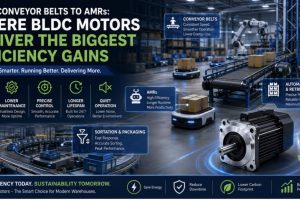
Modern warehouses have evolved far beyond rows of conveyor belts and manual forklifts. Today’s logistics facilities rely on intelligent automation, autonomous mobile robots (AMRs), high-speed sortation systems, and precision material handling equipment to keep products moving around the clock. Behind much of this progress is a technology that rarely gets the spotlight: the brushless DC (BLDC) motor.


When it comes to competitive advantage, right-sized packaging automation offers a quick win, argues AMHSA secretary Dave Berridge.

The news that the Government’s revised Minimum Energy Efficiency Standards (MEES) drops 2027 EPC C deadline for large commercial rentals has to be good news, especially as it was estimated that approximately 128 million ft2 of UK warehouse space, 18% of all units above 50,000 ft2 would have failed to meet it. Liza Helps reports.

Britain is on course to become one of the only Western economies still letting low-value imports in untaxed, says Ronald Kleijwegt.

Dutch supermarket chain Jumbo has transformed its eCommerce logistics operations with Greenplan, EPG’s intelligent route planning and optimisation solution.

This Lucas webinar explains the operational advantages of Dynamic WES. Andrew Southgate, VP business development EMEA at Lucas Systems shares insights.

Two decades on from a piece of landmark legislation governing fire safety in large buildings. Tom Roche asks if it is still fit for purpose, and concludes that work is needed.

Consumers are becoming more selective about what they buy, but increasingly unwilling to compromise on delivery, says Scurri.

That was one of the intriguing questions raised at last week’s SCALA Consulting Annual Supply Chain Debate, which was positively bursting with insights. Logistics Matters editor Simon Duddy reports.
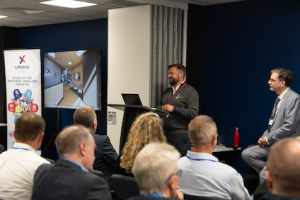
On 8 June 2026, the UK Material Handling Association (UKMHA) officially opened the doors to its brand-new headquarters in Kibworth, Leicestershire, with a special Open Day to welcome guests.

Transit packaging has come of age. Booming internet sales have supercharged the use of transit packaging, making it a focal point for environmental regulation and a must for automation. Chris More, UK sales director at Packsize, looks at what’s happening.

Learn how to prepare your warehouse for peak season with tips on stock, layout and management systems.

The rapid growth of e-commerce has placed unprecedented pressure on warehousing and fulfilment operations, with businesses expected to process higher order volumes faster and more accurately than ever before. As demand continues to surge, scalability has become a critical requirement rather than a competitive advantage.

A Cold Chain Federation (CCF) report sets out ten recommendations, including recognition of the cold chain as Critical National Infrastructure (CNI).

Western Business Media,
Dorset House, 64 High Street,
East Grinstead, RH19 3DE
01342 314 300
[email protected]
© Western Business Media, 2026. All rights reserved.